
World
Data Center Campus
Aerial view of a data center in Sterling, Virginia (Getty Images)

By 2030, AI data centers could take a bigger share of carbon emissions than flights do currently

Running AI compute on phones could offer a glimmer of hope for reducing the tech’s mounting power use.

The AI boom has come with a slew of side effects, but beyond social implications, geopolitical complications, and economic transformations, the growing number of data centers used to power the tech could have a devastating environmental impact — and it might come sooner than we initially imagined. 

New forecasts from Accenture, reported by Axios on Wednesday, show that carbon emissions from AI data centers could increase 11-fold through the decade, accounting for a 3.4% share of total global CO2 emissions by 2030 in the “base case” scenario.
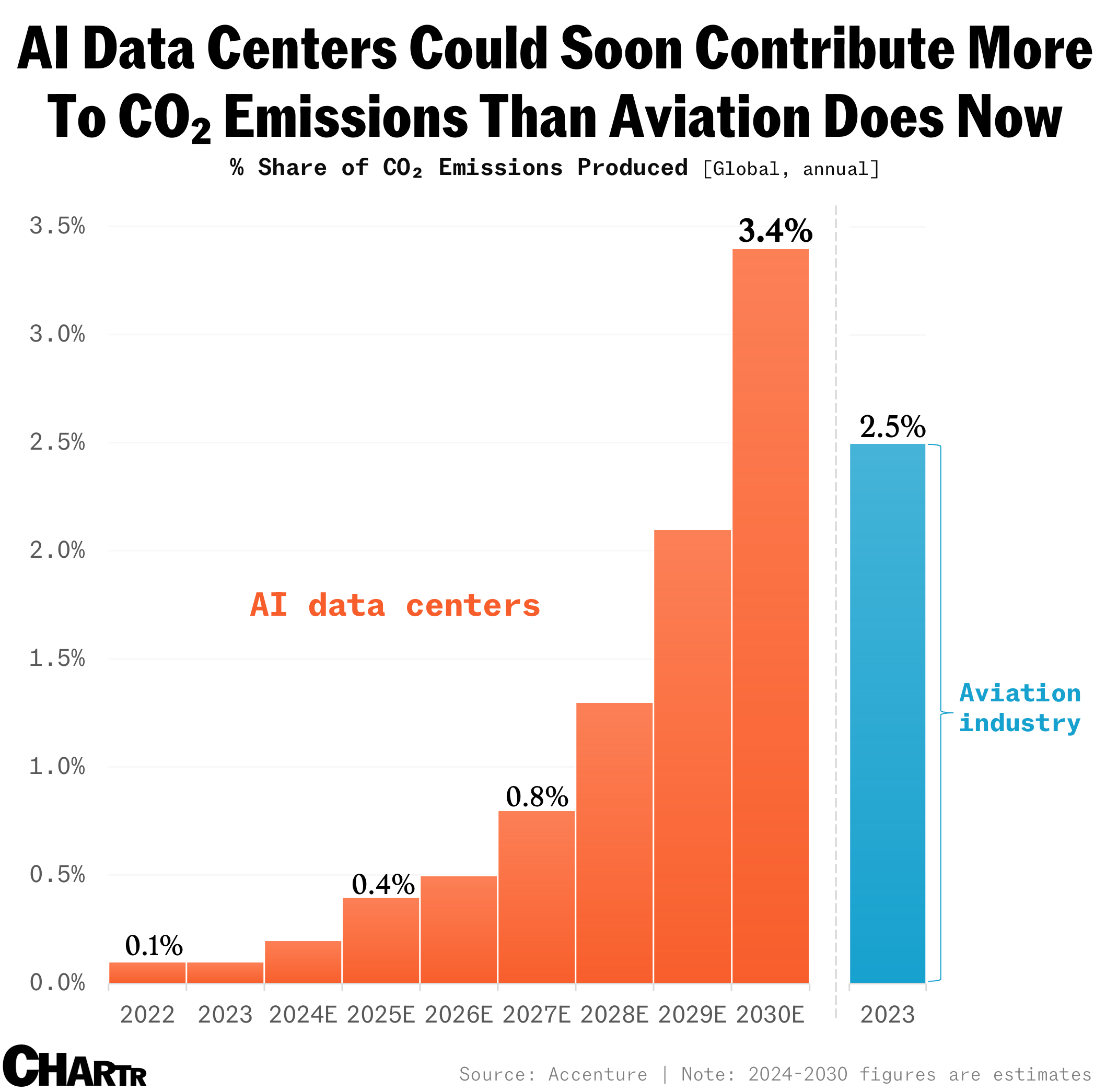
AI data center emissions
Sherwood News

That’s a considerably greater share of total emissions than the entire aviation industry — a sector often admonished for its carbon footprint — notched at the last count, when the flying business took 2.5% of global CO2 emissions. It would also exceed the emissions contributed by both Germany (1.75%) and Saudi Arabia (1.58%) combined in 2022, per estimates from the IEA.

Dialing down

Accenture’s analysis offered some suggestions for making AI less resource-demanding, including utilizing “smart silicon,” a term used to describe running AI workloads on “smarter, compute-efficient hardware and models,” as well as integrating hardware and software to reduce the movement of data between memory and processors.

Just a day later, Axios reported new academic research also supporting the move toward AI power efficiency. In a Qualcomm-sponsored study, researchers at the University of California, Riverside, found that running AI directly on smaller devices like phones rather than the cloud could reduce the power consumption of queries by about 90%.

Moving AI compute to specialized small devices, thus bypassing energy-guzzling data centers for simple tasks, has been hailed by the industry for some time now. But, even if tiny chips in smartphones are the solution to a tech-driven energy crisis, it’ll be difficult to slow down the data center building spree of Amazon, Microsoft, OpenAI, and co. anytime soon.

More World

See all World
world
Tom Jones

The UAE’s OPEC exit will hit the group in the barrels

After just shy of 60 years in OPEC, its membership even predating its status as a nation-state, the United Arab Emirates yesterday announced its shocking departure from the oil production group, effective May 1, as the knock-on effects of the Iran war continue to play out across the Middle East and the energy landscape.

For context, the UAE produces the third-highest amount of oil in the group, per April data and OPEC’s latest set of annual statistics.

According to the cartel’s 2025 Annual Statistical Bulletin, the OPEC group was collectively exporting some 19 million barrels of crude oil a day last year, with the United Arab Emirates accounting for some 14% of that daily output.

UAExit means UAExit

The nation, whose energy minister told Reuters yesterday that the decision was taken “after a careful look at current and future policies related to level of production” and wasn’t made following discussions with any other country, made up a healthy share of the group’s total confirmed crude oil reserves, as well.

OPEC exports chart
Sherwood News

Of the 12 nations in the core group, which was founded by just five oil superpowers back in September 1960, only two (Iraq and Saudi Arabia) exported more barrels of crude oil daily, pumping out 3.36 million and 6.05 million barrels, respectively, each day to nations around the world.

For its part, the UAE said it will “continue its responsible role by gradually and thoughtfully increasing production, in line with demand and market conditions,” per the official state news agency. Clearly, the nation now wants a little more control of just how much oil it can pump around the world, with the UAE having to eat a large proportion of lost revenues due to its healthy abundance and OPEC restrictions.

According to the cartel’s 2025 Annual Statistical Bulletin, the OPEC group was collectively exporting some 19 million barrels of crude oil a day last year, with the United Arab Emirates accounting for some 14% of that daily output.

UAExit means UAExit

The nation, whose energy minister told Reuters yesterday that the decision was taken “after a careful look at current and future policies related to level of production” and wasn’t made following discussions with any other country, made up a healthy share of the group’s total confirmed crude oil reserves, as well.

OPEC exports chart
Sherwood News

Of the 12 nations in the core group, which was founded by just five oil superpowers back in September 1960, only two (Iraq and Saudi Arabia) exported more barrels of crude oil daily, pumping out 3.36 million and 6.05 million barrels, respectively, each day to nations around the world.

For its part, the UAE said it will “continue its responsible role by gradually and thoughtfully increasing production, in line with demand and market conditions,” per the official state news agency. Clearly, the nation now wants a little more control of just how much oil it can pump around the world, with the UAE having to eat a large proportion of lost revenues due to its healthy abundance and OPEC restrictions.

Latest Stories

Sherwood Media, LLC and Chartr Limited produce fresh and unique perspectives on topical financial news and are fully owned subsidiaries of Robinhood Markets, Inc., and any views expressed here do not necessarily reflect the views of any other Robinhood affiliate, including Robinhood Markets, Inc., Robinhood Financial LLC, Robinhood Securities, LLC, Robinhood Crypto, LLC, Robinhood Money, LLC, Robinhood U.K. Ltd, Robinhood Derivatives, LLC, Robinhood Gold, LLC, Robinhood Asset Management, LLC, Robinhood Credit, Inc., Robinhood Ventures DE, LLC and, where applicable, its managed investment vehicles.