World
Travel Destination: Santorini Island
(Athanasios Gioumpasis/Getty Images)
grexit

Goldman Sachs is backing out of its plans for a Greek hotel business

The investment bank has sold the resorts it bought just three years ago, even as tourism soars.

Tom Jones

As summer finally starts to unfurl, the idea of escaping to an idyllic Mediterranean paradise with sandy beaches and clear seas becomes even more appealing than usual. Goldman Sachs, though, doesn’t feel the same way, wrapping up its Greek hotel business before it’s even properly underway, per exclusive Wall Street Journal reporting

The investment banking giant purchased three resorts in Halkidiki on the Greek mainland just three years ago, buoyed by cheap property prices, the nation’s economic recovery, and the hoards of tourists who descend on the European hotspot each year. However, the costs to renovate the hotels rose higher than Goldman had anticipated and, feeling that its plan to revamp the properties and sell them for a tidy profit was taking too much time and money, the company sold this spring. The bank barely broke even on the ~€100 million ($117 million) it sunk into the project, sources told the Journal.

Though Goldman’s Greek odyssey wasn’t the success story it had hoped for, as the behemoth continues its efforts to diversify the business beyond Wall Street, millions of people are still flocking to the island nation, even if they won’t be stopping in a Sachs-backed suite anytime soon.
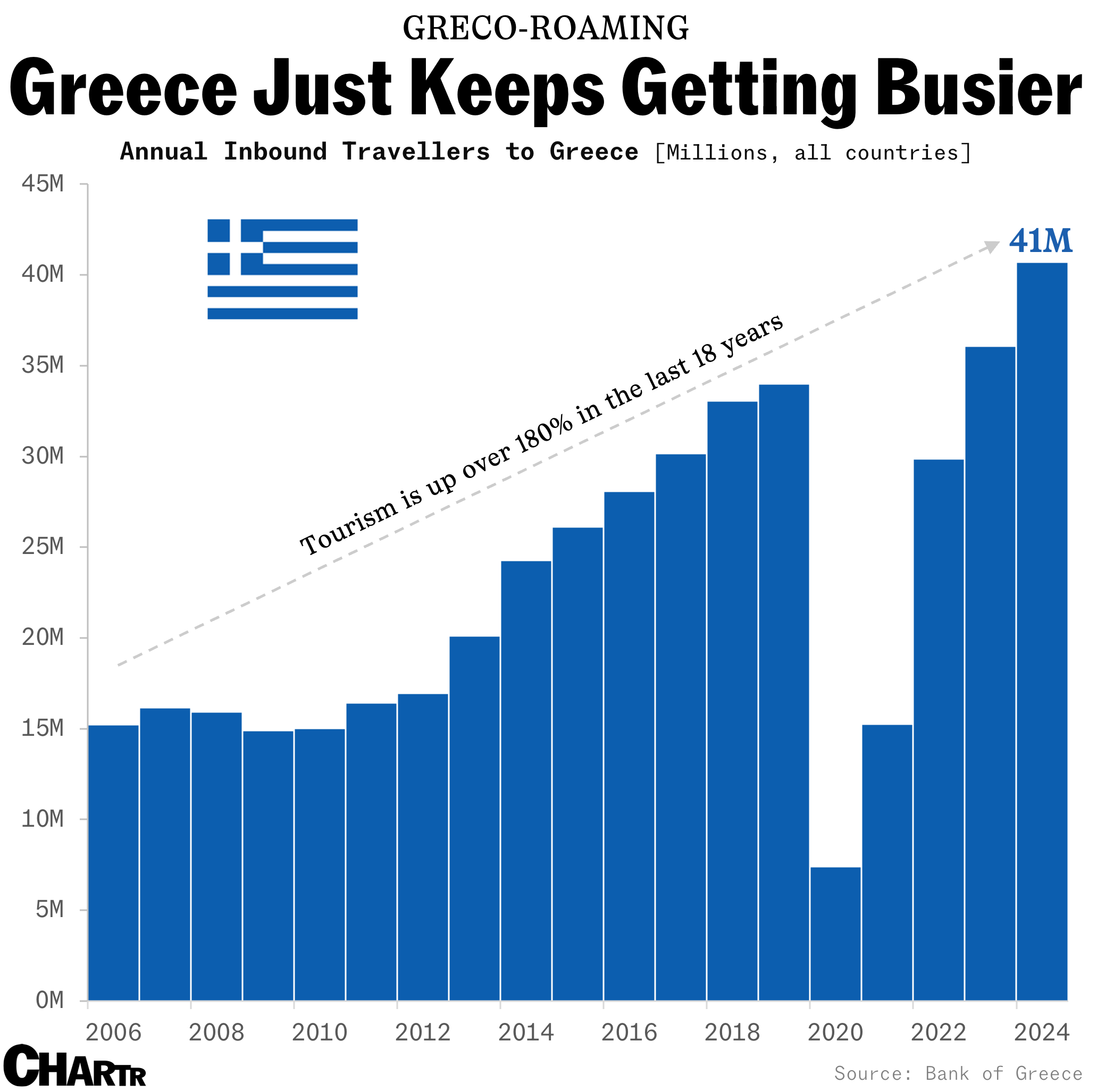
Greek tourism chart
Sherwood News

European locals in picturesque countries blessed with incredible weather and amazing cuisine might not (read: definitely don’t) like it, but more and more people are flocking to their home nations to sample a taste of the Mediterranean lifestyle. Indeed, as authorities looked to combat overtourism, Greece welcomed a record 40.7 million tourists last year — almost 3x as many as it did as recently as 2006 — adding a whopping €21.6 billion ($25.3 billion) to the economy.

More World

See all World
world

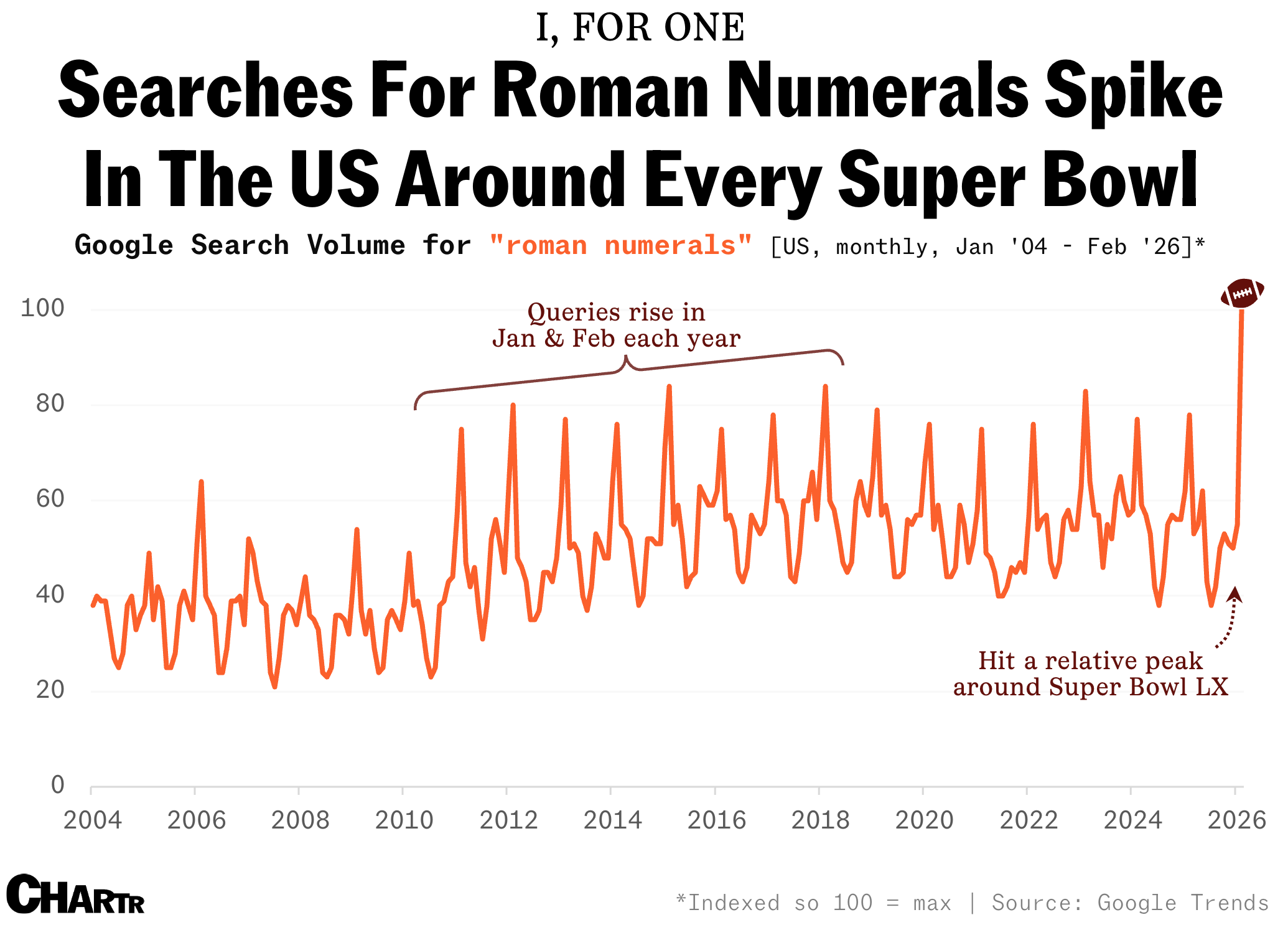
Google searches for “roman numerals” hit a new peak this Super Bowl

Following on from last year’s Super Bowl LIX, and Super Bowl LVIII before that, you’d be forgiven for thinking that the title “Super Bowl LX” might have created less confusion than previous iterations.

But it seems that the archaic notation denoting this year’s Big Game was no exception: monthly search volumes for “roman numerals” in the US were at the highest volume seen in over two decades this February, according to Google Trends data.

Roman numerals super bowl
Sherwood News

If people in shoulder pads throwing around a weirdly shaped ball is your Roman Empire, one thing you have to know is Roman numerals — or join the millions who turn to Google to work out how to read them every Super Bowl season.

Ironically, according to the NFL, the numbering system was adopted for clarity, as the game is played at the start of the year “following a chronologically recorded season.” And so, over its 60-year history, the NFL has labeled almost every Super Bowl with a selection of capital letters like X’s, I’s, and V’s — one of the rare exceptions being Super Bowl 50 in 2016, when the NFL ad designers felt Super Bowl L was too unmarketable.

At least stumped football fans in 2026 will be faring much better than those in the year 12,965 would be, who’d have to refer to the Big Game as Super Bowl (breathes in) MMMMMMMMMMDCCCCLXXXXVIIII.

Latest Stories

Sherwood Media, LLC produces fresh and unique perspectives on topical financial news and is a fully owned subsidiary of Robinhood Markets, Inc., and any views expressed here do not necessarily reflect the views of any other Robinhood affiliate, including Robinhood Markets, Inc., Robinhood Financial LLC, Robinhood Securities, LLC, Robinhood Crypto, LLC, or Robinhood Money, LLC.