World
Travel Destination: Santorini Island
(Athanasios Gioumpasis/Getty Images)
grexit

Goldman Sachs is backing out of its plans for a Greek hotel business

The investment bank has sold the resorts it bought just three years ago, even as tourism soars.

Tom Jones

As summer finally starts to unfurl, the idea of escaping to an idyllic Mediterranean paradise with sandy beaches and clear seas becomes even more appealing than usual. Goldman Sachs, though, doesn’t feel the same way, wrapping up its Greek hotel business before it’s even properly underway, per exclusive Wall Street Journal reporting

The investment banking giant purchased three resorts in Halkidiki on the Greek mainland just three years ago, buoyed by cheap property prices, the nation’s economic recovery, and the hoards of tourists who descend on the European hotspot each year. However, the costs to renovate the hotels rose higher than Goldman had anticipated and, feeling that its plan to revamp the properties and sell them for a tidy profit was taking too much time and money, the company sold this spring. The bank barely broke even on the ~€100 million ($117 million) it sunk into the project, sources told the Journal.

Though Goldman’s Greek odyssey wasn’t the success story it had hoped for, as the behemoth continues its efforts to diversify the business beyond Wall Street, millions of people are still flocking to the island nation, even if they won’t be stopping in a Sachs-backed suite anytime soon.
Greek tourism chart
Sherwood News

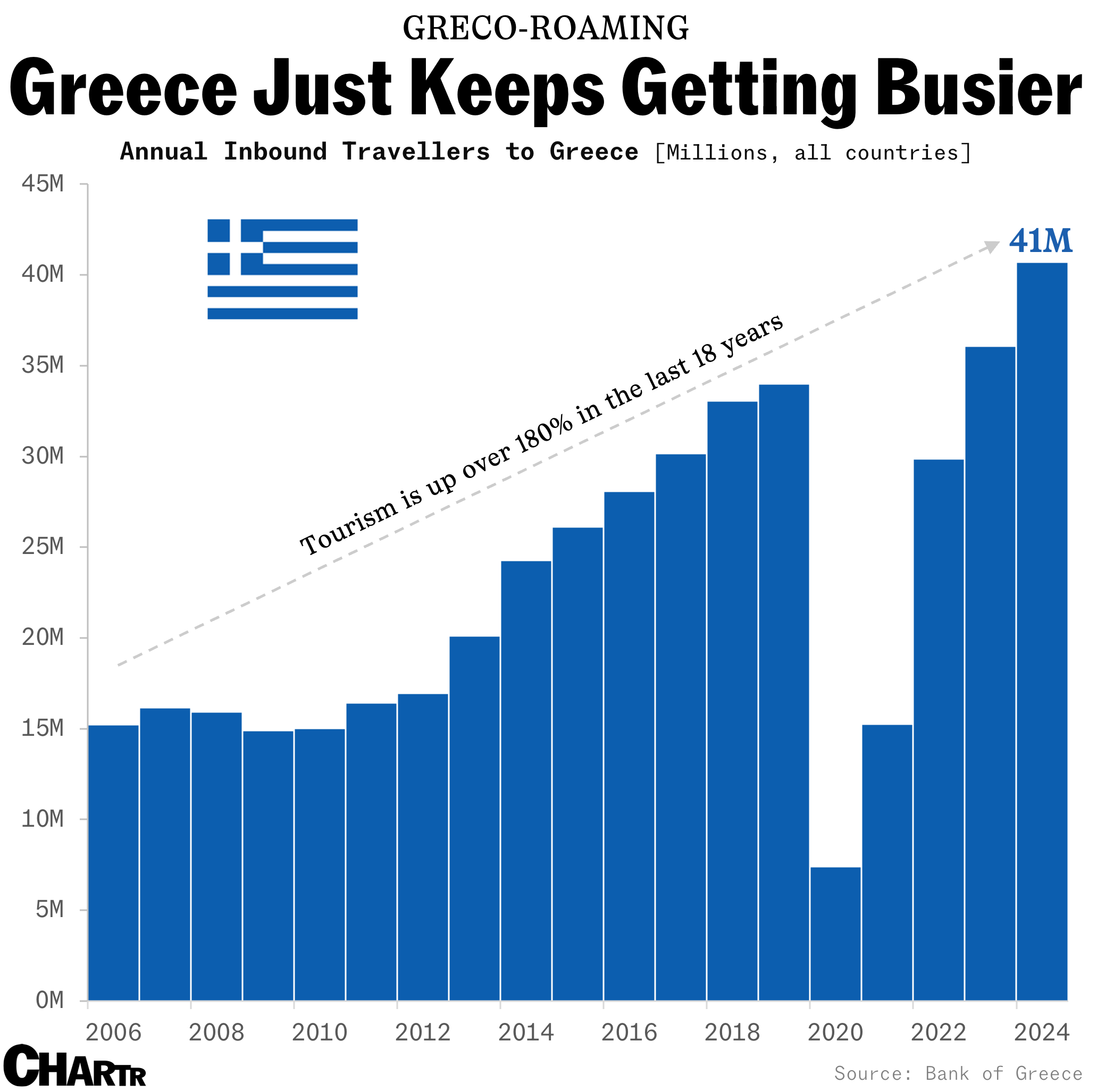
European locals in picturesque countries blessed with incredible weather and amazing cuisine might not (read: definitely don’t) like it, but more and more people are flocking to their home nations to sample a taste of the Mediterranean lifestyle. Indeed, as authorities looked to combat overtourism, Greece welcomed a record 40.7 million tourists last year — almost 3x as many as it did as recently as 2006 — adding a whopping €21.6 billion ($25.3 billion) to the economy.

More World

See all World
world
Tom Jones

The UAE’s OPEC exit will hit the group in the barrels

After just shy of 60 years in OPEC, its membership even predating its status as a nation-state, the United Arab Emirates yesterday announced its shocking departure from the oil production group, effective May 1, as the knock-on effects of the Iran war continue to play out across the Middle East and the energy landscape.

For context, the UAE produces the third-highest amount of oil in the group, per April data and OPEC’s latest set of annual statistics.

According to the cartel’s 2025 Annual Statistical Bulletin, the OPEC group was collectively exporting some 19 million barrels of crude oil a day last year, with the United Arab Emirates accounting for some 14% of that daily output.

UAExit means UAExit

The nation, whose energy minister told Reuters yesterday that the decision was taken “after a careful look at current and future policies related to level of production” and wasn’t made following discussions with any other country, made up a healthy share of the group’s total confirmed crude oil reserves, as well.

OPEC exports chart
Sherwood News

Of the 12 nations in the core group, which was founded by just five oil superpowers back in September 1960, only two (Iraq and Saudi Arabia) exported more barrels of crude oil daily, pumping out 3.36 million and 6.05 million barrels, respectively, each day to nations around the world.

For its part, the UAE said it will “continue its responsible role by gradually and thoughtfully increasing production, in line with demand and market conditions,” per the official state news agency. Clearly, the nation now wants a little more control of just how much oil it can pump around the world, with the UAE having to eat a large proportion of lost revenues due to its healthy abundance and OPEC restrictions.

According to the cartel’s 2025 Annual Statistical Bulletin, the OPEC group was collectively exporting some 19 million barrels of crude oil a day last year, with the United Arab Emirates accounting for some 14% of that daily output.

UAExit means UAExit

The nation, whose energy minister told Reuters yesterday that the decision was taken “after a careful look at current and future policies related to level of production” and wasn’t made following discussions with any other country, made up a healthy share of the group’s total confirmed crude oil reserves, as well.

OPEC exports chart
Sherwood News

Of the 12 nations in the core group, which was founded by just five oil superpowers back in September 1960, only two (Iraq and Saudi Arabia) exported more barrels of crude oil daily, pumping out 3.36 million and 6.05 million barrels, respectively, each day to nations around the world.

For its part, the UAE said it will “continue its responsible role by gradually and thoughtfully increasing production, in line with demand and market conditions,” per the official state news agency. Clearly, the nation now wants a little more control of just how much oil it can pump around the world, with the UAE having to eat a large proportion of lost revenues due to its healthy abundance and OPEC restrictions.

Latest Stories

Sherwood Media, LLC and Chartr Limited produce fresh and unique perspectives on topical financial news and are fully owned subsidiaries of Robinhood Markets, Inc., and any views expressed here do not necessarily reflect the views of any other Robinhood affiliate, including Robinhood Markets, Inc., Robinhood Financial LLC, Robinhood Securities, LLC, Robinhood Crypto, LLC, Robinhood Money, LLC, Robinhood U.K. Ltd, Robinhood Derivatives, LLC, Robinhood Gold, LLC, Robinhood Asset Management, LLC, Robinhood Credit, Inc., Robinhood Ventures DE, LLC and, where applicable, its managed investment vehicles.