World
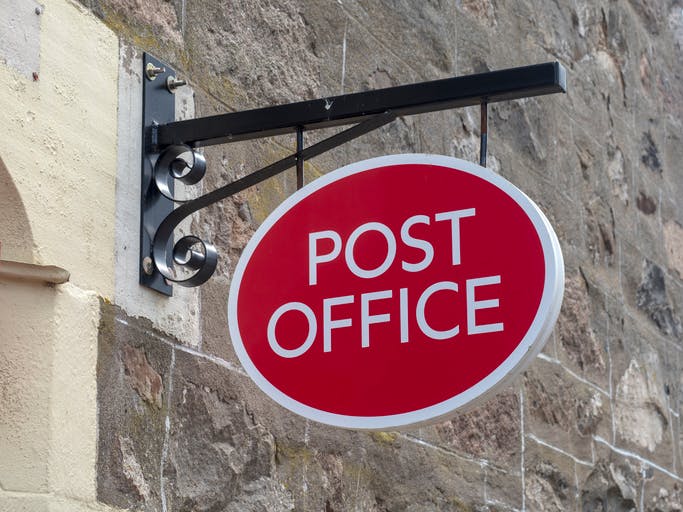
Post Office Sign
(Getty Images)

The British Post Office is franchising its last remaining branches

The state-owned operation dates back to the 17th century.

Tom Jones

Whether you trace it back to when Charles I opened the postal service to the public in 1635, or when Oliver Cromwell established the General Post Office in 1657, or when Charles II established it all over again three years after that, the Post Office is inarguably one of the oldest institutions still operating in the UK today. 

Post haste

Now — not far off four centuries later and serving mostly as a network of hubs, tucked away in the back of bigger shops, to pick up or return online orders — the state-run business is shedding the last 108 branches it owned and operated across Britain. Like the vast majority of its outposts, it plans to franchise the stores in a move that one union secretary called “full privatisation via the back door.” 

While this may feel like déjà vu owing to the recent news of Royal Mail being taken over by Czech billionaire Daniel Křetínskýu, the Post Office and Royal Mail are two separate entities. The latter was first taken private in 2013, as the government has been at pains to point out

Reported interest from big names like Ryman and Tesco is unlikely to quell fears about privatization, workers losing their jobs, and people’s local post offices shutting down (see here for a map showing the affected branches). Zooming out, however, shows that closures are nothing new for the institution since the turn of the digital age.
British Post Offices chart
Sherwood News

Dead letters

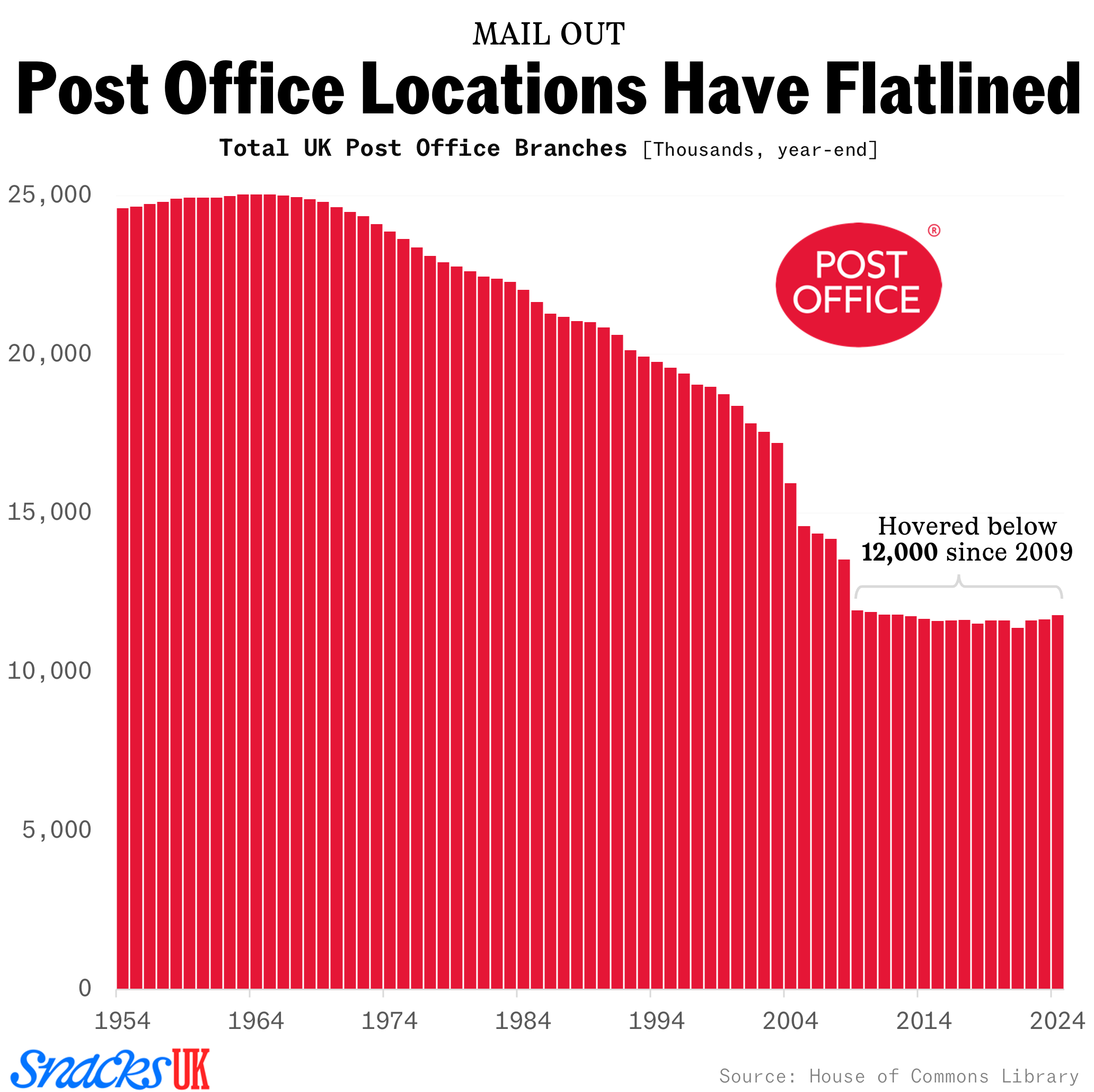
Over the last 50 years, as you might expect since the concept of sending a letter is as alien to some as the fax machine or watching films on VHS, the number of Post Office branches has more than halved, stagnating around the 12,000 mark, largely thanks to a £1.34 billion injection from the government in 2010 to keep the tally above 11,500. 

Last year, the Post Office made almost £200 million more from its money and financial services, such as its insurance, travel money, and banking offerings, than it did from mail (£521 million vs. £319 million)... a clear sign that its role in modern life has changed dramatically. 

Interestingly, Alan Bates, the man at the heart of the Post Office scandal — one of the biggest controversies in the institution’s history, dramatized by ITV in 2024 — suggested the “dead duck” business should be sold to Amazon for £1 in High Court last February.

More World

See all World
world

US and Iran trade strikes overnight amid peace talks

Hours after President Donald Trump dismissed a report regarding a deal to restore traffic through the Strait of Hormuz, the US and Iran exchanged fresh strikes early on Thursday.

Despite an ongoing ceasefire as the countries hold talks to end the conflict, the US carried out new strikes inside Iran, The Guardian reports, prompting a retaliatory attack from Iran on a US airbase in Kuwait.

world
Tom Jones

The UAE’s OPEC exit will hit the group in the barrels

After just shy of 60 years in OPEC, its membership even predating its status as a nation-state, the United Arab Emirates yesterday announced its shocking departure from the oil production group, effective May 1, as the knock-on effects of the Iran war continue to play out across the Middle East and the energy landscape.

For context, the UAE produces the third-highest amount of oil in the group, per April data and OPEC’s latest set of annual statistics.

According to the cartel’s 2025 Annual Statistical Bulletin, the OPEC group was collectively exporting some 19 million barrels of crude oil a day last year, with the United Arab Emirates accounting for some 14% of that daily output.

UAExit means UAExit

The nation, whose energy minister told Reuters yesterday that the decision was taken “after a careful look at current and future policies related to level of production” and wasn’t made following discussions with any other country, made up a healthy share of the group’s total confirmed crude oil reserves, as well.

OPEC exports chart
Sherwood News

Of the 12 nations in the core group, which was founded by just five oil superpowers back in September 1960, only two (Iraq and Saudi Arabia) exported more barrels of crude oil daily, pumping out 3.36 million and 6.05 million barrels, respectively, each day to nations around the world.

For its part, the UAE said it will “continue its responsible role by gradually and thoughtfully increasing production, in line with demand and market conditions,” per the official state news agency. Clearly, the nation now wants a little more control of just how much oil it can pump around the world, with the UAE having to eat a large proportion of lost revenues due to its healthy abundance and OPEC restrictions.

According to the cartel’s 2025 Annual Statistical Bulletin, the OPEC group was collectively exporting some 19 million barrels of crude oil a day last year, with the United Arab Emirates accounting for some 14% of that daily output.

UAExit means UAExit

The nation, whose energy minister told Reuters yesterday that the decision was taken “after a careful look at current and future policies related to level of production” and wasn’t made following discussions with any other country, made up a healthy share of the group’s total confirmed crude oil reserves, as well.

OPEC exports chart
Sherwood News

Of the 12 nations in the core group, which was founded by just five oil superpowers back in September 1960, only two (Iraq and Saudi Arabia) exported more barrels of crude oil daily, pumping out 3.36 million and 6.05 million barrels, respectively, each day to nations around the world.

For its part, the UAE said it will “continue its responsible role by gradually and thoughtfully increasing production, in line with demand and market conditions,” per the official state news agency. Clearly, the nation now wants a little more control of just how much oil it can pump around the world, with the UAE having to eat a large proportion of lost revenues due to its healthy abundance and OPEC restrictions.

Latest Stories

Sherwood Media, LLC and Chartr Limited produce fresh and unique perspectives on topical financial news and are fully owned subsidiaries of Robinhood Markets, Inc., and any views expressed here do not necessarily reflect the views of any other Robinhood affiliate, including Robinhood Markets, Inc., Robinhood Financial LLC, Robinhood Securities, LLC, Robinhood Crypto, LLC, Robinhood Money, LLC, Robinhood U.K. Ltd, Robinhood Derivatives, LLC, Robinhood Gold, LLC, Robinhood Asset Management, LLC, Robinhood Credit, Inc., Robinhood Ventures DE, LLC and, where applicable, its managed investment vehicles.