

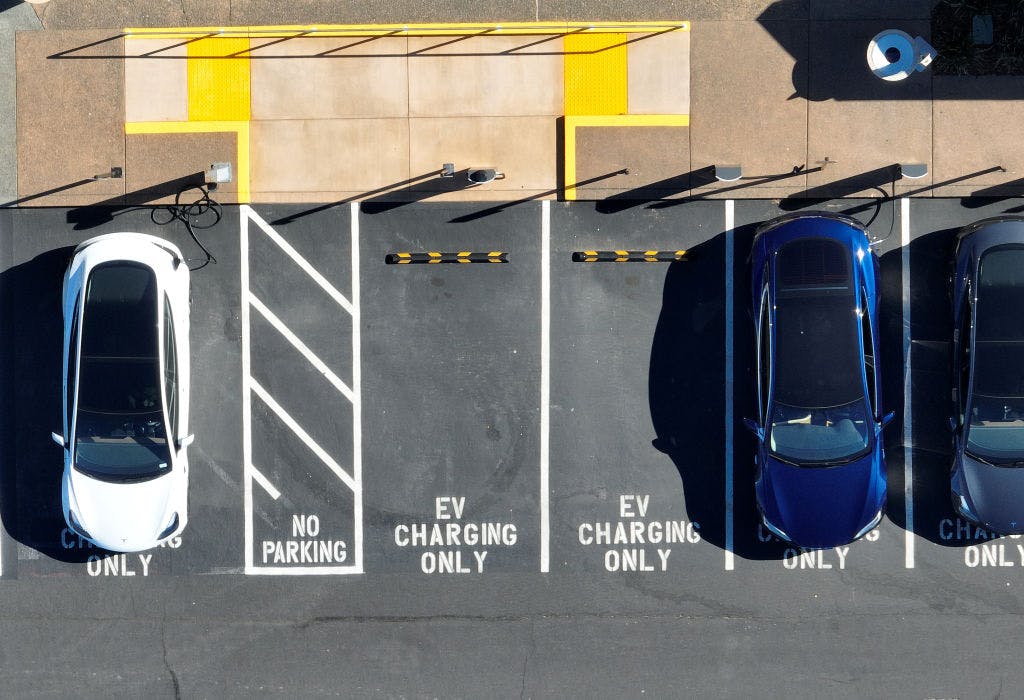
After a big pullback for EVs, climbing gas prices are causing drivers to eye them again
Still, the market is much different than it was the last time oil prices were this high.
Gas prices in the US have climbed $0.60 in less than two weeks because of the war with Iran. Prediction markets are pricing in an implied 62% chance that the price of gas exceeds $4 by the end of the month.
That has EVs once again turning car shoppers’ heads, though the EV landscape is very different than it was the last time oil prices spiked.
A person familiar with car sales across the US told Sherwood News that they’ve seen EV order growth significantly outpacing the non-EV baseline, as consumers’ EV interest has risen over the past several days.
“As we’ve seen in the past, fluctuations in gas prices generally drive more buyers to consider EVs,” the person said.
A spokesperson for auto retailer CarMax told Sherwood News that the company has recently observed a “statistically significant lift in shoppers searching for EVs, Hybrids, and Plug-In Hybrids.”
“From Feb 1st - March 1st (inclusive), compared to March 2nd to March 11th (inclusive), we saw a 6.4% lift in page views for these vehicles,” the spokesperson said.
Recent site activity on CarMax’s Edmunds also reveals that shopper interest in electrified vehicles is seeing an uptick. The category garnered 22.4% of all vehicle research activity on Edmunds in the week beginning March 2, up from 20.7% the week prior. Per Edmunds:
“Fuel prices have long influenced how drivers think about their next vehicle because they are one of the most visible costs of car ownership. But whether the latest spike translates into meaningful shifts toward electrified vehicles may depend less on the price of gasoline itself and more on how long consumers expect fuel costs to remain elevated.
If drivers view higher gas prices as temporary, many may simply absorb the added expense rather than take on the significant financial commitment of replacing their vehicle. But if fuel prices remain elevated for an extended period, more shoppers could begin weighing fuel economy and electrification more seriously as they plan their next purchase.”
A different EVironment
The last time oil prices were this high — as Russia invaded Ukraine in 2022 — the EV market was in a very different position.
At the time, former President Biden had recently signed an executive order seeking to ensure half of all vehicles sold in the US by 2030 were electric. The $7,500 EV tax credit was in effect, boosting demand. Legacy automakers like Ford were bullish on the category, pledging to invest $50 billion into EVs through 2026. There were far fewer EV options available to US buyers and, consequently, fewer used EVs.
Still, EVs saw elevated interest from rising gas prices at the time, with some even selling on the secondary market for more than retail consumers on waitlists had bought them for.
Per Edmunds:
“During the 2022 fuel price surge following Russia’s invasion of Ukraine at the end of February, total electrified vehicle consideration on Edmunds climbed sharply, rising from 17.5% of all vehicle research activity in February to 25.1% in March as fuel prices surged nationwide.”
Today, the EV market has matured and gone through a pullback. The Trump administration eliminated the tax credit and revoked the 50% EV sales target, Elon Musk went all in on the Republican party, and legacy automakers have scaled back their EV ambitions amid disappointing demand.
But the sheer number of EVs available has also grown immensely in that time, driving growth in used EV sales. After a few years on the road, previously new EVs have also depreciated heavily, leaving the market flush with used EVs at lower price points.
At those prices, EVs may be of more interest to cost-weary shoppers. The trend has already begun: in January, used EV sales grew 21% from a year earlier, while new EV sales fell 30%, according to Cox data. Sales could continue to swing toward cheaper used EVs if gas prices remain elevated.
Still, as of now investors don’t appear too bullish on the long-term EV boost hypothesis. Since the US began its war with Iran through Thursday’s close, Rivian is flat, while Lucid and Tesla are each down about 2%.
If gas prices remain elevated in the long term, however, that story could change.
“While higher gas prices do tend to refocus shoppers on fuel economy, the near‑term impact is more likely to show up in household behavior than in vehicle purchase behavior — fewer trips and cutbacks elsewhere,” said Stephanie Valdez-Streaty, Cox Automotive’s director of industry insights. “To materially change buying behavior and drive a trend toward smaller, more efficient vehicles, consumers would need to believe gas prices will remain elevated for years, not just months.”




