
Business
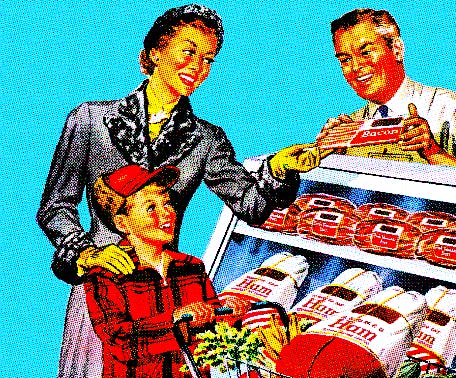
Woman and Son at the Butcher Shop
Getty Images
Cereal offenders

Americans are losing patience with the grocery industry, per Gallup survey

Gallup’s latest analysis also reveals another truth: America loves farmers, not pharma

Millie Giles

Years of inflation are grating on the national mood, with polls repeatedly finding that price rises are the most important issue for Americans — and the public is starting to blame the grocery industry itself.

Gallup’s annual Work and Education survey for 2024, released last week, asks Americans about their feelings towards US industries, and found that two major food sectors — grocery and restaurant — are now rated much less highly than a year ago.

While the restaurant industry was still rated favorably overall, with 52% of adults surveyed viewing the sector as very or somewhat positive, this was down from 61% in 2023. However, favorable opinions of the grocery industry fell by 8%, with just 33% of participants having a net positive view of the sector, marking the first time since 2001 that Americans have expressed a net negative rating of the grocery industry.

With food prices still hovering near all-time highs, this may not come as much of a shock, and a recent string of bacterial outbreaks and product recalls are likely to have contributed to the record-low confidence in the US government’s food safety assurances.

Interestingly, America’s favorite industry is that of the people who fill much of our grocery store shelves, with farming/agriculture the most positively rated industry, scoring 64% in the latest survey. So, it seems that we tend to like the people that grow our food more than the people that sell it.

Meanwhile, America’s view of the sports industry has significantly improved, with positive views of the sector up 11% from 2023 — presumably, Team USA topping so many podiums at the Paris Olympics didn’t hurt. Retail, accounting, and even the federal government also saw their public perceptions improve. 

America’s least-liked industries? Pharmaceuticals and advertising/PR with just 20% of respondents having a “very or somewhat” positive view of those sectors.

More Business

See all Business
9.3%

As the war with Iran produces the biggest spike in US gas prices since Hurricane Katrina, car retailer CarMax is continuing to see heightened interest in EVs, hybrids, and plug-in hybrids.

“From Feb 1st - March 1st (inclusive), compared to March 2nd to March 15th (inclusive), we saw a 9.3% lift in page views for these vehicles,” a spokesperson for the company told Sherwood News.

As industry insiders recently told us, EV interest climbs when gas prices rise. That appears to be holding true even without EV tax credits, which the Trump administration ended under its new budget package.

CarMax also saw EV searches spike in 2022, amid Russia’s invasion of Ukraine and the resulting oil price spike.

Walt Disney Chairman And CEO Bob Iger Rings Opening Bell At NY Stock Exchange

It’s the end of Disney’s Iger era (again)

Incoming CEO Josh D’Amaro is replacing Bob Iger on Wednesday, though Iger will remain a senior adviser through the end of the year.

$35.4B

The tariffs imposed by the Trump administration have cost automakers at least $35.4 billion since the start of 2025, according to a new analysis by Automotive News.

That total will continue to climb this year, since the Supreme Court’s February tariff ruling largely leaves the 25% levy on vehicles and auto parts untouched.

Toyota has taken the biggest hit, projecting more than $9 billion in tariff costs in its fiscal year ending this month, while Detroit’s big three automakers — Ford, GM, and Stellantis — were hit with a combined $6.5 billion tariff charge in 2025.

In the fourth quarter, automakers sold about 8% fewer imported vehicles in the US compared to the same period a year ago, per the Automotive News Research & Data Center.

Tariff charges come at a rough time for legacy carmakers, which are also scaling back EV plans following the Trump administration’s elimination of tax credits and fuel standard goals. According to Automotive News, the cost of EV write-downs and restructuring is, so far, nearly $70 billion.

Universal Studios Orlando Theme Park

Universal Studios is giving theaters a longer minimum exclusive run

Universal will now guarantee a minimum of five weekends before a movie hits home screens — which might help theater companies like AMC finally get back to profitability.

Latest Stories

Sherwood Media, LLC produces fresh and unique perspectives on topical financial news and is a fully owned subsidiary of Robinhood Markets, Inc., and any views expressed here do not necessarily reflect the views of any other Robinhood affiliate, including Robinhood Markets, Inc., Robinhood Financial LLC, Robinhood Securities, LLC, Robinhood Crypto, LLC, Robinhood Derivatives, LLC, or Robinhood Money, LLC. Futures and event contracts are offered through Robinhood Derivatives, LLC.