Business
CEO pay: Exploring the pay packets of America's top execs

CEO pay: Exploring the pay packets of America's top execs

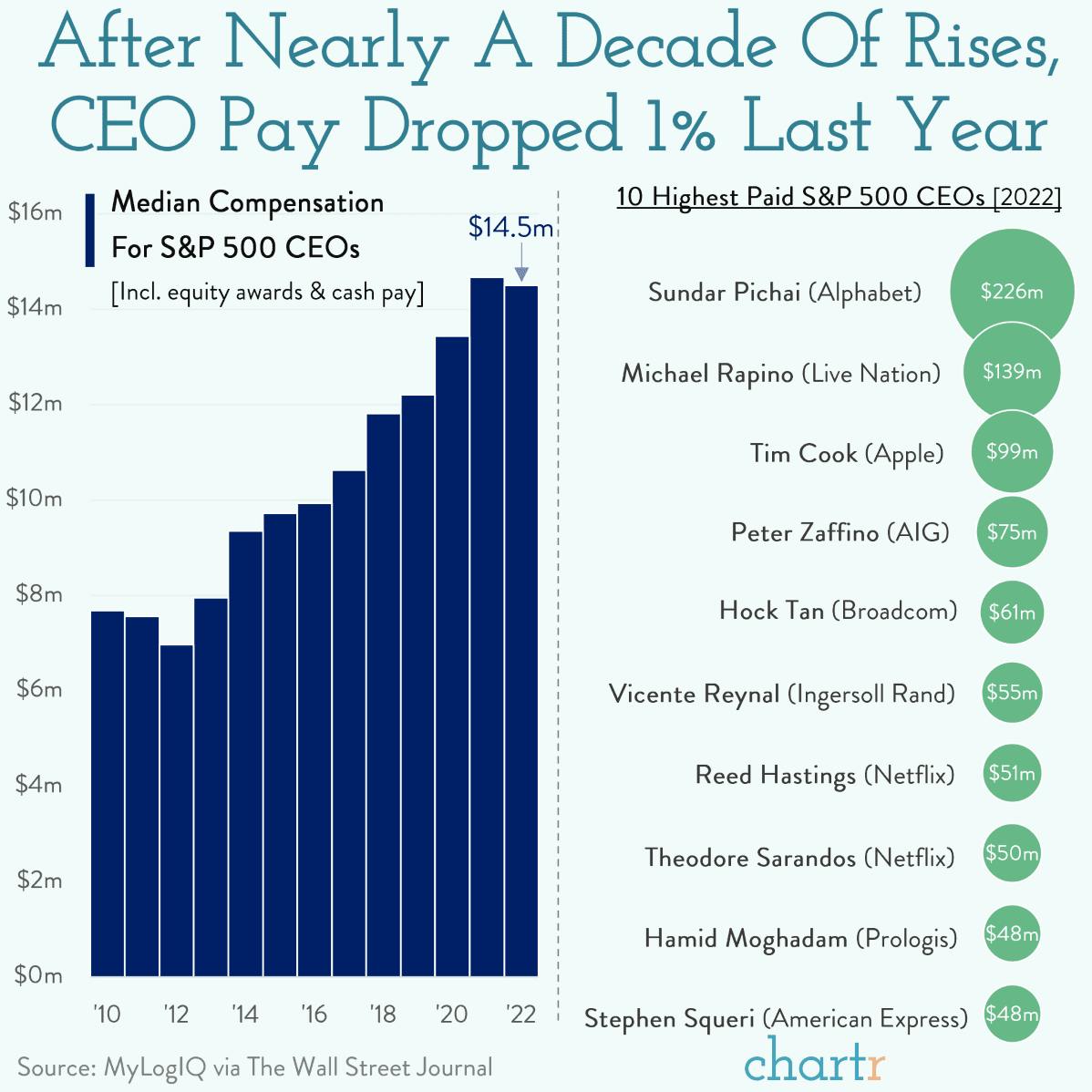
Data reported by The Wall Street Journal reveals that the median pay package for S&P 500 CEOs fell to $14.5 million in 2022, down 1% from a record $14.7 million the previous year — the first decline in a decade.

The highest-paid of the highest-paid was Sundar Pichai, CEO of Alphabet, who was awarded a staggering $226 million last year, 96% of which was from stock options. Alphabet employees are famously well compensated — the typical worker at the company made some $280,000 last year — but even in that context Pichai's figure is astonishing, with his pay more than 800 times what the median employee made.

Michael Rapino, CEO of Live Nation Entertainment, was awarded a package which was worth nearly $140m — a fact unlikely to do him any favors with Congress and frustrated Taylor Swift fans, with both having criticized the ticketing company in recent months. Elsewhere, Netflix’s co-CEOs both made the top 10 in total pay, but in different ways. Reed Hastings received almost all of his compensation through stock awards — earning a base salary of just $650,000, considerably smaller than Sarandos's $20 million salary.

Delayed gratification

Company boards love to stuff executive pay packets with stock awards, rather than salaries, because it (theoretically) aligns the incentives of shareholders and the top brass. However, because those awards typically vest over years, the CEO pay that gets reported has, historically, just been a moment-in-time snapshot. That’s something the SEC recognized, introducing a new measure of executive pay for the first time called "compensation actually paid", which takes into account share price gains and losses. Under this new measure, Pichai’s pay would fall to only $116m, while Rapino's would drop to $36m.


More Business

See all Business
The entrance of Allbirds seen from Hayes St. in San Francisco, Calif.

Allbirds, the once buzzy multibillion-dollar sneaker startup, is selling up for $39 million

That’s less than 1% of its peak market cap about four years ago.

business

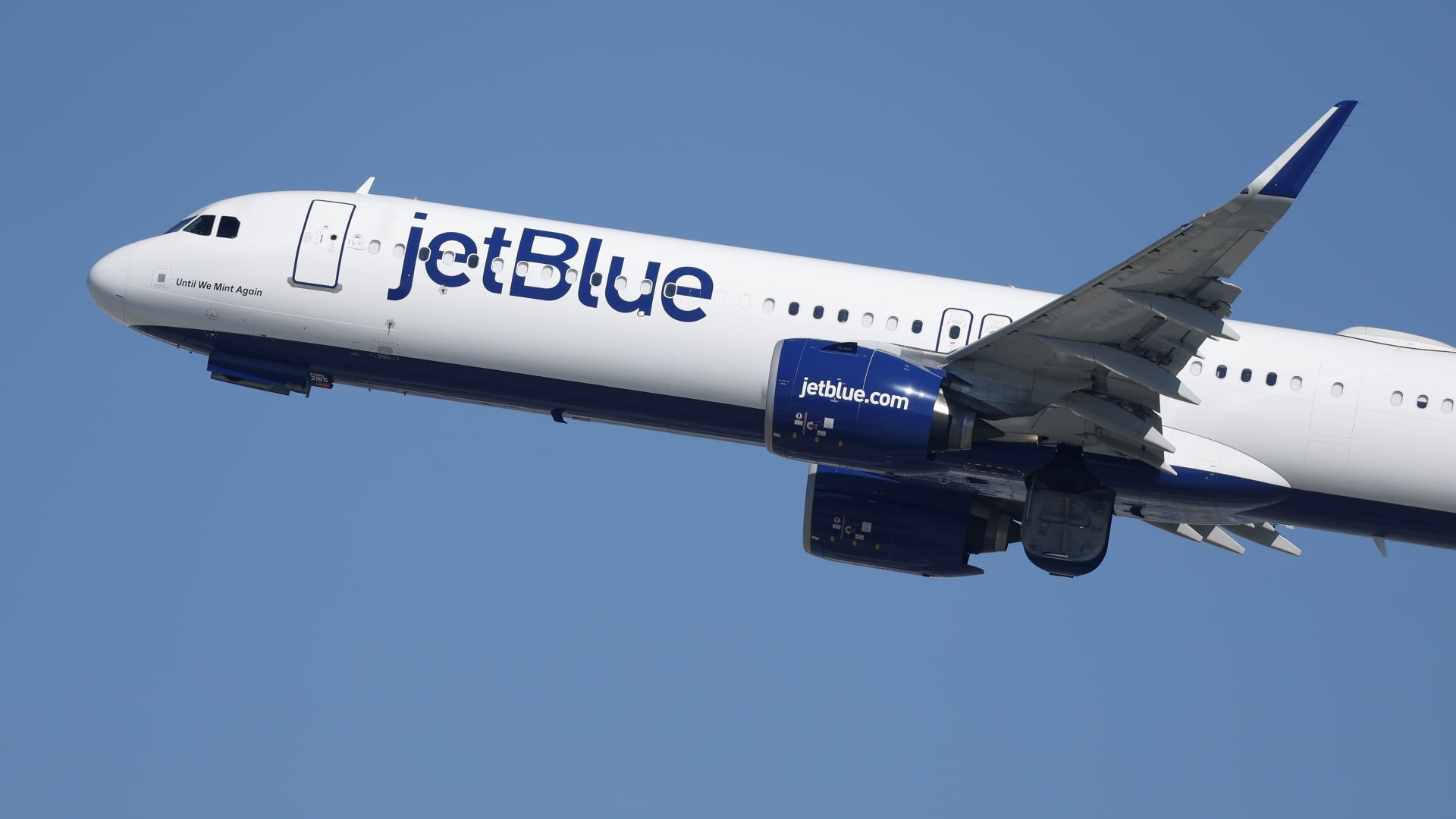
JetBlue is raising its bag fees as fuel costs squeeze airlines

JetBlue will reportedly hike its bag fees, as the cost of jet fuel continues to climb amid the war in Iran. It’s the latest example of carriers finding ways to push rising costs onto travelers.

Last week, United Airlines CEO Scott Kirby said that if fuel prices remain elevated, fares would need to rise another 20% for his airline to break even this year.

As CNBC reported, when one airline raises fees, others tend to follow.

Earlier this month, JetBlue hiked its first-quarter outlook for operating revenue per seat mile to between 5% and 7%, saying that strong Q1 demand helped “partially offset additional expenses realized from operational disruptions and rising fuel costs.” Now, the carrier appears to be making moves to further boost revenue to offset those costs.

Earlier on Monday, JetBlue rival Alaska Air lowered its Q1 profit forecast. The refining margins for the carrier’s cheapest fuel option — sourced from Singapore and representing about 20% of Alaska’s overall supply — have spiked 400% since February.

JetBlue did not immediately respond to a request for comment.

As CNBC reported, when one airline raises fees, others tend to follow.

Earlier this month, JetBlue hiked its first-quarter outlook for operating revenue per seat mile to between 5% and 7%, saying that strong Q1 demand helped “partially offset additional expenses realized from operational disruptions and rising fuel costs.” Now, the carrier appears to be making moves to further boost revenue to offset those costs.

Earlier on Monday, JetBlue rival Alaska Air lowered its Q1 profit forecast. The refining margins for the carrier’s cheapest fuel option — sourced from Singapore and representing about 20% of Alaska’s overall supply — have spiked 400% since February.

JetBlue did not immediately respond to a request for comment.

business

Netflix is hiking its prices again

Netflix is raising its subscription prices for the fourth time in four years, a move first spotted by Android Authority.

Per Netflix’s US pricing page, the cost of an ad-supported plan is climbing $1 to $8.99 per month, while the cost of a standard ad-free plan is going up $2 to $19.99 per month. The premium tier has also risen $2 to $26.99 per month.

The streamer last raised its subscription costs more than a year ago in January 2025. It also hiked prices in 2023, 2022, 2020, and 2019. Netflix shares climbed about 2% on the news.

“Our approach remains the same: we continue offering a range of prices and plans to meet a variety of needs, and as we deliver more value to our members we are updating our prices to enable us to reinvest in quality entertainment and improve their experience by updating our prices,” said a Netflix spokesperson, in a statement to Sherwood News.

The streamer last raised its subscription costs more than a year ago in January 2025. It also hiked prices in 2023, 2022, 2020, and 2019. Netflix shares climbed about 2% on the news.

“Our approach remains the same: we continue offering a range of prices and plans to meet a variety of needs, and as we deliver more value to our members we are updating our prices to enable us to reinvest in quality entertainment and improve their experience by updating our prices,” said a Netflix spokesperson, in a statement to Sherwood News.

Latest Stories

Sherwood Media, LLC produces fresh and unique perspectives on topical financial news and is a fully owned subsidiary of Robinhood Markets, Inc., and any views expressed here do not necessarily reflect the views of any other Robinhood affiliate, including Robinhood Markets, Inc., Robinhood Financial LLC, Robinhood Securities, LLC, Robinhood Crypto, LLC, Robinhood Derivatives, LLC, or Robinhood Money, LLC. Futures and event contracts are offered through Robinhood Derivatives, LLC.