
Business
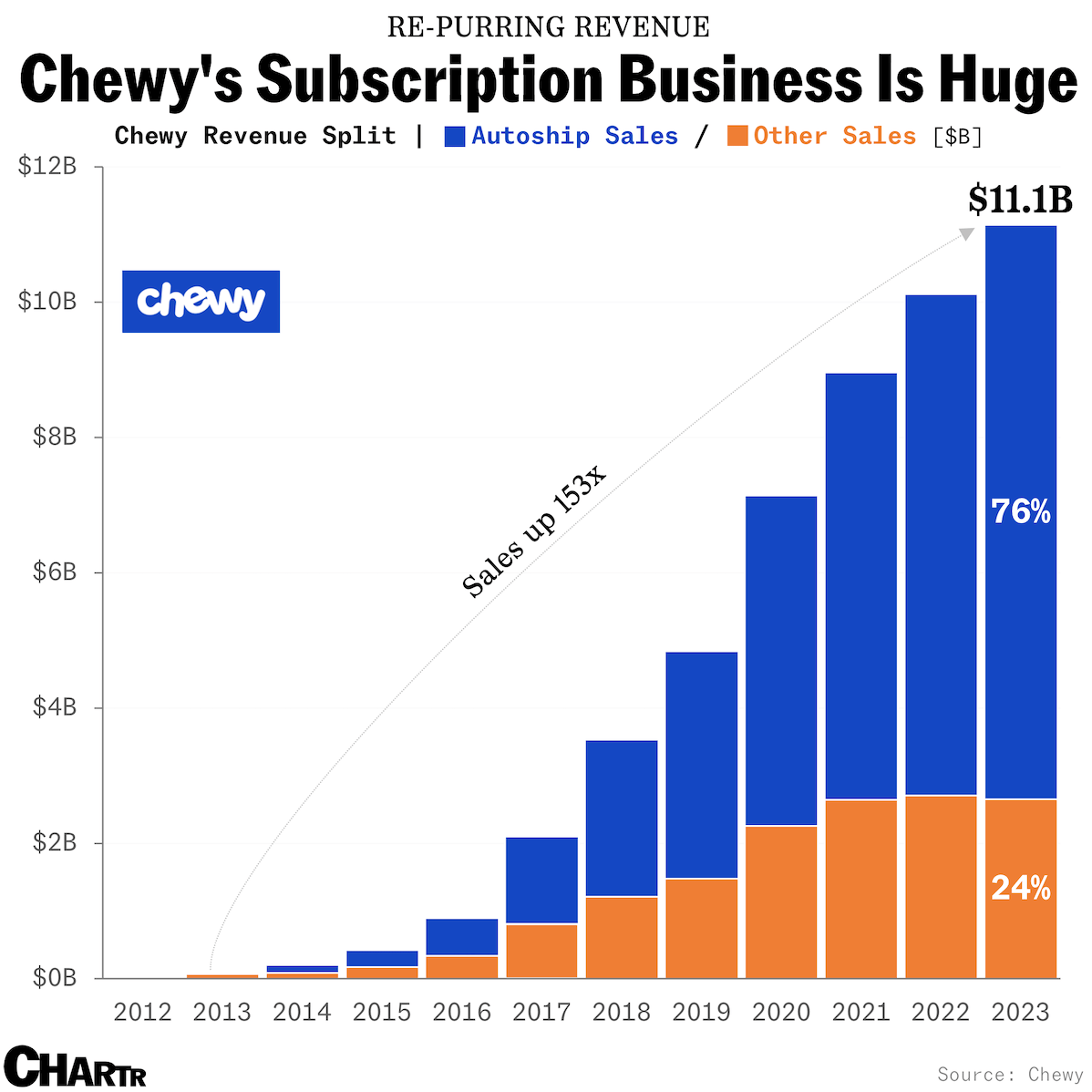
Chewy autoship sales

Chewy rode the pandemic pet boom and built a huge subscription business

Autopilot

At some point in the last few years, you might have asked yourself: “why is everything a subscription these days?

The success of software, cable, phone contracts, streaming, and other products in the 2000s inspired entrepreneurs to try just about anything as a subscription, chasing the holy grail of predictable ‘recurring revenue’. From razors to glasses, toilet paper to your entire wardrobe, if you’ve bought it in a store, it’s probably been tried as a subscription business (or at least a direct-to-consumer business). Most efforts, it must be said, have struggled to make the economics work, despite millions of dollars in VC funding. Pet supplier Chewy, however, has bucked the trend.

Chewy autoship sales

Indeed, shares in the company are up more than 30% this week after reporting a set of Q1 results that came in way ahead of expectations. Chewy’s “autoship” sales — an offering where customers can set up repeat deliveries for a discount — were up 6.4% year-on-year, and its revenue per active customer rose to a whopping $562. The market lapped up that progress, with autoship sales now more than 75% of Chewy’s business, driving almost all of its growth since 2021... and investors seemed to like the announcement of a $500M share buyback.

Pet project

The uptick for Chewy comes after a difficult few years. A pandemic darling, Chewy’s sales soared during the pet boom of COVID, and — like so many other “pandemic winners” — the reality never quite matched up to the expectation. From its peak, CHWY is down 82%... with the shares loosely tracking the volume of Google searches for the phrase “puppies for sale”, which boomed throughout 2020’s lockdown days.
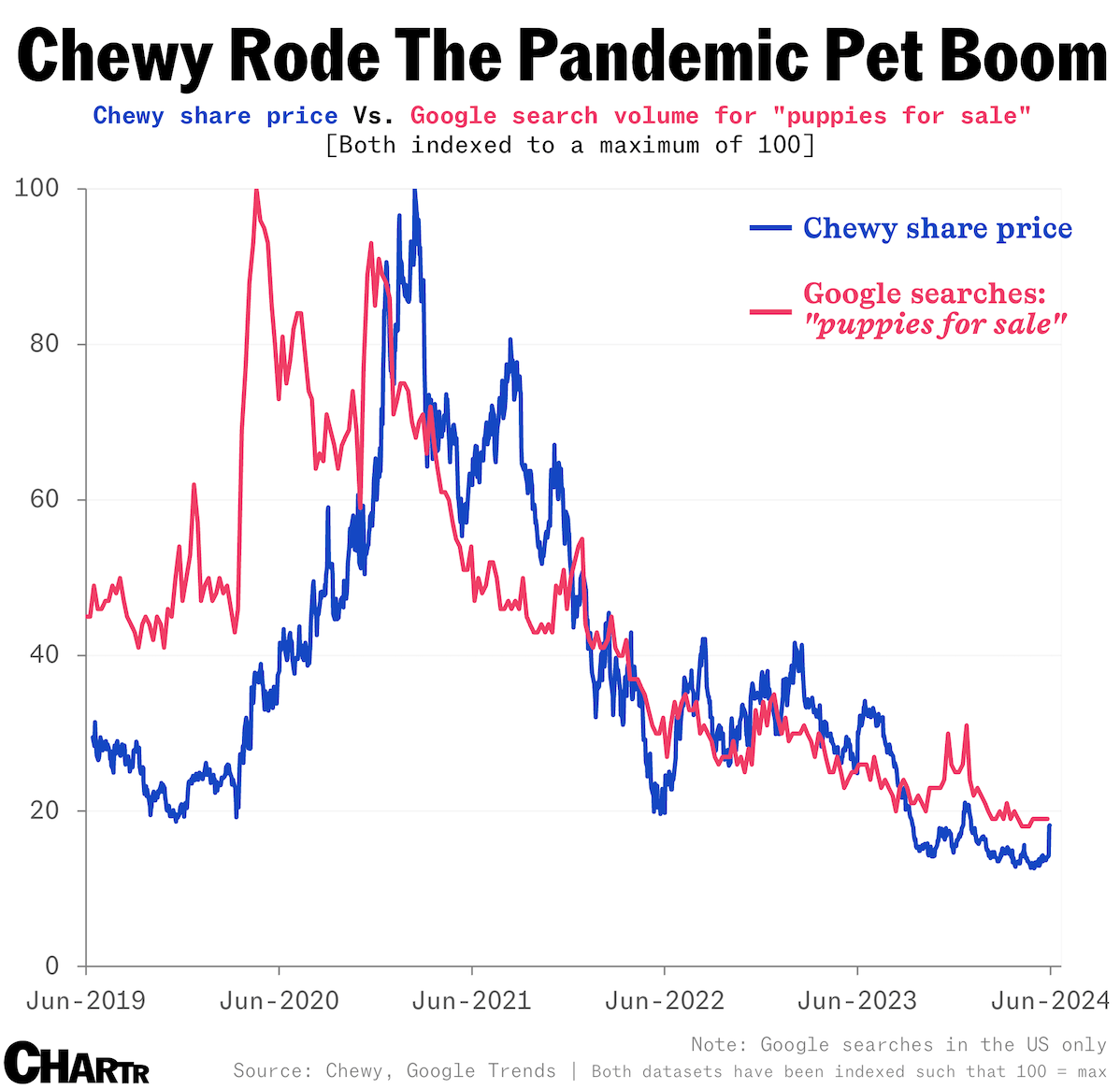
Chewy share prices, puppies for sale

But, while Chewy’s stock may have lost some of its bite, the pet product peddler remains a huge business, with revenues north of $10B. This makes it one of the most successful of a vintage of subscription / direct-to-consumer brands — such as Casper (mattresses), StitchFix (personal styling), Peloton (fitness), SmileDirectClub (oral care), Allbirds (shoes), Blue Apron (meal kits), and others — that have struggled, or even gone bankrupt since their Covid boom. Random consumer subscriptions may be for Christmas, but pet supply subscriptions are for life.

Go fetch: Chewy’s founder, Ryan Cohen, is none other than the CEO of GameStop.

More Business

See all Business
Daily Life In Warsaw

Smartphones are 12% cheaper than last year, according to the latest inflation data... except they’re not

Phones are one of a few important categories that get quality, or “hedonic,” adjustments in the Consumer Price Index — which make their price go down in the official statistics.

business

Texas sues Netflix, accusing streamer of spying on children and collecting user data without consent

The state of Texas filed a lawsuit Monday against streaming giant Netflix, alleging that the company has built a “behavioral-surveillance program of staggering scale.”

The suit alleges that Netflix is “deceptively designed” to be addictive, using features like autoplay to get viewers hooked, “mining those users for data, and then converting that data into lucrative intelligence for global advertising juggernauts.”

“When you watch Netflix, Netflix watches you,” the lawsuit reads.

“This lawsuit lacks merit and is based on inaccurate and distorted information,” Netflix said in a statement to Sherwood News. “Netflix takes our members’ privacy seriously and complies with privacy and data‑protection laws everywhere we operate.”

Texas is seeking civil penalties of “up to $10,000 per violation” of the Texas Deceptive Trade Practices-Consumer Protection Act, along with an additional penalty of up to $250,000 per violation involving a consumer aged 65 or older.

“Netflix is not the ad-free and kid-friendly platform it claims to be. Instead, it has misled consumers while exploiting their private data to make billions,” said Texas Attor­ney Gen­er­al Ken Pax­ton in the press release announcing the lawsuit.

Netflix did not immediately respond to a request for comment.

“This lawsuit lacks merit and is based on inaccurate and distorted information,” Netflix said in a statement to Sherwood News. “Netflix takes our members’ privacy seriously and complies with privacy and data‑protection laws everywhere we operate.”

Texas is seeking civil penalties of “up to $10,000 per violation” of the Texas Deceptive Trade Practices-Consumer Protection Act, along with an additional penalty of up to $250,000 per violation involving a consumer aged 65 or older.

“Netflix is not the ad-free and kid-friendly platform it claims to be. Instead, it has misled consumers while exploiting their private data to make billions,” said Texas Attor­ney Gen­er­al Ken Pax­ton in the press release announcing the lawsuit.

Netflix did not immediately respond to a request for comment.

Latest Stories

Sherwood Media, LLC and Chartr Limited produce fresh and unique perspectives on topical financial news and are fully owned subsidiaries of Robinhood Markets, Inc., and any views expressed here do not necessarily reflect the views of any other Robinhood affiliate, including Robinhood Markets, Inc., Robinhood Financial LLC, Robinhood Securities, LLC, Robinhood Crypto, LLC, Robinhood Money, LLC, Robinhood U.K. Ltd, Robinhood Derivatives, LLC, Robinhood Gold, LLC, Robinhood Asset Management, LLC, Robinhood Credit, Inc., Robinhood Ventures DE, LLC and, where applicable, its managed investment vehicles.
