
Business
Chipotle store front New York
(Michael M. Santiago/Getty Images)
Take the wrap

Chipotle “Mexican Grill” is coming to Mexico for the first time in 2026

The chain is expanding into its fare’s homeland — something that rival Taco Bell has already failed to do twice.

Millie Giles

Anyone in Mexico that’s stumped as to where they could possibly go to get a taco or a burrito finally has an answer: Chipotle Mexican Grill is opening its first-ever outpost in the country, the company announced on Monday.

Step asada

The California-based chain said it will partner with Alsea — a Mexico City-based restaurant operator that has successfully brought brands like Starbucks, Chili’s, and the Cheesecake Factory to Latin America — to open a new location in Mexico in early 2026. In the press release, Chipotle confidently cited “familiarity with [their] ingredients” as a reason why the brand’s “classically-cooked” food will “resonate with guests in Mexico.” 

However, American takes on its southern neighbor’s cuisine don’t always hit in the Mexican market. Even Yum! Brands’ Taco Bell, the biggest Mexican restaurant chain in the US with over 8,000 locations, has twice tried — and twice failed — to open in the country.
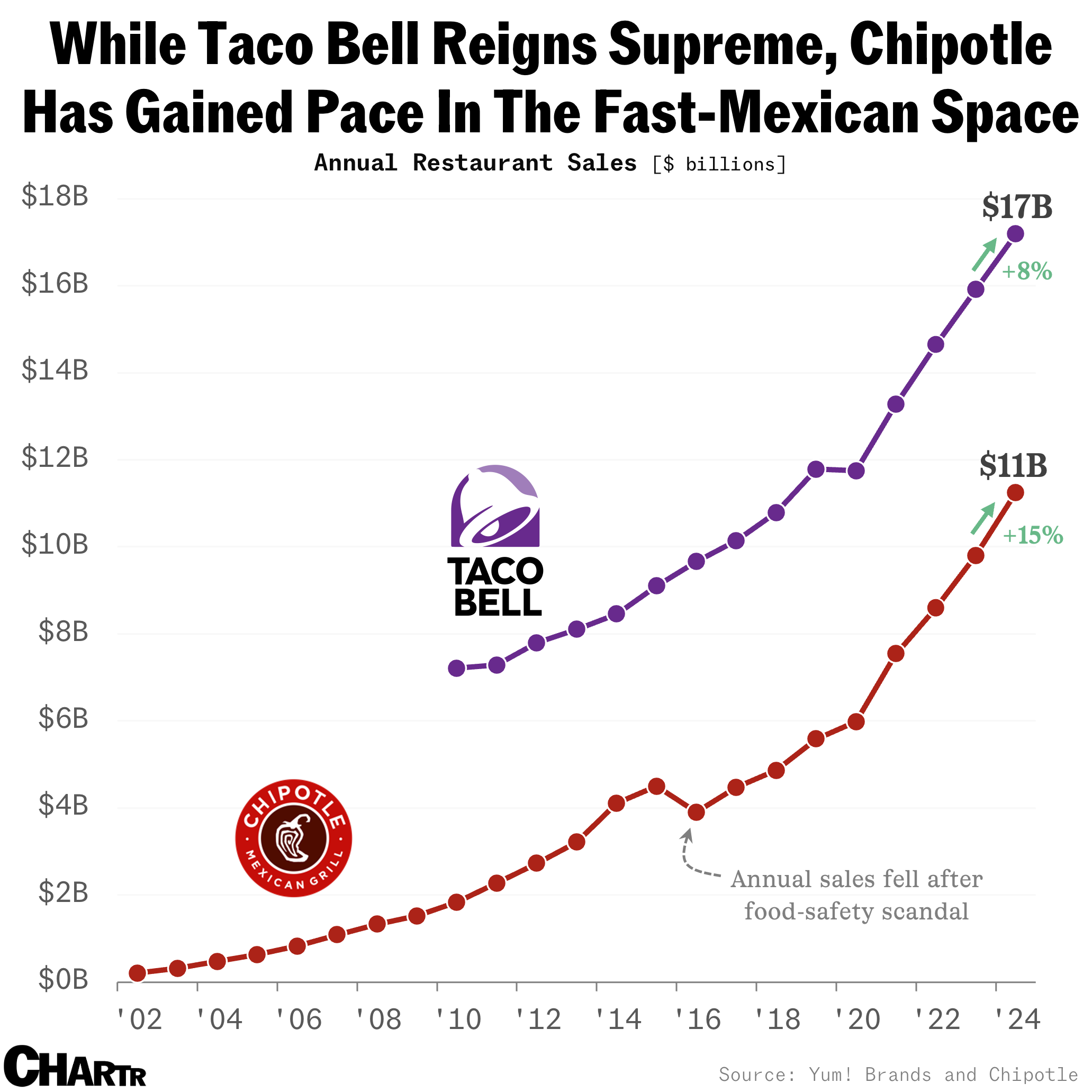
Chipotle and Taco Bell sales chart
Sherwood News

Despite its failure in the home of its namesake fare, Taco Bell has still seen sales soar over the last decade, peaking at $17 billion last year. And while Chipotle isn’t quite at that level going into its southern expansion, it’s growing more quickly than its closest rival, with restaurant revenues up 15% year over year.

Fillings the gap

Though it’s opened more than 90 international units since 2008, including 58 locations in Canada and 20 in the UK, Chipotle has never expanded to the native land of many of its dishes. Now, though, could be the perfect time.

As prices of produce imported from Mexico to the US are expected to rise on President Trump’s 25% tariffs, Chipotle has been on a mission to find avocados from alternate sources to make its (famously not free) guacamole, along with many other imported ingredients. Opening restaurants in its primary supplying country not only keeps menu prices low in stores in that region, but could also help to hedge against higher costs domestically by staying close to the source, per Quartz.

Even with Chipotle’s prices surging in recent years, it seems that people keep coming back for the chain’s fresh, customizable creations — regardless of the fact that its burrito bowls and salads aren’t exactly what you’d get in Mexico. But, with Taco Bell serving as an example of a rapidly growing, rapidly modernizing chain that just couldn’t crack the Mexican market, time will tell whether Chipotle’s calidad will outshine its autenticidad among local consumers.

More Business

See all Business
The entrance of Allbirds seen from Hayes St. in San Francisco, Calif.

Allbirds, the once buzzy multibillion-dollar sneaker startup, is selling up for $39 million

That’s less than 1% of its peak market cap about four years ago.

Tom Jones3/31/26
business

JetBlue is raising its bag fees as fuel costs squeeze airlines

JetBlue will reportedly hike its bag fees, as the cost of jet fuel continues to climb amid the war in Iran. It’s the latest example of carriers finding ways to push rising costs onto travelers.

Last week, United Airlines CEO Scott Kirby said that if fuel prices remain elevated, fares would need to rise another 20% for his airline to break even this year.

As CNBC reported, when one airline raises fees, others tend to follow.

Earlier this month, JetBlue hiked its first-quarter outlook for operating revenue per seat mile to between 5% and 7%, saying that strong Q1 demand helped “partially offset additional expenses realized from operational disruptions and rising fuel costs.” Now, the carrier appears to be making moves to further boost revenue to offset those costs.

Earlier on Monday, JetBlue rival Alaska Air lowered its Q1 profit forecast. The refining margins for the carrier’s cheapest fuel option — sourced from Singapore and representing about 20% of Alaska’s overall supply — have spiked 400% since February.

JetBlue did not immediately respond to a request for comment.

As CNBC reported, when one airline raises fees, others tend to follow.

Earlier this month, JetBlue hiked its first-quarter outlook for operating revenue per seat mile to between 5% and 7%, saying that strong Q1 demand helped “partially offset additional expenses realized from operational disruptions and rising fuel costs.” Now, the carrier appears to be making moves to further boost revenue to offset those costs.

Earlier on Monday, JetBlue rival Alaska Air lowered its Q1 profit forecast. The refining margins for the carrier’s cheapest fuel option — sourced from Singapore and representing about 20% of Alaska’s overall supply — have spiked 400% since February.

JetBlue did not immediately respond to a request for comment.

Latest Stories

Sherwood Media, LLC produces fresh and unique perspectives on topical financial news and is a fully owned subsidiary of Robinhood Markets, Inc., and any views expressed here do not necessarily reflect the views of any other Robinhood affiliate, including Robinhood Markets, Inc., Robinhood Financial LLC, Robinhood Securities, LLC, Robinhood Crypto, LLC, Robinhood Derivatives, LLC, or Robinhood Money, LLC. Futures and event contracts are offered through Robinhood Derivatives, LLC.
