Business
Ocean liner cartoon
(Getty Images)
cruisy

The cruise industry is booming thanks to younger consumers looking to “seacation”

Operators are still managing to lure Gen Z and millennials with shorter, cheaper, and more action-packed trips.

Claire Yubin Oh

The cruise industry’s old cliche that “the newly wed, the overfed, and the nearly dead” fuel the business could do with a little update in 2025. As Sherwood News noted earlier this year, a growing number of Gen Zers and millennials captivated by the idea of “seacationing” are powering cruise lines through the gloom that’s dawned in parts of the broader travel industry this year, as passenger volumes are forecast to hit to ~38 million, up 27% from the prepandemic level in 2019.

When cruise travel reached a record high last year, 36% of global cruise travelers were under the age of 40, per research from the Cruise Lines International Association.

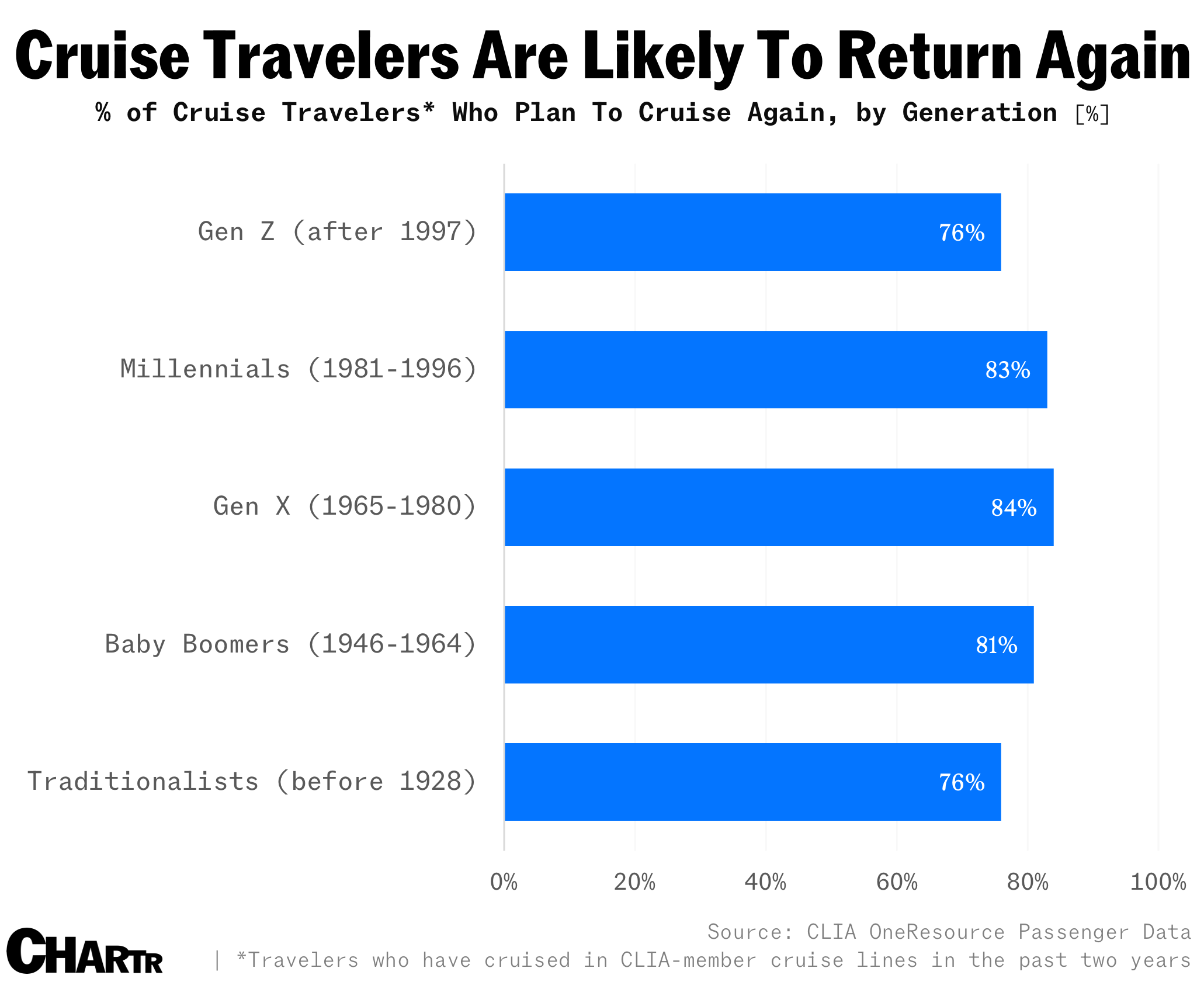
Furthermore, 76% of Gen Zers and a whopping 83% of millennials who have gone on a trip in the last two years say they would plan to cruise again, as North America’s largest cruise operators work hard to appeal to younger travelers, betting on shorter three- to four-day trips, private island destinations, and curated experiences at every turn. 
Repeat cruise trips chart
Sherwood News

The new cruise-going demographic is happily adding to these businesses’ top lines — some 30% of Royal Caribbean’s 2.3 million guests in Q2 were millennial-age or younger, per the company’s earnings call, and its research shows that more than half of those passengers are “now more likely to consider cruising.” In the last three years, Royal Caribbean shares have surged more than 340%. 

Rival Norwegian Cruise Lines is enjoying the same uptick, with CEO Harry Sommer commenting on CNBC that “we appeal obviously to older customers, but millennial and Gen Z is the fastest-growing segment of our cruising right now.” By focusing on younger guests and providing them with experiences that keep them coming back, companies are now actively working to “cultivate the next generation of cruisers,” in the words of Royal Caribbean CFO Naftali Holtz, to prop up a business that relies on customer loyalty.

Often highly sensitive to consumer spending, the cruise industry has had a decent year, with the three largest North American cruise operators — Royal Caribbean, Carnival, and Norwegian — all raising their full-year earnings guidance throughout 2025, sustained even amid price increases

More Business

See all Business
business

Sony is reportedly considering pushing the PlayStation 6 to 2028 or 2029 as AI RAM demand squeezes consumer electronics

AI’s ongoing need for more memory chips, which some are referring to as “RAMmageddon,” is reportedly shifting Sony’s plans for its next PlayStation console.

According to reporting by Bloomberg, the company is weighing a delay of the PS6 to 2028 or 2029 — a pivot from the company’s typical six- to seven-year console life cycle.

Memory costs could also result in Nintendo hiking the price of the Switch 2, per the report.

The report is part of a larger trend of AI demand impacting consumer electronics, including gaming equipment. Earlier this month, reports said that Nvidia will not release a new gaming graphics chip this year — a first. Steam owner Valve delayed its forthcoming Steam Machine console, and its popular Steam Deck handheld is currently unavailable for purchase in the US. Per Valve’s website: “Steam Deck OLED may be out-of-stock intermittently in some regions due to memory and storage shortages.”

Amid the AI memory squeeze, gaming stocks have also experienced major recent sell-offs following the release of Google’s AI interactive world-generation tool, Project Genie.

Memory costs could also result in Nintendo hiking the price of the Switch 2, per the report.

The report is part of a larger trend of AI demand impacting consumer electronics, including gaming equipment. Earlier this month, reports said that Nvidia will not release a new gaming graphics chip this year — a first. Steam owner Valve delayed its forthcoming Steam Machine console, and its popular Steam Deck handheld is currently unavailable for purchase in the US. Per Valve’s website: “Steam Deck OLED may be out-of-stock intermittently in some regions due to memory and storage shortages.”

Amid the AI memory squeeze, gaming stocks have also experienced major recent sell-offs following the release of Google’s AI interactive world-generation tool, Project Genie.

Robot illustration

Video game experts say Google’s Project Genie isn’t an industry killer. Investors don’t seem convinced.

Analysts and company execs are trying to dispel fears around AI’s impact on gaming, but Wall Street is still wary.

LA Auto Show

Rivian just had its best day ever on the stock market, after more than 4 years of pain

The EV maker’s software division helped power a strong Q4, as industry giants pump the brakes on their electric ambitions.

Latest Stories

Sherwood Media, LLC produces fresh and unique perspectives on topical financial news and is a fully owned subsidiary of Robinhood Markets, Inc., and any views expressed here do not necessarily reflect the views of any other Robinhood affiliate, including Robinhood Markets, Inc., Robinhood Financial LLC, Robinhood Securities, LLC, Robinhood Crypto, LLC, or Robinhood Money, LLC.