Business
The original world famous Din Tai Fung Restaurant in Taipei, Taiwan.
(Getty Images)
=sum(dim)

Din Tai Fung earns more per restaurant than any other chain in the US

Dumplings, Disneyland, and long lines of diners are a multimillion-dollar recipe for success.

Tom Jones

Though no one can quite agree on just how many branches of Din Tai Fung, the buzzy dumpling spot, there are in the US — The Wall Street Journal went for 16 this week, Bloomberg put it at 17 in early October, and the chain’s website lists a host of new openings that might muddy the waters further in months to come — everyone does concur on one thing: each one is a finely tuned orchestration that turns dough into tens of millions of dollars.

The Bao generation

In the early 1970s, when tinned cooking oil started eating into sales at their shop in Taipei, Din Tai Fung founder Bing-Yi Yang and his wife decided to convert half the store into a restaurant making and selling Xiao Long Bao — the soup dumplings it’s famous around the world for to this day. The pivot proved popular and, after the Taiwanese spot cropped up in The New York Times’ “Top-Notch Tables” in 1993, international expansion would be only a matter of time.

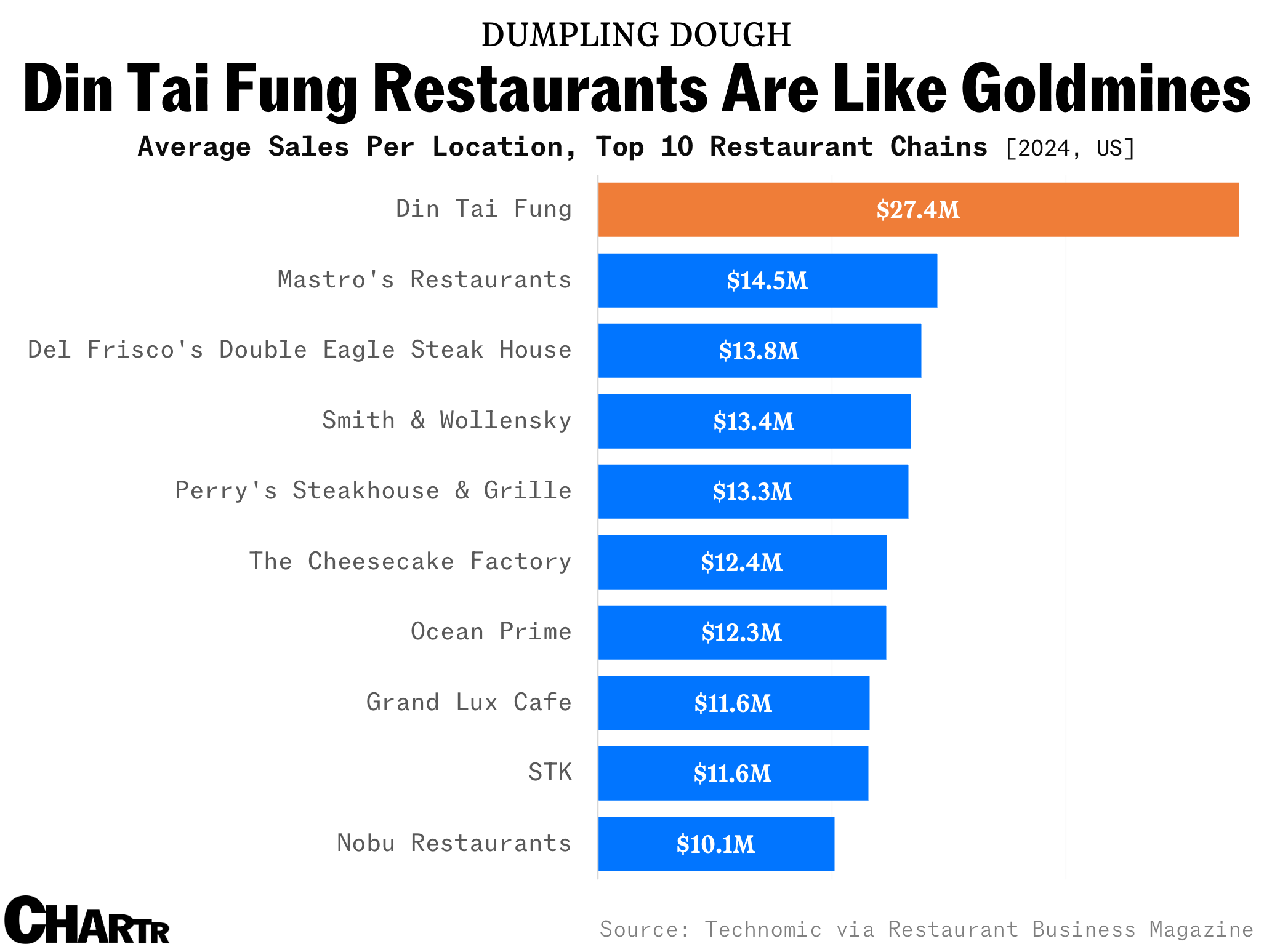
However, when the company opened its first US branch in Arcadia, California, in March 2000, even the most evangelical DTF fan might not have predicted that it would grow into the stateside hit it is today, as America’s top-earning restaurant chain. With a string of locations along the West Coast, some prime real estate in New York City, and an outpost in Disneyland to boot, each Din Tai Fung brought in a whopping $27.4 million on average last year, per figures from industry research firm Technomic.
Din Tai Fung sales chart
Sherwood News

To put that into context, at the world’s largest Din Tai Fung branch in Times Square (where, as of April, a portion of 10 traditional Xiao Long Bao sets you back $18.50), $27.4 million would equate to the restaurant shifting a staggering ~15 million individual dumplings across 2024.

The $27.4 million figure is impressive in its own right, but it becomes even more so when stacked up against the other top-earning restaurant chains in the Technomic report, such as The Cheesecake Factory or Nobu.

According to Restaurant Business Magazine, a chain must do three things to secure the sort of turnover DTF is posting: it must be big, busy, and customers must spend a decent amount when they’re there. Thanks to its expansive floor plans, snaking lines outside most restaurants, and a menu made up of items that lend themselves nicely to sprawling family-style banquets, Restaurant Business says the Taiwanese chain ticks the boxes on all three counts.

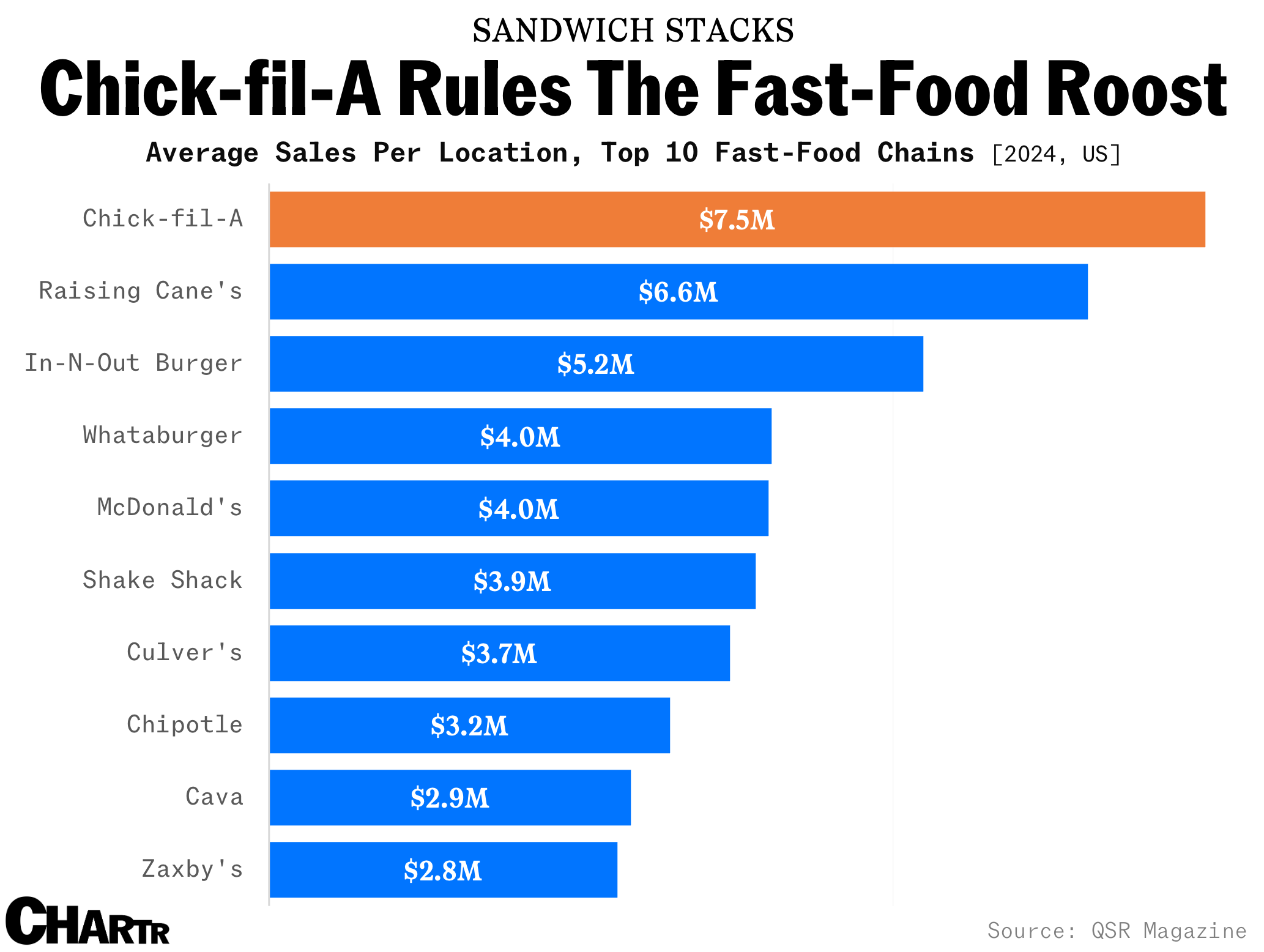
It’s impressive when compared to the world of fast food, too, where, despite most outlets famously closing on Sundays, Chick-fil-A has soared above the competition on sales per restaurant for some time. But still, even the chicken sandwich shop’s impressive $7.5 million per-store average, boosted by busy (if slow) drive-thru lanes at most locations, is nowhere near Din Tai Fung’s output.
Chick-fil-A sales chart
Sherwood News

More Business

See all Business
business

Netflix is down amid reports it’s leading the Warner Bros. bidding war as Paramount cries foul

Netflix’s charm offensive appears to be working.

Netflix is reportedly emerging as the leader in the bidding war for Warner Bros. Discovery after second-round bids this week, edging out entertainment juggernaut rivals Comcast and Paramount Skydance.

Investors don’t appear psyched by the streaming leader’s turn of fortune: the stock is down on Thursday morning, a day after closing down nearly 5% following reports that scooping up HBO Max wouldn’t necessarily result in a big market share boost.

Paramount, which has reportedly made five bids for Warner Bros. Discovery, doesn’t love the current state of play, either. The company sent WBD a letter questioning the “fairness and adequacy” of the process, highlighting reports that WBD’s board favors Netflix and is resisting Paramount.

Any offer would be subject to regulatory approval — a fact that may have weighed against Netflix’s offer given that cofounder Reed Hastings’ politics are vocally to the left, very much at odds with the current regulatory regime. Paramount seems confident in its ability to get approval, reportedly boosting its breakup fee to $5 billion should its potential acquisition fall apart in the regulatory process.

Investors don’t appear psyched by the streaming leader’s turn of fortune: the stock is down on Thursday morning, a day after closing down nearly 5% following reports that scooping up HBO Max wouldn’t necessarily result in a big market share boost.

Paramount, which has reportedly made five bids for Warner Bros. Discovery, doesn’t love the current state of play, either. The company sent WBD a letter questioning the “fairness and adequacy” of the process, highlighting reports that WBD’s board favors Netflix and is resisting Paramount.

Any offer would be subject to regulatory approval — a fact that may have weighed against Netflix’s offer given that cofounder Reed Hastings’ politics are vocally to the left, very much at odds with the current regulatory regime. Paramount seems confident in its ability to get approval, reportedly boosting its breakup fee to $5 billion should its potential acquisition fall apart in the regulatory process.

business

Delta says the government shutdown will cost it $200 million in Q4

The 43-day government shutdown that ended last month will result in a $200 million ding for Delta Air Lines, the airline said in a filing on Wednesday.

That’s about $100,000 per shutdown-related canceled flight. (Delta previously said it canceled more than 2,000 flights due to FAA flight reductions.) When the company reports its fourth-quarter earnings, the shutdown will lop off about $0.25 per share.

Delta initially stayed calm about the shutdown, with CEO Ed Bastian stating in early October that the company was running smoothly and hadn’t seen any impacts at all. One historically long shutdown later, Delta wasn’t able to remain untouched.

The skies have since cleared, though, and Delta’s filing states that booking growth has “returned to initial expectations following a temporary softening in November.”

Delta’s shares were up over 2% as of Wednesday’s market open.

Delta initially stayed calm about the shutdown, with CEO Ed Bastian stating in early October that the company was running smoothly and hadn’t seen any impacts at all. One historically long shutdown later, Delta wasn’t able to remain untouched.

The skies have since cleared, though, and Delta’s filing states that booking growth has “returned to initial expectations following a temporary softening in November.”

Delta’s shares were up over 2% as of Wednesday’s market open.

Latest Stories

Sherwood Media, LLC produces fresh and unique perspectives on topical financial news and is a fully owned subsidiary of Robinhood Markets, Inc., and any views expressed here do not necessarily reflect the views of any other Robinhood affiliate, including Robinhood Markets, Inc., Robinhood Financial LLC, Robinhood Securities, LLC, Robinhood Crypto, LLC, or Robinhood Money, LLC.