
Business
Doctors Performing Surgery
Doctors performing surgery

Employer-provided healthcare premiums rose to an average of $27,000 this year

Coverage of GLP-1s is among the drivers for rising premiums.

J. Edward Moreno

Premiums for employer-provided health insurance plans reached nearly $27,000 this year, and are expected to rise even more in 2026 amid rising costs of care.

Family premiums for these plans, for which the costs are shared between the employer and employee, grew 6% to $26,993 in 2025, according to KFF’s annual survey of more than 1,800 employers, released Wednesday. That compares with 7% increases in each of the previous two years. It’s also more than double the overall inflation rate, which is 2.9% as of the most recent reading.

“There is a quiet alarm bell going off,” Drew Altman, CEO of KFF, said in a statement.

High costs of brand-name prescription drugs, rising hospital costs, and tariffs have employers anticipating an even bigger bill next year, respondents told KFF. Employers expect costs to rise by as much as 9% in 2026, a separate survey by Mercer found.

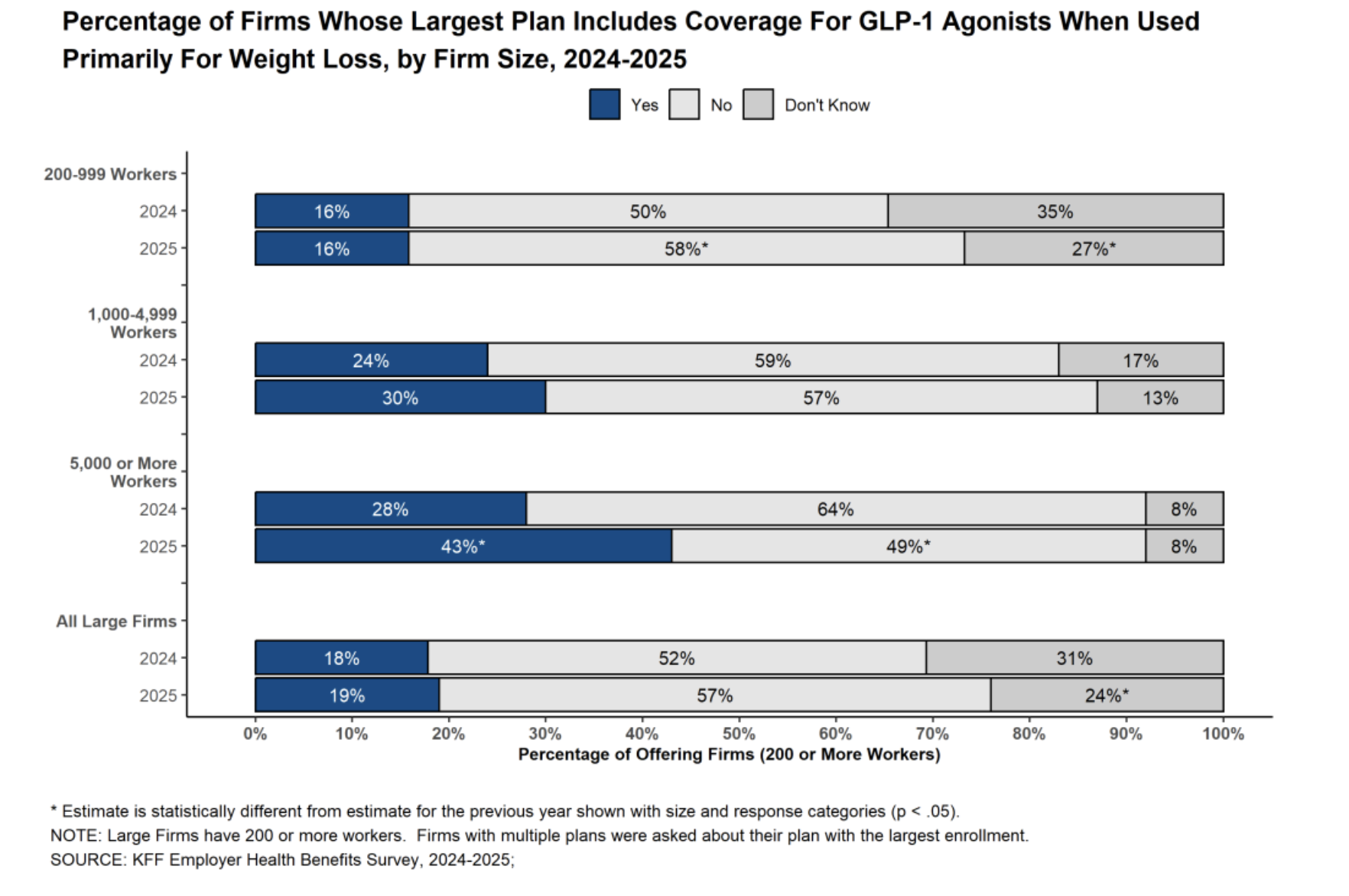
Employers told KFF that one of the drivers of rising premiums is coverage of weight-loss and diabetes drugs made by Eli Lilly and Novo Nordisk. Despite being expensive and popular, employers generally increased coverage for them from 2024 to 2025, with larger employers more likely to cover them, the survey found.

The news comes as President Trump is putting pressure on drugmakers to lower prices for Americans, with tariffs looming as the administrations remedy of choice.

So far drugmakers have been able to claim victories on that front by offering direct-to-consumer prices, which are lower because they skip over middlemen, including insurance companies. This is a popular model for GLP-1s, with DTC prices at roughly $300 to $500 a month compared to the upward of $1,000 typically charged to insurance for the same drug.

But other brand-name, life-saving drugs are much more expensive and have cash prices that would be difficult for a patient to swallow even if it were half of what is typically billed to their insurance. Some employers are exploring ways to subsidize those DTC cash-pay prices. Weight Watchers, for one, recently announced that its setting up a way for employers to do that with GLP-1s.
Screenshot 2025-10-22 at 10.40.06 AM
KFF

More Business

See all Business
business

Netflix is down amid reports it’s leading the Warner Bros. bidding war as Paramount cries foul

Netflix’s charm offensive appears to be working.

Netflix is reportedly emerging as the leader in the bidding war for Warner Bros. Discovery after second-round bids this week, edging out entertainment juggernaut rivals Comcast and Paramount Skydance.

Investors don’t appear psyched by the streaming leader’s turn of fortune: the stock is down on Thursday morning, a day after closing down nearly 5% following reports that scooping up HBO Max wouldn’t necessarily result in a big market share boost.

Paramount, which has reportedly made five bids for Warner Bros. Discovery, doesn’t love the current state of play, either. The company sent WBD a letter questioning the “fairness and adequacy” of the process, highlighting reports that WBD’s board favors Netflix and is resisting Paramount.

Any offer would be subject to regulatory approval — a fact that may have weighed against Netflix’s offer given that cofounder Reed Hastings’ politics are vocally to the left, very much at odds with the current regulatory regime. Paramount seems confident in its ability to get approval, reportedly boosting its breakup fee to $5 billion should its potential acquisition fall apart in the regulatory process.

Investors don’t appear psyched by the streaming leader’s turn of fortune: the stock is down on Thursday morning, a day after closing down nearly 5% following reports that scooping up HBO Max wouldn’t necessarily result in a big market share boost.

Paramount, which has reportedly made five bids for Warner Bros. Discovery, doesn’t love the current state of play, either. The company sent WBD a letter questioning the “fairness and adequacy” of the process, highlighting reports that WBD’s board favors Netflix and is resisting Paramount.

Any offer would be subject to regulatory approval — a fact that may have weighed against Netflix’s offer given that cofounder Reed Hastings’ politics are vocally to the left, very much at odds with the current regulatory regime. Paramount seems confident in its ability to get approval, reportedly boosting its breakup fee to $5 billion should its potential acquisition fall apart in the regulatory process.

business

Delta says the government shutdown will cost it $200 million in Q4

The 43-day government shutdown that ended last month will result in a $200 million ding for Delta Air Lines, the airline said in a filing on Wednesday.

That’s about $100,000 per shutdown-related canceled flight. (Delta previously said it canceled more than 2,000 flights due to FAA flight reductions.) When the company reports its fourth-quarter earnings, the shutdown will lop off about $0.25 per share.

Delta initially stayed calm about the shutdown, with CEO Ed Bastian stating in early October that the company was running smoothly and hadn’t seen any impacts at all. One historically long shutdown later, Delta wasn’t able to remain untouched.

The skies have since cleared, though, and Delta’s filing states that booking growth has “returned to initial expectations following a temporary softening in November.”

Delta’s shares were up over 2% as of Wednesday’s market open.

Delta initially stayed calm about the shutdown, with CEO Ed Bastian stating in early October that the company was running smoothly and hadn’t seen any impacts at all. One historically long shutdown later, Delta wasn’t able to remain untouched.

The skies have since cleared, though, and Delta’s filing states that booking growth has “returned to initial expectations following a temporary softening in November.”

Delta’s shares were up over 2% as of Wednesday’s market open.

Latest Stories

Sherwood Media, LLC produces fresh and unique perspectives on topical financial news and is a fully owned subsidiary of Robinhood Markets, Inc., and any views expressed here do not necessarily reflect the views of any other Robinhood affiliate, including Robinhood Markets, Inc., Robinhood Financial LLC, Robinhood Securities, LLC, Robinhood Crypto, LLC, or Robinhood Money, LLC.
