Business
President Trump Delivers An Announcement From The Oval Office
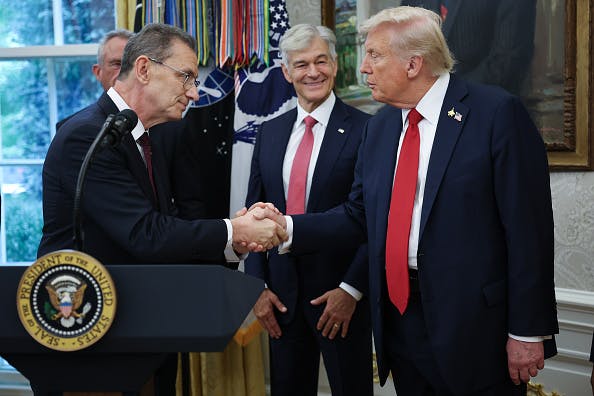
Pfizer CEO Albert Bourla shakes hands with US President Donald Trump on September 30, 2025, in the Oval Office (Win McNamee/Getty Images)

Can pharma companies put tariff threats behind them?

Big Pharma may have gotten Trump off its back for now. But are drug prices coming down?

For the past nine months, pharmaceutical companies have been paralyzed by uncertainty over the threat of US tariffs. It appears that regulatory haze is starting to clear. 

Pfizer CEO Albert Bourla stood with President Trump on Tuesday and announced that his company had agreed to sell drugs through Medicaid at prices lower than other wealthy countries and to offer cash-pay discounts on some of its drugs. Pfizer shares rallied along with the entire sector as Wall Street took the announcement as a sign that companies could get the administration off their backs without shrinking margins, in part by cutting out middlemen. 

Boardrooms are now in a place to take more decisive actions, Stephen Farrelly, the global lead for ING's pharma and healthcare research. “The biggest problems that boardrooms have faced over the past nine months is: what do we do with all of this?” 

President Trump has threatened to impose tariffs on pharmaceuticals, which are typically shielded from trade wars, since he took office. 

Trump’s tariff threats have taken many forms this year, but most recently, on September 25, he said that starting on October 1, there would be a 100% tariff on patented, branded pharmaceuticals “unless a Company IS BUILDING their Pharmaceutical Manufacturing Plant in America.” A July 31 letter sent to 17 drugmakers asked them to commit to lowering prices by the same deadline. 

Most drugmakers have already committed to investing in US manufacturing. And Pfizer “may have done the rest of the industry a favor by giving a framework for a bespoke solution that we feel would be very tenable” for most drugmakers with little impact on their business, analysts at Jefferies wrote in an October 1 note. 

“I think we can almost put the tariff conversation to bed,” Farrelly said. 

So, are drug prices going to fall?

The Pfizer deal applies only to brand-name drugs, which are typically manufactured in Europe. Generics, which account for more than 90% of prescriptions filled in the US, are predominantly made in China and India by other manufacturers. The Trump administration is still considering tariffs on those, citing national security concerns.

Pfizer also agreed to participate in “TrumpRx,” which is not live yet, but has been described as a website that will point people to direct-to-consumer options from manufacturers — allowing Trump to put his stamp on a trend well underway in the industry.

“You might think of it as an overlay on what was already happening with the DTC prices,” said Miriam Paramore, CEO of RxUtility, a service that helps patients find affordable prescriptions. “Anything that focuses on lowering prescription prices is good. On the other hand, I think it’s going to add confusion for the consumer.”

Novo Nordisk and Eli Lilly were the first drugmakers to wade into DTC sales by offering cash-pay options for their popular weight-loss shots, which are often not covered by insurance. Several other drugmakers have followed suit, offering direct cash-pay options for brand-name drugs. 

Let’s say you have a prescription for Lilly’s Zepbound, the hottest weight-loss drug on the market right now. Here are the prices you might pay:

Your insurance, if you have it, will be billed roughly $1,200 for a month’s supply. If they don’t cover it, this is what you would be charged at the pharmacy counter.

If you are covered, the average copay is about $25

If you are not covered or are not using insurance, you can now buy it online directly from Lilly for between $349 and $499.

So, by adding a DTC option, Lilly is able to say it brought the price of Zepbound down from $1,200 to $349.

Though patients were given a new option, at no point was Lilly required to accept a lower profit margin because it simply cut out middlemen by selling directly to the patient instead of selling to a wholesaler, which sells it to a pharmacy, which bills an insurance company. 

“When they bypass that and go directly to consumers, yes, technically the price is being reduced, but the manufacturers are making the same amount of money,” said Alec Ginsberg, owner of C.O. Bigelow, a pharmacy in Manhattan.

Still, many brand-name drugs Americans take aren’t as DTC-friendly as GLP-1s, which are in high demand but generally not immediate life-or-death treatments. 

“Almost nobody in America pays for brand-name medications out of pocket because costs are astronomical.”

Some drugs, like Merck’s Keytruda, have to be administered in a healthcare setting, which makes it difficult to sell directly to a patient. Others are simply so expensive that even large discounts don’t make it worth paying for without insurance. 

For example: Xeljanz, a pill for several inflammatory conditions made by Pfizer, will be 40% off for cash-paying patients under the deal announced Tuesday, meaning the roughly $6,000 list price for a month’s supply goes down to $3,600 for those paying cash. That is still, for most people, prohibitively expensive.

“Almost nobody in America pays for brand-name medications out of pocket because costs are astronomical,” Ginsberg said. 

So far, the president’s actions on drug pricing have focused on drugmakers. But about half of every dollar spent on medications goes to middlemen, according to an estimate from the pharma lobby.

The biggest chunk of that goes to pharmacy benefit managers, which are used by insurance companies to get better deals on medications. PBMs can push up drug prices by demanding manufacturer rebates for covering a medication, marking up drugs through spread pricing, and steering patients toward higher-cost medications.

“All these manufacturer websites are workarounds,” Douglas Hoey, CEO of the National Community Pharmacists Association, said in an October 1 statement. “Reforming the way PBMs and insurance companies operate is the only solution.”

More Business

See all Business
business
Tom Jones

Prime Day is here again and Amazon’s subscription service has never been more popular

Well, it’s that time of year again: many have made their wish lists, people are scraping together the money they’ve saved to pick out a perfect gift, some are presumably leaving out refreshments for the weary delivery drivers and, more and more, drones.

It’s Amazon Prime Day — meaning that it’s the second day of the four-day promotional event that Amazon still calls Prime Day — of course, and it’s even come early this year, with the company bringing the period into late June from July, when it’s been traditionally held for the last five years.

The Prime Age

Alongside the eyes and endless clicks that the arbitrary stream of listicles on “The Best Prime Day Deals” that almost every media outlet pours into, Amazon will also be cheering the fact that there’s now more Prime users than ever before to devour the retailer and its sellers’ sometimes-contested “discounts.” Indeed, according to the latest annual estimates from Consumer Intelligence Research Partners (CIRP), there were just over 200 million American shoppers using Amazon’s massive subscription service at the end of 2025.

business

Electronic Arts launches a platform to put more ads in its games

Video game publishing giant EA launched a new platform on Monday designed to make the process of selling immersive ad space in its popular games easier.

The company says the platform, called EA Advertising, allows brands to “integrate directly into gameplay through dynamic, real-time placements, from stadium signage to custom in-game content.”

More so than other studios, EA has incorporated advertising into its most popular titles. As Kotaku points out, the company’s ad efforts stretch as far back as 2006. Several of its sports franchises already feature partnerships with brands like Visa, Lowe’s, Red Bull, and PepsiCo.

In-game advertising hasn’t exactly been embraced by fans, but industry experts expect it to ramp up as companies seek more revenue to offset higher games budgets and surging memory costs. EA rival Take-Two has taken a different approach, with CEO Strauss Zelnick recently saying the company was “not at risk of doing brand partnerships” in the forthcoming “Grand Theft Auto VI,” and that ads in full-price games seems “unfair.”

The $55 billion deal to take EA private, led by Saudi Arabia’s Public Investment Fund, is set to close at the end of this month. Being the largest leveraged buyout in history, EA will likely look for more ways to boost revenue to cover interest payments.

More so than other studios, EA has incorporated advertising into its most popular titles. As Kotaku points out, the company’s ad efforts stretch as far back as 2006. Several of its sports franchises already feature partnerships with brands like Visa, Lowe’s, Red Bull, and PepsiCo.

In-game advertising hasn’t exactly been embraced by fans, but industry experts expect it to ramp up as companies seek more revenue to offset higher games budgets and surging memory costs. EA rival Take-Two has taken a different approach, with CEO Strauss Zelnick recently saying the company was “not at risk of doing brand partnerships” in the forthcoming “Grand Theft Auto VI,” and that ads in full-price games seems “unfair.”

The $55 billion deal to take EA private, led by Saudi Arabia’s Public Investment Fund, is set to close at the end of this month. Being the largest leveraged buyout in history, EA will likely look for more ways to boost revenue to cover interest payments.

business

JM Smucker says it sold $1 billion worth of Uncrustables in FY2026

After years of booming sandwich sales, JM Smucker has finally earned a billion-dollar crust.

On Tuesday, the company reported results for fiscal year 2026, highlighting better-than-expected profits driven by higher prices for coffee and sweet baked goods. However, at another point on the earnings call, CEO Mark Smucker pointed to one particularly jammy figure: in line with previous forecasts, the company sold $1 billion worth of its (almost always) crustless sandwiches, Uncrustables, in the last year alone.

business

Paramount reportedly offers concessions to resolve multistate antitrust investigation

Paramount has reportedly offered up some concessions in an effort to prevent an antitrust lawsuit by California and about 10 other states, according to Bloomberg reporting on Monday.

Reuters first reported on the potential suit from a group of unnamed states last week, which could throw a wrench in Paramount’s plans to buy rival Warner Bros. Discovery in a Hollywood megamerger.

The list of concessions is unknown, though Bloomberg previously reported that Paramount is open to divesting some of its kids TV assets to appease EU regulators.

Late last month, reports said US regulators appeared likely to approve the $110 billion merger, following a meeting between Paramount CEO David Ellison and DOJ antitrust staffers.

The list of concessions is unknown, though Bloomberg previously reported that Paramount is open to divesting some of its kids TV assets to appease EU regulators.

Late last month, reports said US regulators appeared likely to approve the $110 billion merger, following a meeting between Paramount CEO David Ellison and DOJ antitrust staffers.

$98B ⛽

The IATA released its latest financial outlook for the airline industry over the weekend, forecasting a $98 billion jump in the sector’s collective fuel bill. The world’s largest trade group representing airlines expects the oil spike to halve profits by 49% from last year to $23 billion.

The group also expects profit margins to halve year over year, falling from 2025’s 4.2% to 2%. Still, revenue is expected to climb to $1.17 trillion from $1.07 trillion.

A surge in the cost of jet fuel has rocked US and global airlines this year, leading Delta Air Lines, United Airlines, American Airlines, Southwest Airlines, JetBlue, and others to raise fares and ancillary charges like bag fees. Low-cost carriers, which operate on smaller margins, have been squeezed the hardest, resulting in Spirit’s shutdown.

“It’s a tough year for all airlines, especially those whose balance sheets had not yet recovered from COVID. And, of course, for those operating in the Gulf,” said IATA Director General Willie Walsh, who added that demand is holding up and about half of passengers expect to spend more on travel this year. “That bodes well for a strong northern summer peak season. The big unknown is how long travelers and shippers can tolerate the higher costs of connectivity.”

Latest Stories

Sherwood Media, LLC and Chartr Limited produce fresh and unique perspectives on topical financial news and are fully owned subsidiaries of Robinhood Markets, Inc., and any views expressed here do not necessarily reflect the views of any other Robinhood affiliate, including Robinhood Markets, Inc., Robinhood Financial LLC, Robinhood Securities, LLC, Robinhood Crypto, LLC, Robinhood Money, LLC, Robinhood U.K. Ltd, Robinhood Derivatives, LLC, Robinhood Gold, LLC, Robinhood Asset Management, LLC, Robinhood Credit, Inc., Robinhood Ventures DE, LLC and, where applicable, its managed investment vehicles.