Business
President Biden Speaks At The Intel Ocotillo Campus In Arizona
Intel CEO Patrick Gelsinger in Chandler, Arizona (Rebecca Noble/Getty Images)

Intel’s deal with Amazon might be just the Hail Mary it needs

The big-name deal may provide the beleaguered chip maker with some much-needed momentum.

Intel has not been having a great year in 2024, with its stock price down 54% year-to-date compared to a 19% gain by the S&P 500, and its last earnings report provided a perfect summary of the company’s recent struggles. To quote myself from August:

Intel reported lackluster earnings last week, with a 1% decline in year-over-year revenue and a $1.61 billion operating loss, including a $2.8 billion loss stemming from its Foundry unit that generated $4.3 billion in revenue (4% year over year growth). Even worse, the company stated that it was slashing 17,500 jobs and suspending its dividend just five months after announcing that the CHIPS Act funding would create almost 30,000 jobs.

One of Intel’s problems is that it has repeatedly missed deadlines for releasing more powerful chips, causing it to fall behind competitors like Nvidia and AMD in the AI arms race. Another issue has been the company’s struggle to build a large customer base for its foundry business. 

Foundries manufacture chips that were designed by other companies, and TSMC dominates the foundry market, with data from Statista showing that it has ~62% of the foundry market share, with its largest competitor, Samsung, only holding an 11% market share.

One reason for TSMC’s success is that its 3nm chips are the most advanced technology on the market. Another TSMC advantage, however, is its lack of conflicts of interest. In 1987, TSMC was founded as the world’s first dedicated semiconductor foundry company, and it doesn’t design its own chips. Companies simply send TSMC their designs and pay them to produce chips.

While Intel has grand foundry ambitions, it also designs and sells its own chips, which created an inherent conflict of interest. Investor and technology analyst Kevin Xu explains it well here:

As a customer, how can you be certain that Intel will prioritize manufacturing your chips over its own? To address these concerns, Intel announced in October 2022 that it would “create greater decision-making separation between its chip designers and chip-making factories as part of Chief Executive Pat Gelsinger’s bid to revamp the company and boost returns.” For the last two years, we have waited to see if this move would attract big-name customers, and on Monday, we got our answer:

In the same 24-hour period, Intel announced that it was turning its foundry business into a “wholly owned subsidiary,” making it totally operationally independent from the rest of the company, and it signed a “multibillion-dollar agreement for Amazon.com’s cloud-computing arm to manufacture chips at Intel factories using an advanced chip-making technology expected to go into production next year.”

There is a common phenomenon in the venture market where investors might hesitate to invest in a startup until a big-name fund like a16z or Sequoia writes a check, then everyone wants to participate in the next funding round. Right or wrong (as we saw with FTX), a well-known fund investing in a startup is a positive signal to the market, giving other investors more trust in the company.

Amazon may be Intel’s Sequoia: if the $2 trillion tech giant is willing to invest in Intel, other companies might do the same. To be clear, Intel is still in a hole: Intel Foundry lost $2.8 billion last quarter, and management noted that foundry investments would continue to weigh on its operating profits through the end of the year. However, Amazon has provided some much-needed positive momentum for the ailing chipmaker.

Also, if you happen to believe that the The Economist cover is really a contrarian indicator, things are looking good for Intel now:
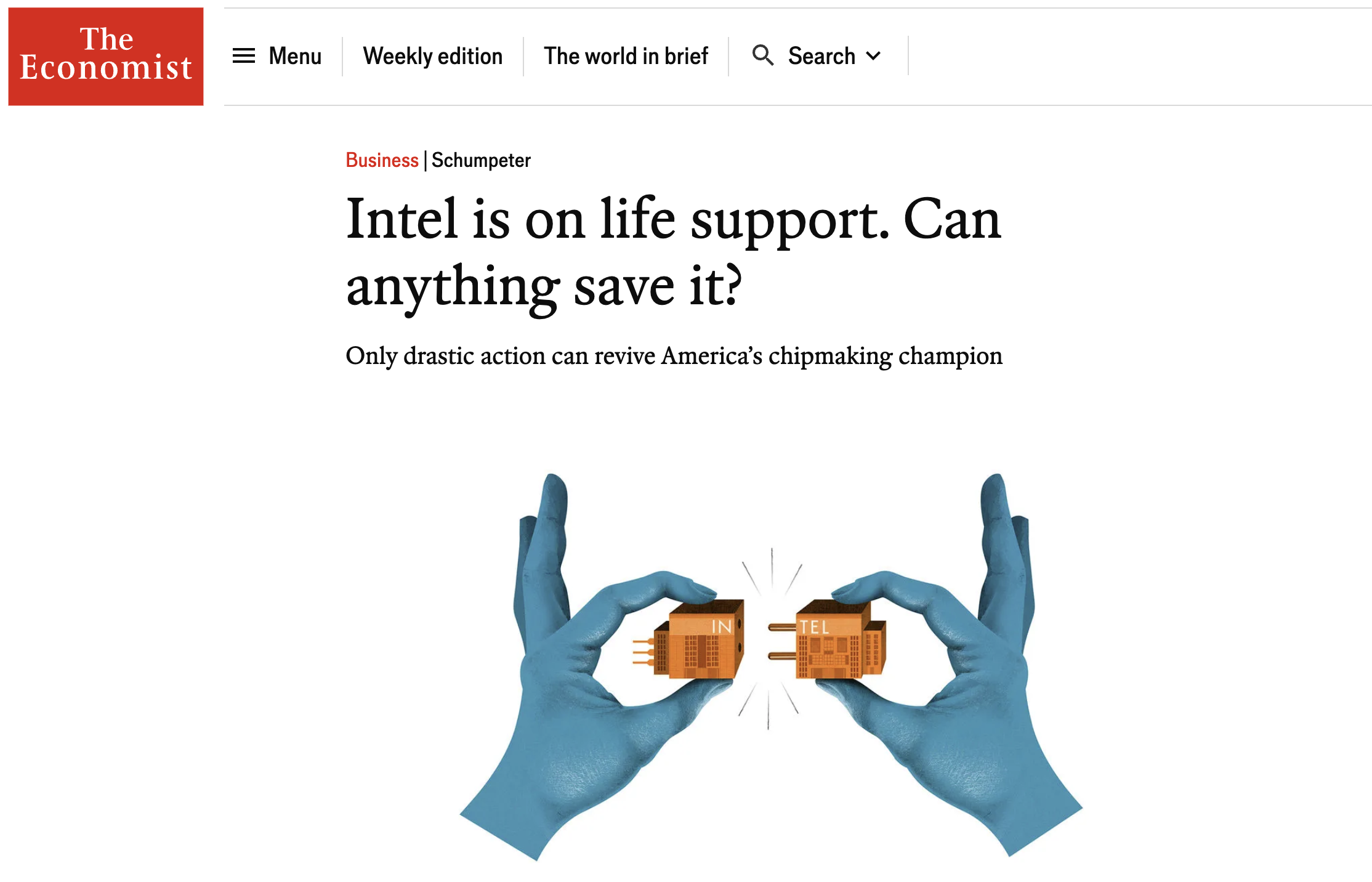

Economist Cover
The Economist cover from September 12

More Business

See all Business
business

Xbox CEO overhauls leadership team with Microsoft AI execs amid sales declines

Microsoft is continuing to shake up Xbox, with gaming chief Asha Sharma (who took over the division suddenly in February) announcing an executive overhaul.

According to an internal memo seen by CNBC, Sharma is bringing four leaders from her former CoreAI group into the Xbox fold, as they have “consumer and technical expertise [Xbox does] not yet have.”

“Right now, it is too hard to ship impact quickly. We spend too much time inward instead of with the community, and we lack the depth we need in some of the fundamentals,” Sharma said in the memo.

Aside from the CoreAI team, David Schloss, a former Instacart growth exec, will take over the subscription and cloud business.

Following Microsoft’s earnings report last week, in which Xbox console sales fell 33% from last year, Sharma said the division had work to do. The company forecast more sales declines for Game Pass and consoles in the current quarter.

“Right now, it is too hard to ship impact quickly. We spend too much time inward instead of with the community, and we lack the depth we need in some of the fundamentals,” Sharma said in the memo.

Aside from the CoreAI team, David Schloss, a former Instacart growth exec, will take over the subscription and cloud business.

Following Microsoft’s earnings report last week, in which Xbox console sales fell 33% from last year, Sharma said the division had work to do. The company forecast more sales declines for Game Pass and consoles in the current quarter.

business

Ford’s April EV sales climb from March but make up less than 2% of its total sales this year

Ford sold 22% more EVs in April than in March, but the category makes up just 1.7% of the automaker’s total 2026 sales through April. At the same point last year, EVs were about 4% of sales.

The company released its April sales figures Monday morning, with EVs climbing sequentially but still down nearly 25% from last year. Its more popular hybrids were down 5% from March and about 33% from last year.

Overall, Ford posted a 14.4% drop in sales in April from last year. SUVs were down more than 16%, trucks fell more than 14%, and cars (the company doesn’t sell many) climbed 18%.

When it reported its Q1 earnings last week, Ford boosted its full-year guidance for adjusted earnings before interest and taxes to between $8.5 billion and $10.5 billion.

business

Amazon opens up its supply chain to everyone

Today Amazon unveiled Supply Chain Services, a new business that turns the vast warehousing and logistics network behind its e-commerce empire into a product for other companies — an AWS-style move applied to the physical world.

As Amazon put it: “Any business can now move, store, and deliver everything from raw materials to finished products using the same supply chain that supports Amazon and its independent selling partners.”

That could make Amazon a behind-the-scenes operator for an even wider swath of commerce, expanding its reach beyond its marketplace and helping it capture more of the $1.3 trillion third-party logistics market.

Shares of traditional shipping companies UPS and FedEx fell after the announcement.

Amazon listed Procter & Gamble, 3M, and American Eagle among the logistics service’s first customers.

That could make Amazon a behind-the-scenes operator for an even wider swath of commerce, expanding its reach beyond its marketplace and helping it capture more of the $1.3 trillion third-party logistics market.

Shares of traditional shipping companies UPS and FedEx fell after the announcement.

Amazon listed Procter & Gamble, 3M, and American Eagle among the logistics service’s first customers.

Ford Announces Plans For New Electric-Vehicle Battery Plant

Ford’s leaving the door open for a Chinese automaker collaboration, says RBC

US lawmakers have raced to introduce legislation to lock in restrictions on cheaper Chinese vehicles and parts ahead of the Trump-Xi meeting in May.

Latest Stories

Sherwood Media, LLC produces fresh and unique perspectives on topical financial news and is a fully owned subsidiary of Robinhood Markets, Inc., and any views expressed here do not necessarily reflect the views of any other Robinhood affiliate, including Robinhood Markets, Inc., Robinhood Financial LLC, Robinhood Securities, LLC, Robinhood Crypto, LLC, Robinhood Derivatives, LLC, or Robinhood Money, LLC. Futures and event contracts are offered through Robinhood Derivatives, LLC.