Business
Inflatable Ronald
Getty Images

Fast food is in flux, but America’s still lovin’ it

McDonald’s retained the top spot in the latest QSR 50 ranking

Millie Giles, Tom Jones

The fast food industry is in a state of flux, with consumers balking at higher prices on the menus of some of the biggest names in the game.

Yesterday, Pizza Hut and KFC both reported that same-store sales had fallen. That followed industry giant McDonald’s, which hasn't had the smoothest start to the year so far, last week reporting that same-store sales had dropped 0.7% too — the first decline since 2020.

The Big Mac

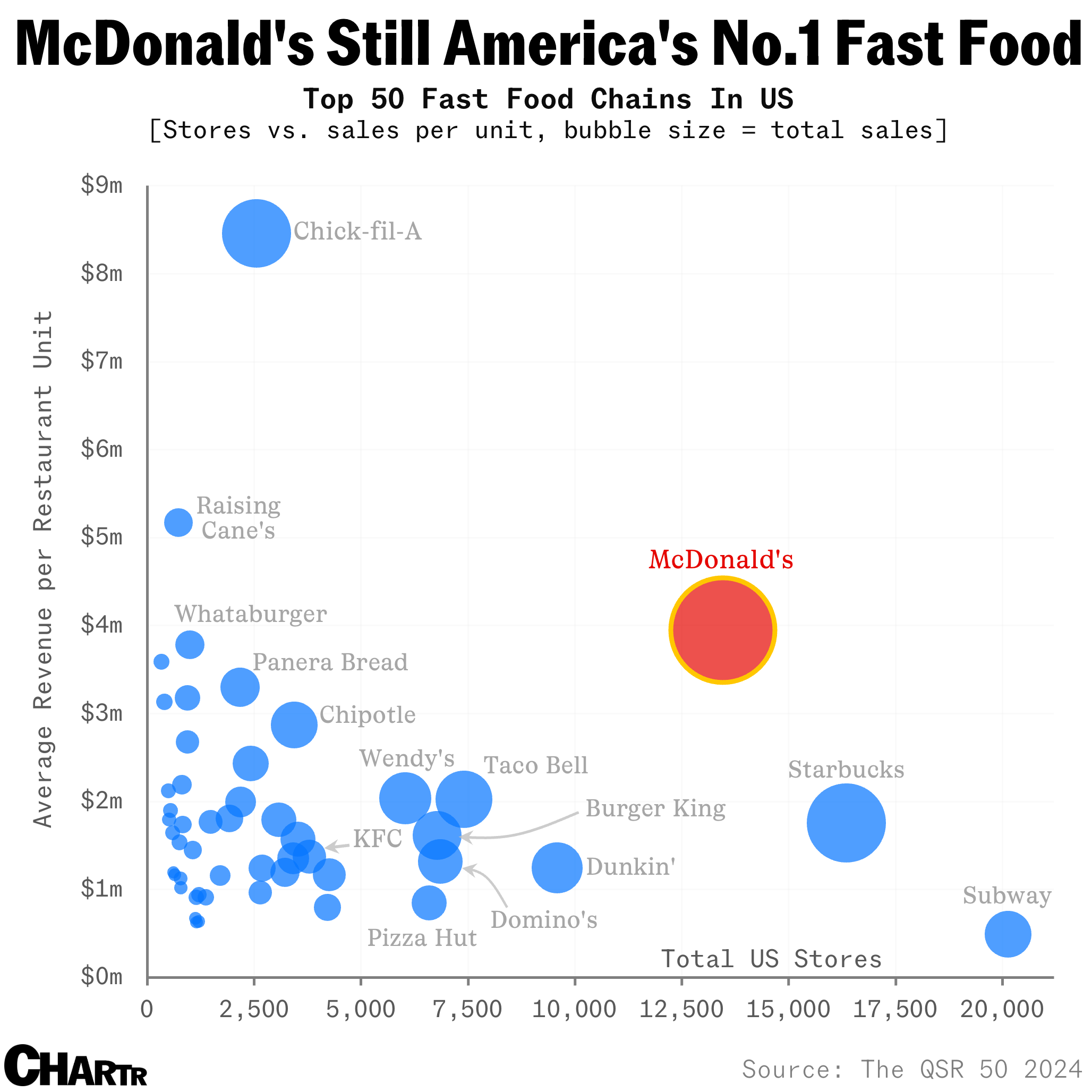
But, even with huge shifts in consumer behavior, when it comes to McDonald’s, America just can’t help lovin’ it. Indeed, in Monday’s QSR 50 report, a comprehensive annual ranking of US fast food chains, McDonald’s held onto the top spot thanks to its 13,457 outlets pulling in total sales of more than $53 billion last year.
America’s largest fast food chains
Sherwood News

Now, McDonald’s is embracing affordability — harking back to the success of the iconic “Dollar Menu” — by doubling down on its $5 meal deal to lure back customers, mentioning the word "value" more than 90 times in its Q2 earnings call, per Edward Moreno.

No small fry

While no fast food outlet comes anywhere close to McDonald’s for revenue — Starbucks, at the No.2 spot, made only $28.7 billion in sales last year — some still surpass the chain for sheer efficiency. None more so than Chick-fil-A.

Known for its focus on customer service and long drive-thru lines, Chick-fil-A has 10,905 fewer units than McDonalds but manages to bring in a massive $8.5 million on average at each of its outlets — more than double the takings at an average McD’s. On the other hand, Subway, which secured the largest franchise-backed bond ever for its buyout back in May, only brings in ~$490,000 from each of its mind-boggling 20,000+ units. For how much longer Subway will retain its store count supremacy, however, is another matter.
Fast growing fast food chains
Sherwood News

Footlongs and farewells

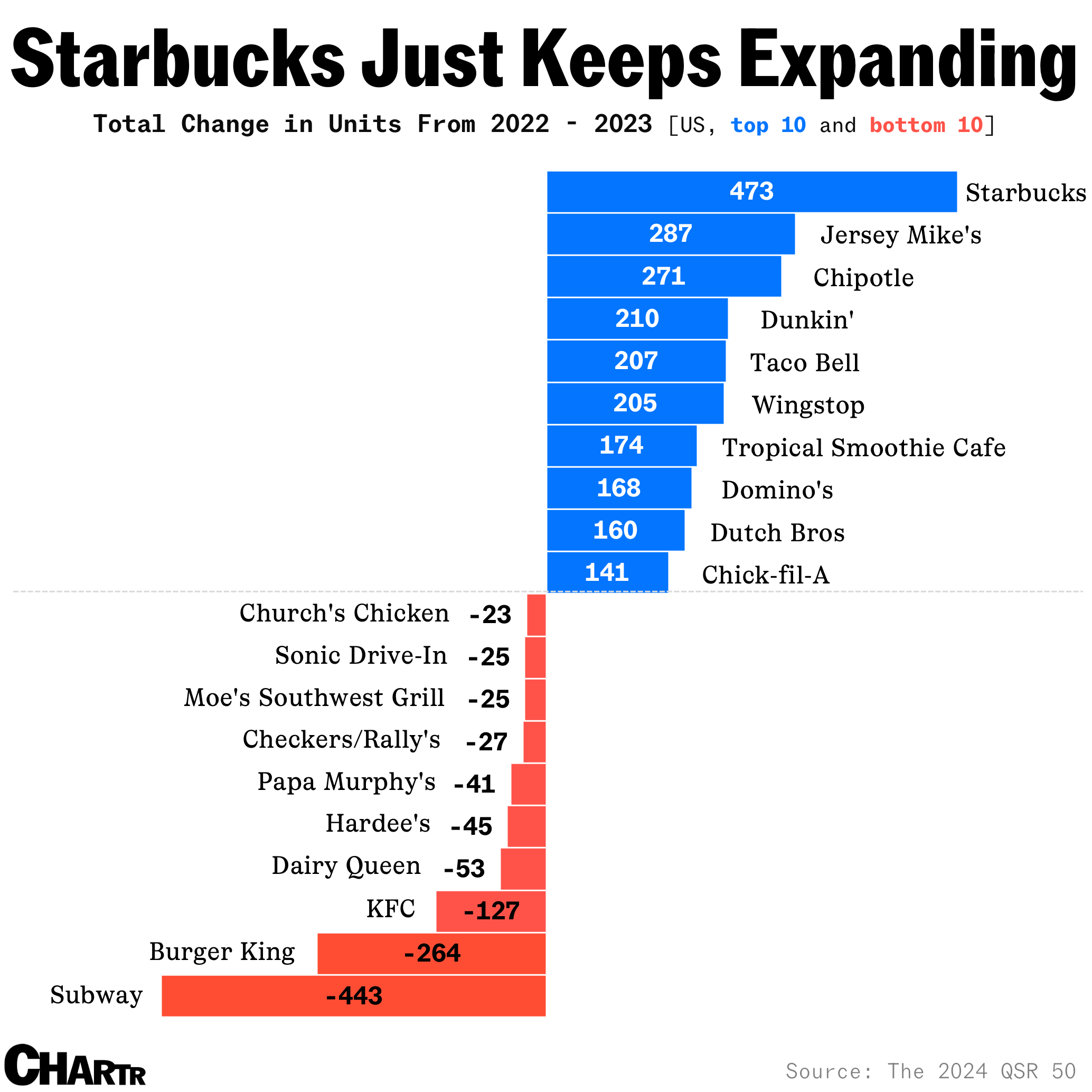
Last year, the “Eat Fresh” chain’s US store tally fell by almost 450 locations, as the sandwich giant shut more American restaurants than it opened for the 8th year in a row. Although that drop was actually the least steep it’s been since 2016, it was still nearly 200 more closures than second place Burger King.

At the other end of the table, a few restaurants that aren’t yet household names are growing rapidly. Jersey Mike’s — a sub rival that’s gained traction with a simple set of sandwiches that spotlight the freshness of their meats and cheeses — is expanding at breakneck speed, adding 287 units last year. Chicken connoisseurs Wingstop also added more than 200 restaurants, and Gen Z’s increasing love for Tropical Smoothie Cafe, which mostly sells what its name suggests, has driven the chain to report its 12th straight year of positive same-store sales growth.

Starbucks, meanwhile, was also closing the gap on Subway again last year, taking the fastest-growing fast food chain crown for the second year in a row by adding some 473 stores nationwide in 2023 — proving US expansion to be a pretty significant part of the chain’s efforts to open the equivalent of 8 stores around the world every single day until 2030.

More Business

See all Business
Family Watching Baseball On Tv

Netflix and Disney+ probably only added ad-tier subscribers this year, says Morgan Stanley

As streaming prices climb, ad-free subscribers are becoming a rarity.

Aldi Grand Opening

Discount stores are having a moment in America, drawing high- and low-income consumers alike

Everyone loves a deal in 2025 — and Aldi, Walmart, and Dollar Tree are all cashing in.

Millie Giles12/17/25
business

Report: OpenAI won’t pay a dime in cash for its 3-year licensing deal for Disney IP

More financial details behind the landmark deal that will grant OpenAI three years of access to Disney intellectual property are coming out, and they’re pretty surprising.

The deal will reportedly see OpenAI pay zero dollars in licensing fees, instead compensating Disney in stock warrants. It was previously reported that Disney would invest $1 billion into OpenAI as part of the agreement.

It’s very abnormal for Disney to grant anyone access to its massive IP library without a cash payment, and the entertainment juggernaut has been known to strike down even crocheted Etsy Yodas for infringing on its turf. In its fiscal year 2025, Disney booked more than $10 billion in revenue from licensing fees across merchandising, television, and theatrical distribution.

It’s very abnormal for Disney to grant anyone access to its massive IP library without a cash payment, and the entertainment juggernaut has been known to strike down even crocheted Etsy Yodas for infringing on its turf. In its fiscal year 2025, Disney booked more than $10 billion in revenue from licensing fees across merchandising, television, and theatrical distribution.

business

Ford says it will take $19.5 billion in charges in a massive EV write-down

The EV business has marked a long stretch of losing for Ford, and today the automaker announced it will take $19.5 billion in charges tied, for the most part, to its EV division.

Ford said it’s launching a battery energy storage business, leveraging battery plants in Kentucky and Michigan to “provide solutions for energy infrastructure and growing data center demand.”

According to Ford, the changes will drive Ford’s electrified division to profitability by 2029. The company will stop making its electric F-150, the Lightning, and instead shift to an “extended-range electric vehicle” that includes a gas-powered generator.

The Detroit automaker also raised its adjusted earnings before interest and taxes outlook to “about $7 billion” from a range of $6 billion to $6.5 billion.

Ford’s write-down is one of the largest taken by a company as legacy automakers scale back on EVs, giving EV-only automakers a market share boost.

Latest Stories

Sherwood Media, LLC produces fresh and unique perspectives on topical financial news and is a fully owned subsidiary of Robinhood Markets, Inc., and any views expressed here do not necessarily reflect the views of any other Robinhood affiliate, including Robinhood Markets, Inc., Robinhood Financial LLC, Robinhood Securities, LLC, Robinhood Crypto, LLC, or Robinhood Money, LLC.