Business
Starbucks sales

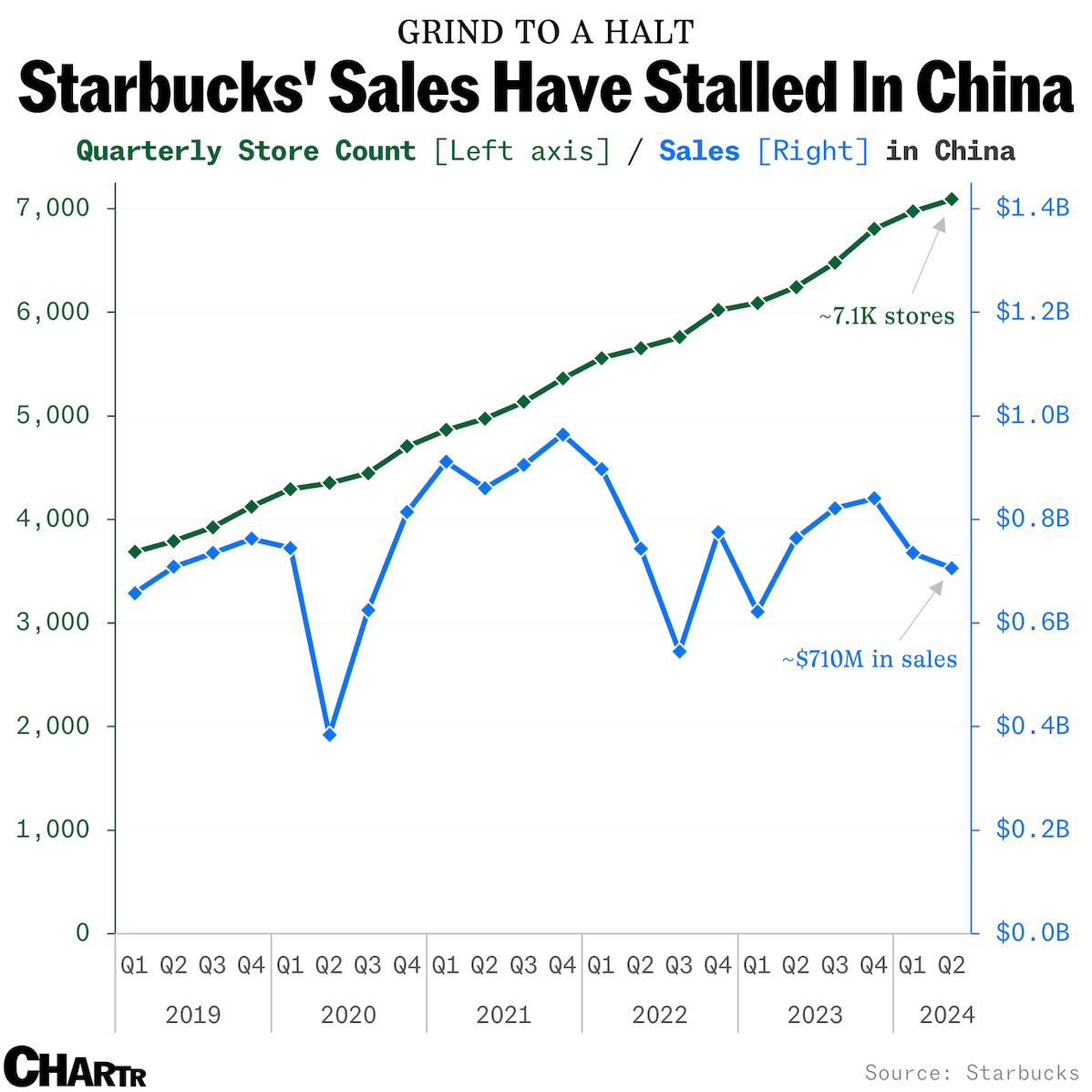
Starbucks keeps opening stores in China, but sales haven’t grown

Starbucks shares are trading near a 2-year low this morning, after a Q2 earnings report where revenues sank 2% and net income plummeted 15% — largely due to same-store sales, which dropped for the first time since 2020, particularly in China where the metric was down 11% year-on-year

It turns out that Starbucks’ ability to sell coffee in China is almost as bad as its attempts to get your name right on their cups. Although, unlike baristas’ hurried efforts to scribble Ian or Ashlyn on the side of espresso vessels, no one can accuse the chain of not trying in the Chinese market…

Venti frustrations

Starbucks’ global expansion goals have been going full steam ahead in recent years, having reported plans to open the equivalent of 8 stores around the world every day until 2030, and China — with its affluent and increasingly caffeine-addicted middle class — has long been at the center of those growth efforts. However, it seems that the company’s famous green Siren still has a lot of work to do to entice Chinese customers away from local competitors like Luckin Coffee, which continues to go from strength to strength.

Despite adding a whopping 850 stores in the country since Q2 ‘23, not to mention a pork-flavored latte for Lunar New Year, Starbucks’ revenue in the region has been flatlining. In fact, if you look back 5 years, the company has nearly doubled its stores in the region. Sales over that time frame? Down 0.4%.

Even so, the chain still seems convinced that China will come around to the brand, with ambitions to hit 9,000 stores in the region by 2025.

Related reading: Starbucks’ untapped investing potential.

More Business

See all Business
The entrance of Allbirds seen from Hayes St. in San Francisco, Calif.

Allbirds, the once buzzy multibillion-dollar sneaker startup, is selling up for $39 million

That’s less than 1% of its peak market cap about four years ago.

Tom Jones3/31/26
business

JetBlue is raising its bag fees as fuel costs squeeze airlines

JetBlue will reportedly hike its bag fees, as the cost of jet fuel continues to climb amid the war in Iran. It’s the latest example of carriers finding ways to push rising costs onto travelers.

Last week, United Airlines CEO Scott Kirby said that if fuel prices remain elevated, fares would need to rise another 20% for his airline to break even this year.

As CNBC reported, when one airline raises fees, others tend to follow.

Earlier this month, JetBlue hiked its first-quarter outlook for operating revenue per seat mile to between 5% and 7%, saying that strong Q1 demand helped “partially offset additional expenses realized from operational disruptions and rising fuel costs.” Now, the carrier appears to be making moves to further boost revenue to offset those costs.

Earlier on Monday, JetBlue rival Alaska Air lowered its Q1 profit forecast. The refining margins for the carrier’s cheapest fuel option — sourced from Singapore and representing about 20% of Alaska’s overall supply — have spiked 400% since February.

JetBlue did not immediately respond to a request for comment.

As CNBC reported, when one airline raises fees, others tend to follow.

Earlier this month, JetBlue hiked its first-quarter outlook for operating revenue per seat mile to between 5% and 7%, saying that strong Q1 demand helped “partially offset additional expenses realized from operational disruptions and rising fuel costs.” Now, the carrier appears to be making moves to further boost revenue to offset those costs.

Earlier on Monday, JetBlue rival Alaska Air lowered its Q1 profit forecast. The refining margins for the carrier’s cheapest fuel option — sourced from Singapore and representing about 20% of Alaska’s overall supply — have spiked 400% since February.

JetBlue did not immediately respond to a request for comment.

Latest Stories

Sherwood Media, LLC produces fresh and unique perspectives on topical financial news and is a fully owned subsidiary of Robinhood Markets, Inc., and any views expressed here do not necessarily reflect the views of any other Robinhood affiliate, including Robinhood Markets, Inc., Robinhood Financial LLC, Robinhood Securities, LLC, Robinhood Crypto, LLC, Robinhood Derivatives, LLC, or Robinhood Money, LLC. Futures and event contracts are offered through Robinhood Derivatives, LLC.