Business
Cartoon of multiple rockets in space
(Getty Images)
Rocket-fueled

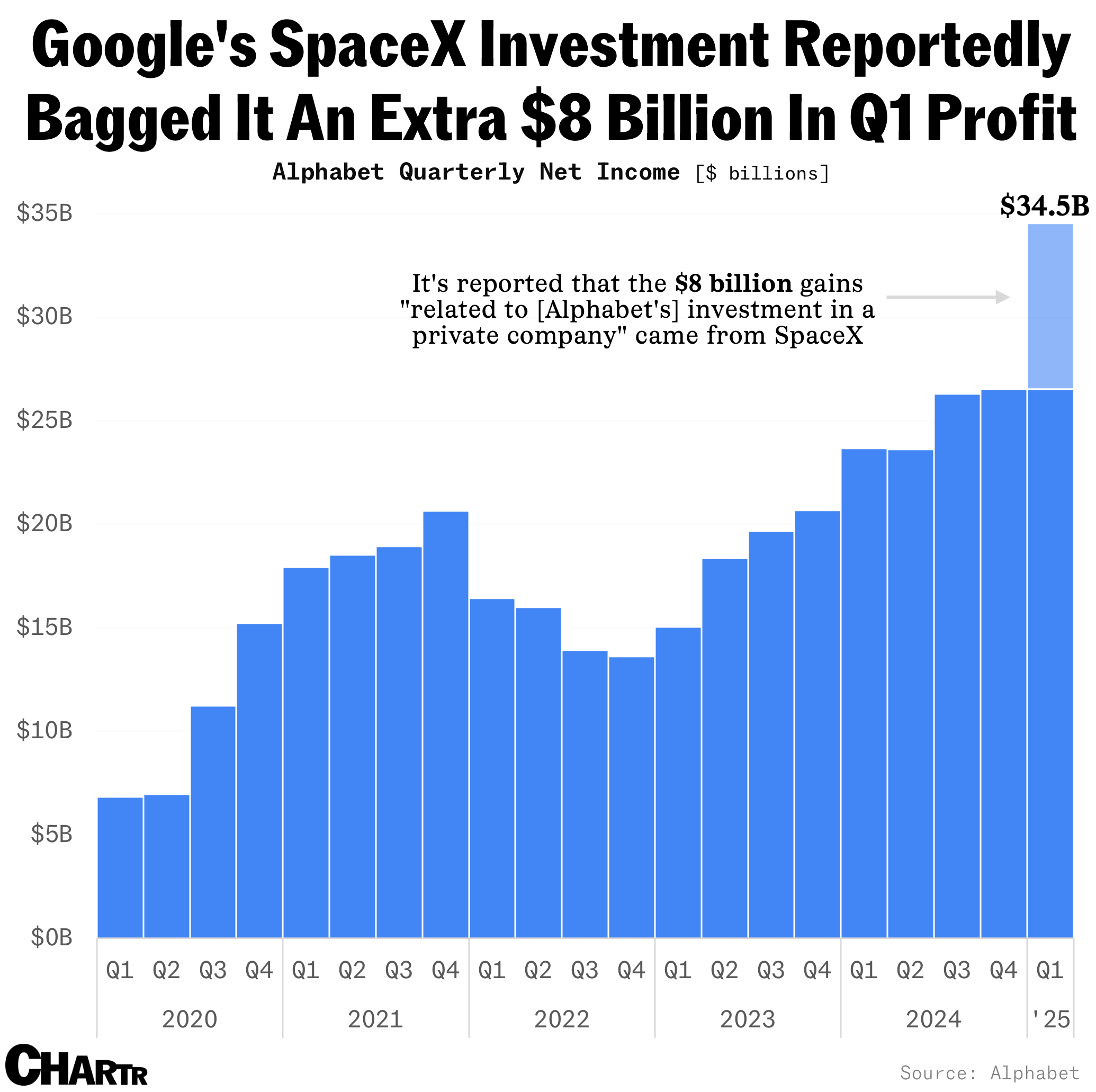
Nearly 25% of Google’s Q1 net income reportedly came from its SpaceX investment

Unrealized gains from an investment in an unnamed private company gave Alphabet an $8 billion boost.

Tom Jones

Last night and into this morning, Alphabet investors have been cheering yesterday’s big earnings beat after the tech giant posted revenue and earnings-per-share figures that surpassed Wall Street expectations for the first quarter of the year. 

While there were a handful of big numbers in the Google parent company’s earnings for shareholders to get stoked about, like Google Cloud revenue jumping 28% year over year to hit $12.3 billion, or YouTube ad revenue climbing 10% in the same period, one figure fell a little by the wayside in the excitement. From the report

Net Gain on Equity Securities

OI&E of $11.2 billion for the three months ended March 31, 2025 included an $8.0 billion unrealized gain on our non-marketable equity securities related to our investment in a private company.”

The mysterious, unnamed private company that added an extra $8 billion to the search behemoth’s bottom line in Q1? Elon Musk’s SpaceX, per Bloomberg reporting

Alphabet net income SpaceX boost
Sherwood News

We have liftoff

In December, it was reported that the valuation of Musk’s private rocket company had soared by almost $100 billion in just one month, reaching $350 billion after its latest round of employee share purchases. That was good news for Musk, certainly, whose stake in SpaceX outweighed his Tesla shares on paper in February, but also for other big investors in the 23-year-old business, not least Google.

In early 2015 — months before cofounder Larry Page had even announced the formation of Alphabet as Google’s parent company — the business made a joint $1 billion investment in SpaceX alongside Fidelity, giving the two a combined ~10% stake in Musk’s company, which was “exploring new ways to connect people to the internet” at the time. Those ambitions would be realized down the line with Starlink’s growing fleet, while Google’s 2015 investment in the rocket business is clearly still paying off a decade later.

More Business

See all Business
Daily Life In Warsaw

Smartphones are 12% cheaper than last year, according to the latest inflation data... except they’re not

Phones are one of a few important categories that get quality, or “hedonic,” adjustments in the Consumer Price Index — which make their price go down in the official statistics.

business

Texas sues Netflix, accusing streamer of spying on children and collecting user data without consent

The state of Texas filed a lawsuit Monday against streaming giant Netflix, alleging that the company has built a “behavioral-surveillance program of staggering scale.”

The suit alleges that Netflix is “deceptively designed” to be addictive, using features like autoplay to get viewers hooked, “mining those users for data, and then converting that data into lucrative intelligence for global advertising juggernauts.”

“When you watch Netflix, Netflix watches you,” the lawsuit reads.

“This lawsuit lacks merit and is based on inaccurate and distorted information,” Netflix said in a statement to Sherwood News. “Netflix takes our members’ privacy seriously and complies with privacy and data‑protection laws everywhere we operate.”

Texas is seeking civil penalties of “up to $10,000 per violation” of the Texas Deceptive Trade Practices-Consumer Protection Act, along with an additional penalty of up to $250,000 per violation involving a consumer aged 65 or older.

“Netflix is not the ad-free and kid-friendly platform it claims to be. Instead, it has misled consumers while exploiting their private data to make billions,” said Texas Attor­ney Gen­er­al Ken Pax­ton in the press release announcing the lawsuit.

Netflix did not immediately respond to a request for comment.

“This lawsuit lacks merit and is based on inaccurate and distorted information,” Netflix said in a statement to Sherwood News. “Netflix takes our members’ privacy seriously and complies with privacy and data‑protection laws everywhere we operate.”

Texas is seeking civil penalties of “up to $10,000 per violation” of the Texas Deceptive Trade Practices-Consumer Protection Act, along with an additional penalty of up to $250,000 per violation involving a consumer aged 65 or older.

“Netflix is not the ad-free and kid-friendly platform it claims to be. Instead, it has misled consumers while exploiting their private data to make billions,” said Texas Attor­ney Gen­er­al Ken Pax­ton in the press release announcing the lawsuit.

Netflix did not immediately respond to a request for comment.

Latest Stories

Sherwood Media, LLC and Chartr Limited produce fresh and unique perspectives on topical financial news and are fully owned subsidiaries of Robinhood Markets, Inc., and any views expressed here do not necessarily reflect the views of any other Robinhood affiliate, including Robinhood Markets, Inc., Robinhood Financial LLC, Robinhood Securities, LLC, Robinhood Crypto, LLC, Robinhood Money, LLC, Robinhood U.K. Ltd, Robinhood Derivatives, LLC, Robinhood Gold, LLC, Robinhood Asset Management, LLC, Robinhood Credit, Inc., Robinhood Ventures DE, LLC and, where applicable, its managed investment vehicles.