

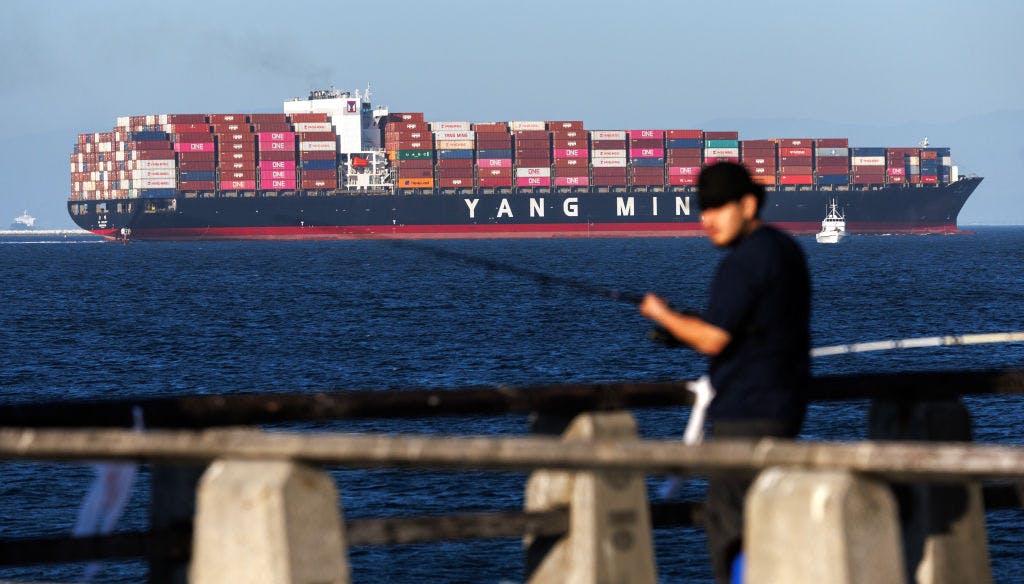
Shipping costs have tripled on increasingly dangerous seas
Retailers will have to choose between squeezing their margins or crushing their customers.
It costs more to send products overseas than it has in nearly two years, once again exposing a shaky supply chain rattled by insatiable consumers and geopolitical tensions.
As of this week, it costs an average of about $4,500 to ship a 40-foot shipping container overseas, according to the Freightos shipping index. That’s three times the cost of a year ago, when it cost roughly $1,500 to ship the same container.
It’s particularly expensive to ship from Asia to Europe: It costs nearly $7,000 to send a 40-foot container on that route, up from $1,500 a year ago, according to Xeneta, a Norwegian freight analytics company. That spike appears to be driven by a wave of attacks on commercial ships by Houthi rebels in the Red Sea and Suez Canal, creating a choke in an area that handles 12% of global trade.
Consumer demand is the primary driver of the overall increased ocean shipping rates, said Nathan Strang, director of ocean freight at Flexport. Attacks, droughts, and tariffs have only amplified the issue.
“Unfortunately for most shippers, the decision to ship is inelastic,” he said. “That is, they need to ship their goods in order to get them to market, to sell them. The company is then faced with the choice of passing through that cost to the end consumer, or absorbing the cost against their revenues.”
While shipping rates are abnormally high, they are still far behind what they were during the global shipping crisis. At its height in September 2021, it cost more than $11,000 it cost to ship a 40-foot container.
And despite recent history, companies didn’t diversify their shipping strategies, prioritizing cutting costs instead, Strang said.
“We have not seen as much diversification in supply chains as we would have expected coming out of the pandemic,” he said.
FedEx reported seeing an increase in demand for international air cargo from Asia. Its stock price is up about 15% after it beat analyst estimates on earnings and revenue. While shipping merchandise on planes is generally more expensive, air freight rates have been less volatile than ocean freight.



