
Business
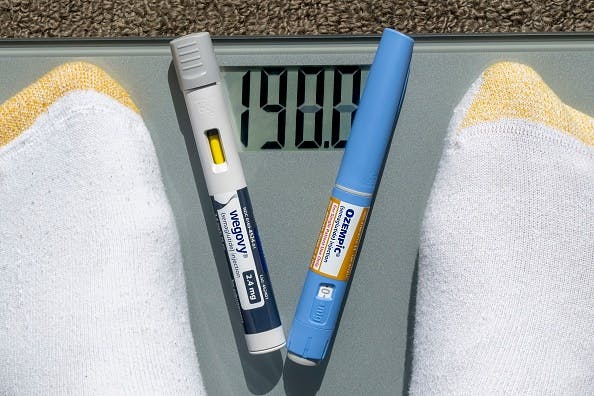
Still life of Ozempic and Wegovy with weight scale.
(Michael Siluk/Getty Images)

Is Ozempic old news?

The race to create the next miracle weight-loss drug is ramping up. Here’s where things stand.

Ozempic, a drug developed by Novo Nordisk to treat type 2 diabetes, entered the market in December 2017. Then people without diabetes learned it’s really good at making people lose weight.

Next came the celebrity Ozempic allegations, a weight-loss cheat code only the rich and famous could afford. Fast-forward to now: about 13% of adults have taken a GLP-1 medication, a class of drugs of which Ozempic is the most well known.

But Ozempic’s dominance is fleeting. Its patent expires in 2031 and Novo Nordisk wants to keep its place as the dominant weight-loss drug dealer as competition is heating up.

The company’s stock has recently taken a beating after the most recent clinical trials for its next weight-loss drug, CagriSema, fell short of expectations. Its shares fell even further after Swiss pharmaceutical giant Roche announced Wednesday that it had struck a $5.3 billion deal to develop Danish biotech Zealand Pharma’s obesity drug candidate, further ramping up competition.

Who sells GLP-1s?

Besides Ozempic, which is for diabetes, Novo Nordisk also sells Wegovy, which has the same active ingredient as Ozempic, semaglutide, but can be prescribed explicitly for weight loss. The company made nearly $15 billion selling those two drugs alone in 2024.

Then there’s Eli Lilly, which sells Mounjaro and Zepbound; the first is for diabetes, the latter is for weight loss. Both have the active ingredient tirzepatide. These drugs entered the market in 2022 and are more effective than Novo Nordisk’s. Eli Lilly’s patent on tirzepatide expires in 2036.

GLP-1s, which work by mimicking a hormone that causes reduced appetite, have been around since 2005. Both Novo Nordisk and Eli Lilly have older, less effective GLP-1s with recently expired patents. Hims & Hers, a telepharmacy that sold knock-off Ozempic while it was in a shortage, said it would sell Novo Nordisk’s older GLP-1 drug, liraglutide.

Who’s making the next GLP-1 jab?

Once drugmakers saw the money to be made in weight-loss drugs, more have tried to develop their own while Novo Nordisk and Eli Lilly try to improve on their current offerings.

Amgen is developing its own GLP-1 jab, MariTide, which would be administered once a month compared to the weekly injections currently on the market. Its most recent trial results in November showed that its effectiveness was in line with Wegovy and Zepbound, though not much better, disappointing investors.

Novo Nordisk is developing CagriSema (the one that recently produced disappointing clinical results), a jab that combines semaglutide with another compound, cagrilintide.

I’m scared of needles. What’s the state of oral GLP-1s?

Most people would rather not inject themselves, it turns out. Several companies have tried to make oral GLP-1s but have failed, including Pfizer and Roche.

Novo Nordisk is the only company with a GLP-1 pill on the market, Rybelsus, an oral form of semaglutide. Rybelsus is a daily pill that must be taken on an empty stomach rather than weekly injections, but it’s only approved to treat diabetes and some say it’s less effective.

Eli Lilly’s GLP-1 pill, Orforglipron, is in late-stage trials with final results expected mid-2025. Orforglipron can be taken on a more flexible schedule and may be more effective at delivering weight-loss results than Rybelsus. The company’s CEO, Dave Ricks, told Bloomberg he expects FDA approval in early 2026.

More Business

See all Business
business

Netflix is down amid reports it’s leading the Warner Bros. bidding war as Paramount cries foul

Netflix’s charm offensive appears to be working.

Netflix is reportedly emerging as the leader in the bidding war for Warner Bros. Discovery after second-round bids this week, edging out entertainment juggernaut rivals Comcast and Paramount Skydance.

Investors don’t appear psyched by the streaming leader’s turn of fortune: the stock is down on Thursday morning, a day after closing down nearly 5% following reports that scooping up HBO Max wouldn’t necessarily result in a big market share boost.

Paramount, which has reportedly made five bids for Warner Bros. Discovery, doesn’t love the current state of play, either. The company sent WBD a letter questioning the “fairness and adequacy” of the process, highlighting reports that WBD’s board favors Netflix and is resisting Paramount.

Any offer would be subject to regulatory approval — a fact that may have weighed against Netflix’s offer given that cofounder Reed Hastings’ politics are vocally to the left, very much at odds with the current regulatory regime. Paramount seems confident in its ability to get approval, reportedly boosting its breakup fee to $5 billion should its potential acquisition fall apart in the regulatory process.

Investors don’t appear psyched by the streaming leader’s turn of fortune: the stock is down on Thursday morning, a day after closing down nearly 5% following reports that scooping up HBO Max wouldn’t necessarily result in a big market share boost.

Paramount, which has reportedly made five bids for Warner Bros. Discovery, doesn’t love the current state of play, either. The company sent WBD a letter questioning the “fairness and adequacy” of the process, highlighting reports that WBD’s board favors Netflix and is resisting Paramount.

Any offer would be subject to regulatory approval — a fact that may have weighed against Netflix’s offer given that cofounder Reed Hastings’ politics are vocally to the left, very much at odds with the current regulatory regime. Paramount seems confident in its ability to get approval, reportedly boosting its breakup fee to $5 billion should its potential acquisition fall apart in the regulatory process.

business

Delta says the government shutdown will cost it $200 million in Q4

The 43-day government shutdown that ended last month will result in a $200 million ding for Delta Air Lines, the airline said in a filing on Wednesday.

That’s about $100,000 per shutdown-related canceled flight. (Delta previously said it canceled more than 2,000 flights due to FAA flight reductions.) When the company reports its fourth-quarter earnings, the shutdown will lop off about $0.25 per share.

Delta initially stayed calm about the shutdown, with CEO Ed Bastian stating in early October that the company was running smoothly and hadn’t seen any impacts at all. One historically long shutdown later, Delta wasn’t able to remain untouched.

The skies have since cleared, though, and Delta’s filing states that booking growth has “returned to initial expectations following a temporary softening in November.”

Delta’s shares were up over 2% as of Wednesday’s market open.

Delta initially stayed calm about the shutdown, with CEO Ed Bastian stating in early October that the company was running smoothly and hadn’t seen any impacts at all. One historically long shutdown later, Delta wasn’t able to remain untouched.

The skies have since cleared, though, and Delta’s filing states that booking growth has “returned to initial expectations following a temporary softening in November.”

Delta’s shares were up over 2% as of Wednesday’s market open.

Latest Stories

Sherwood Media, LLC produces fresh and unique perspectives on topical financial news and is a fully owned subsidiary of Robinhood Markets, Inc., and any views expressed here do not necessarily reflect the views of any other Robinhood affiliate, including Robinhood Markets, Inc., Robinhood Financial LLC, Robinhood Securities, LLC, Robinhood Crypto, LLC, or Robinhood Money, LLC.