Business
UK Daily Life 2024
John Keeble via Getty Images

Rightmove, the British equivalent of Zillow, is wildly profitable

Which is why Rupert Murdoch-backed REA Group wants to acquire it so badly, making its 4th offer after 3 rejections

The UK’s largest online property portal, Rightmove, has now turned down three acquisition offers from the Murdoch-owned REA Group and, as of this morning, has just received a fourth. The latest bid values the company at £6.2 billion ($8.7 billion) — roughly an 11% bump on the initial offer first received on September 11th, per Bloomberg.

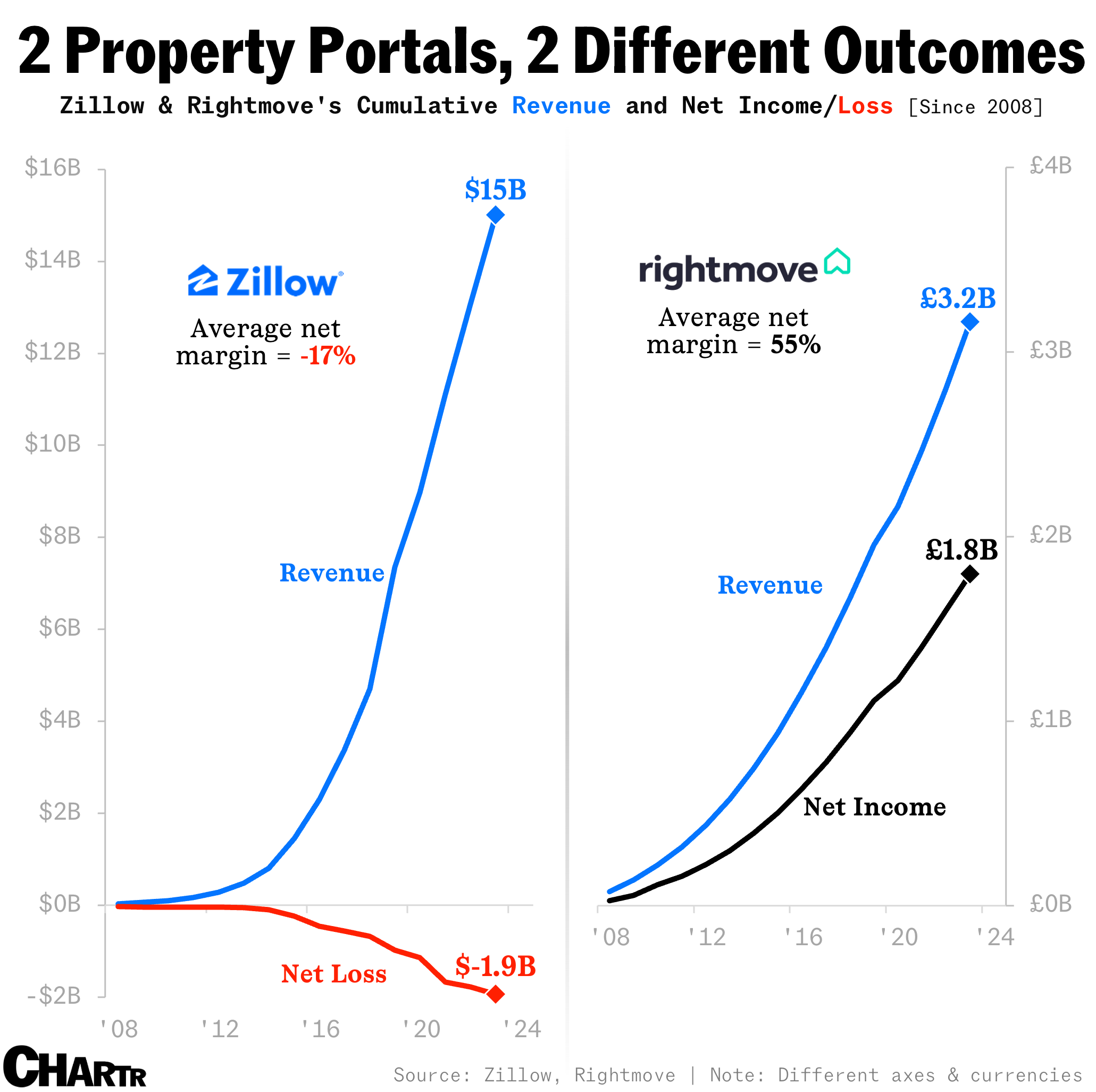
While Rightmove might not be a household name for Americans, most would be familiar with what it offers: a platform for realtors to list properties, where would-be buyers can browse to their heart’s content, like Zillow or its rivals such as Realtor.com or Redfin. But, despite similar products, Zillow and Rightmove’s financials are wildly different.
Zillow vs. Rightmove
Sherwood News

Although Zillow's cumulative revenue of $15 billion over the past decade-and-a-half greatly exceeds Rightmove's £3.2 billion ($4.3 billion), the British company has something else to show for its efforts: billions in profit. Indeed, Rightmove is a cash-producing machine, whereas Zillow has racked up loss after loss since going public in 2011. Last year, the UK company reported a staggering 55% net profit margin and an even more remarkable 71% underlying operating profit margin.

So, how is Rightmove so profitable, and Zillow so unprofitable.

Arguably the main factor is simply that Zillow has a lot more competition, while Rightmove is highly dominant in the UK, with an estimated market share of some 80%, helping it keep both the largest audience and the most listings, in a virtuous circle. It does this with just ~800 employees. Australian-based REA Group is also highly profitable.

Zillow, however, faces more substantial competition, and because of the sheer size of the US, the market is naturally a bit more regional. According to data from Similarweb, Zillow’s website got 357 million visits in August 2024. Realtor.com got 139 million and Redfin.com got 105 million.

Of course, the fact that Zillow’s home flipping project, which attempted to use data to buy houses, failed miserably and cost the company hundreds of millions of dollars hasn’t helped its bottom line.

More Business

See all Business
business
Tom Jones

Demis Hassabis, Google DeepMind’s CEO and founder, was also an early Anthropic investor

A chess prodigy and an actual a knight of the realm in the UK, it’s perhaps no surprise that Demis Hassabis has made some strategic moves about his exposure to AI upside. According to people familiar with the matter, the influential AI architect became an angel investor in Anthropic, currently behind many of the leading AI models, per Arena AI leaderboards.

The Nobel Prize winner’s position in the Claude creator was previously undisclosed and, per the Financial Times, highlights Hassabis’ “growing influence across the AI industry.”

Google, which bought DeepMind, the company that Hassabis cofounded and heads to this day, for a reported ~$400 million in 2014, is also a key Anthropic investor. The tech giant reportedly plans to invest up to $40 billion in the AI company as part of the mutually beneficial relationship the pair have forged, with reports that Anthropic has committed to spending $200 billion in the other direction on Google’s cloud services over the next five years.

Im playing all sides, so I always come out on top

In addition to his financial support for Anthropic, Hassabis has also invested in a range of AI startups launched by colleagues, such as Inflection AI, a company set up by DeepMind cofounder Mustafa Suleyman (who is now CEO of Microsoft AI), as well as efforts from other collaborators, like David Silver’s Ineffable Intelligence.

Hassabis also emerged as a recurring figure on the fringes of the recent Elon Musk v. Sam Altman trial, cropping up repeatedly in testimonies and court documents and appearing to live, as The Verge put it, “rent-free” in Musk’s head.

Founded in 2021, Anthropic has recently raised funding at a reported $900 billion valuation, sending it soaring ahead of competitor OpenAI.

The Nobel Prize winner’s position in the Claude creator was previously undisclosed and, per the Financial Times, highlights Hassabis’ “growing influence across the AI industry.”

Google, which bought DeepMind, the company that Hassabis cofounded and heads to this day, for a reported ~$400 million in 2014, is also a key Anthropic investor. The tech giant reportedly plans to invest up to $40 billion in the AI company as part of the mutually beneficial relationship the pair have forged, with reports that Anthropic has committed to spending $200 billion in the other direction on Google’s cloud services over the next five years.

Im playing all sides, so I always come out on top

In addition to his financial support for Anthropic, Hassabis has also invested in a range of AI startups launched by colleagues, such as Inflection AI, a company set up by DeepMind cofounder Mustafa Suleyman (who is now CEO of Microsoft AI), as well as efforts from other collaborators, like David Silver’s Ineffable Intelligence.

Hassabis also emerged as a recurring figure on the fringes of the recent Elon Musk v. Sam Altman trial, cropping up repeatedly in testimonies and court documents and appearing to live, as The Verge put it, “rent-free” in Musk’s head.

Founded in 2021, Anthropic has recently raised funding at a reported $900 billion valuation, sending it soaring ahead of competitor OpenAI.

business

Jury rules against Musk in lawsuit against OpenAI and Altman

Jurors in Tesla CEO Elon Musk’s lawsuit against Sam Altman, Greg Brockman, and OpenAI found the defendants not liable on all claims on Monday.

In a unanimous verdict reached after less than two hours of deliberation, the Oakland jury found that Musk had waited too long to bring his case forward, exceeding the statute of limitations.

Musk had alleged that OpenAI abandoned its founding mission as a nonprofit dedicated to developing AI for humanity and instead became a profit-driven company closely tied to Microsoft.

The verdict caps off a three-week blockbuster tech trial that could have seen Altman and Brockman removed from OpenAI leadership.

Musk had alleged that OpenAI abandoned its founding mission as a nonprofit dedicated to developing AI for humanity and instead became a profit-driven company closely tied to Microsoft.

The verdict caps off a three-week blockbuster tech trial that could have seen Altman and Brockman removed from OpenAI leadership.

Latest Stories

Sherwood Media, LLC and Chartr Limited produce fresh and unique perspectives on topical financial news and are fully owned subsidiaries of Robinhood Markets, Inc., and any views expressed here do not necessarily reflect the views of any other Robinhood affiliate, including Robinhood Markets, Inc., Robinhood Financial LLC, Robinhood Securities, LLC, Robinhood Crypto, LLC, Robinhood Money, LLC, Robinhood U.K. Ltd, Robinhood Derivatives, LLC, Robinhood Gold, LLC, Robinhood Asset Management, LLC, Robinhood Credit, Inc., Robinhood Ventures DE, LLC and, where applicable, its managed investment vehicles.