Business
Sweetgreen fries
Screenshot courtesy of Sweetgreen.com
Potato salad?

Sweetgreen has been losing millions selling $16 salads — maybe fries will help it turn a profit?

The fast-casual lunch spot is making ripples with its latest launch, but the company’s profit margins still aren’t in the green.

Millie Giles

Having shot to office worker lunch fame off the back of premium salad offerings, Sweetgreen has just addressed a burning question belying its usual bowls of shredded kale and herbed quinoa: do you want fries with that?

On Tuesday, the salad maker announced the launch of “Ripple Fries,” an air-fried (read: rapidly baked) potato product made with only five simple ingredients, described by Sweetgreen as “a fresh take on a fast food staple.” Indeed, Sweetgreen’s fries notch only 240 calories per portion — around 161 fewer calories than the same weighted amount of McDonald’s fries.

But will the humble french fry finally be what tips Sweetgreen into profitability, something that even robot chefs and steak salads have yet to achieve thus far?

Potayto, potahto

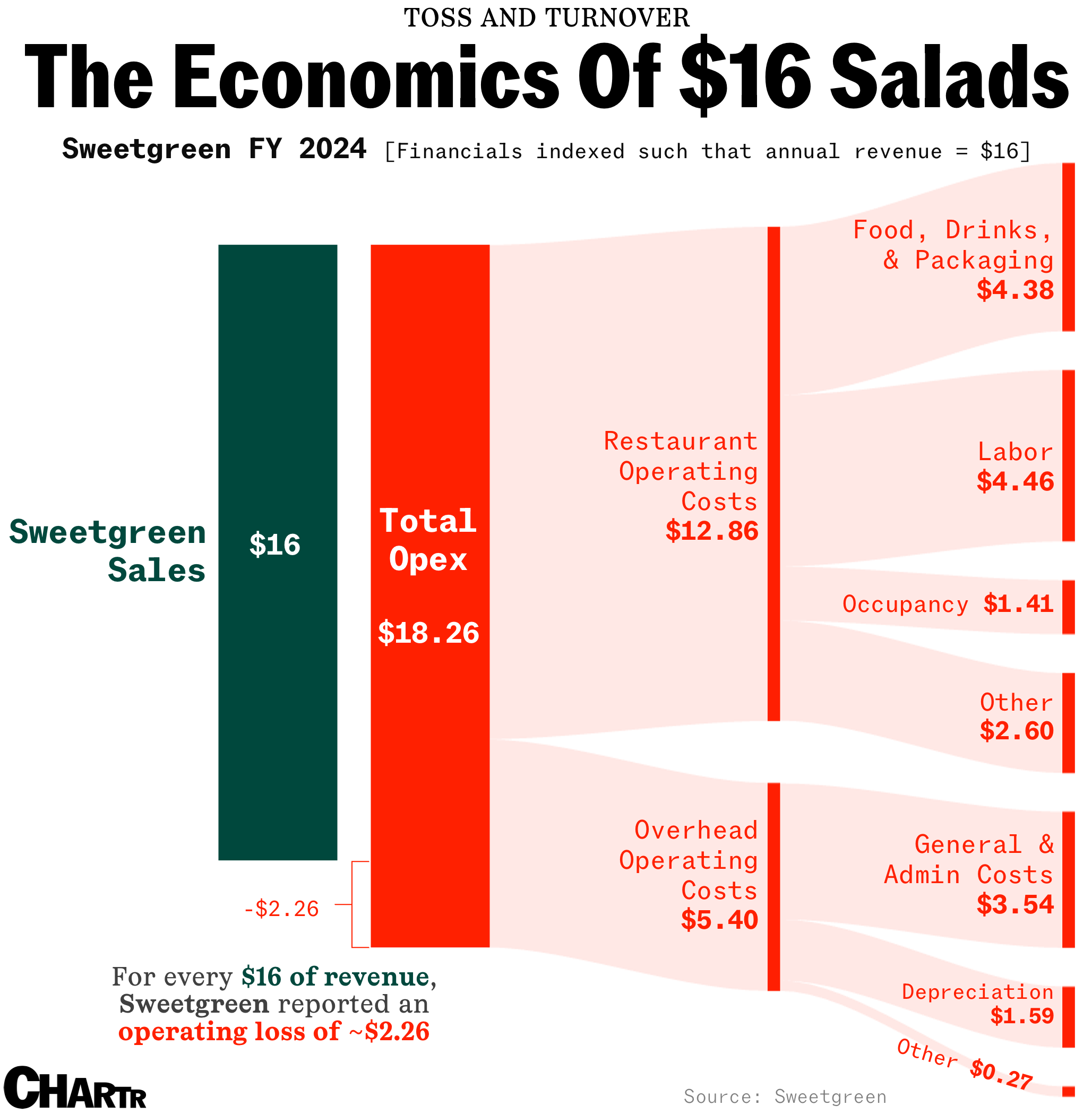
Sweetgreen’s annual report for fiscal year 2024, which disappointed investors last week, showed that despite some of its base menu items touching nearly $18 and the company’s revenues soaring to $677 million (up 16% year on year), the fast-casual restaurant chain still made a ~$90 million net loss. To put this into perspective, by indexing Sweetgreen’s earnings to $16, roughly the average cost of a meal item at the chain, you can see that the company lost about $2.26 for each typical salad it sold in 2024.
Sweetgreen-economics-2024
Sherwood News

Still, it might take something of a bigger fry to impress investors: Sweetgreen was down almost 1% after the announcement at yesterday’s close, adding to what has been a miserable month for the stock, which has shed 34% of its value since early February.

Girl dinner… Sweetgreen might have been inspired by one of last summer’s viral food trends for its frites dispatch. Online hype surrounding the “ultimate girl dinner” — namely a Caesar salad, fries, and a Diet Coke — saw TikTok posts featuring these items rocket to over 60 million in total last June.

More Business

See all Business
Daily Life In Warsaw

Smartphones are 12% cheaper than last year, according to the latest inflation data... except they’re not

Phones are one of a few important categories that get quality, or “hedonic,” adjustments in the Consumer Price Index — which make their price go down in the official statistics.

business

Texas sues Netflix, accusing streamer of spying on children and collecting user data without consent

The state of Texas filed a lawsuit Monday against streaming giant Netflix, alleging that the company has built a “behavioral-surveillance program of staggering scale.”

The suit alleges that Netflix is “deceptively designed” to be addictive, using features like autoplay to get viewers hooked, “mining those users for data, and then converting that data into lucrative intelligence for global advertising juggernauts.”

“When you watch Netflix, Netflix watches you,” the lawsuit reads.

“This lawsuit lacks merit and is based on inaccurate and distorted information,” Netflix said in a statement to Sherwood News. “Netflix takes our members’ privacy seriously and complies with privacy and data‑protection laws everywhere we operate.”

Texas is seeking civil penalties of “up to $10,000 per violation” of the Texas Deceptive Trade Practices-Consumer Protection Act, along with an additional penalty of up to $250,000 per violation involving a consumer aged 65 or older.

“Netflix is not the ad-free and kid-friendly platform it claims to be. Instead, it has misled consumers while exploiting their private data to make billions,” said Texas Attor­ney Gen­er­al Ken Pax­ton in the press release announcing the lawsuit.

Netflix did not immediately respond to a request for comment.

“This lawsuit lacks merit and is based on inaccurate and distorted information,” Netflix said in a statement to Sherwood News. “Netflix takes our members’ privacy seriously and complies with privacy and data‑protection laws everywhere we operate.”

Texas is seeking civil penalties of “up to $10,000 per violation” of the Texas Deceptive Trade Practices-Consumer Protection Act, along with an additional penalty of up to $250,000 per violation involving a consumer aged 65 or older.

“Netflix is not the ad-free and kid-friendly platform it claims to be. Instead, it has misled consumers while exploiting their private data to make billions,” said Texas Attor­ney Gen­er­al Ken Pax­ton in the press release announcing the lawsuit.

Netflix did not immediately respond to a request for comment.

Latest Stories

Sherwood Media, LLC and Chartr Limited produce fresh and unique perspectives on topical financial news and are fully owned subsidiaries of Robinhood Markets, Inc., and any views expressed here do not necessarily reflect the views of any other Robinhood affiliate, including Robinhood Markets, Inc., Robinhood Financial LLC, Robinhood Securities, LLC, Robinhood Crypto, LLC, Robinhood Money, LLC, Robinhood U.K. Ltd, Robinhood Derivatives, LLC, Robinhood Gold, LLC, Robinhood Asset Management, LLC, Robinhood Credit, Inc., Robinhood Ventures DE, LLC and, where applicable, its managed investment vehicles.