

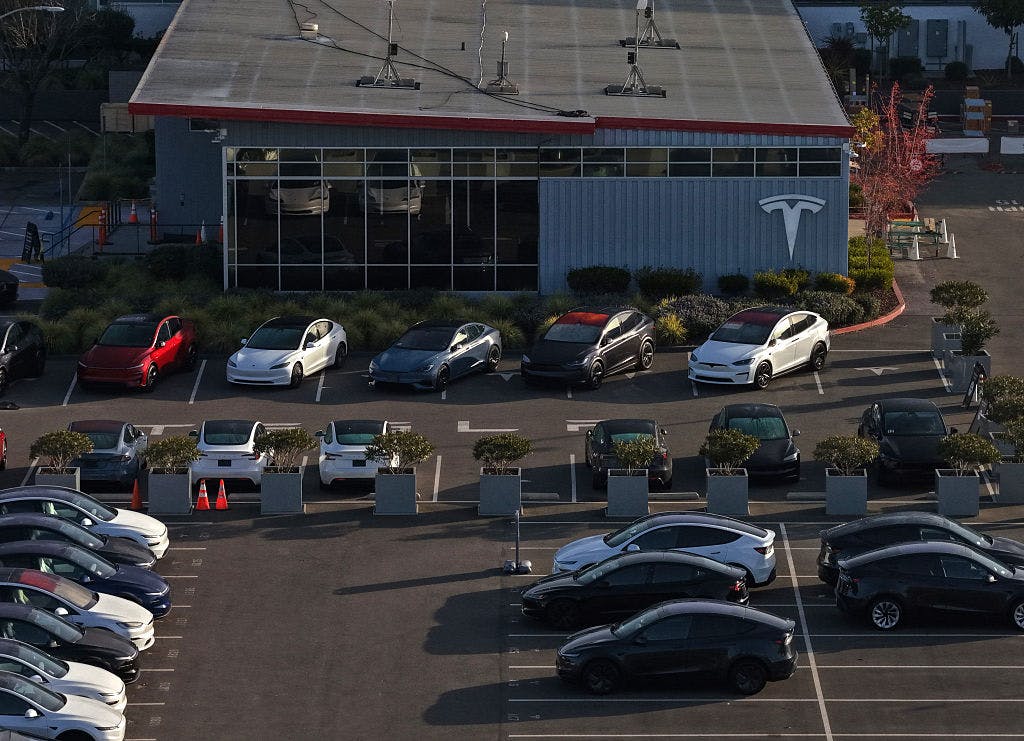
The economics of Tesla the company are still all about cars. The economics of Tesla the stock are not.
The company is ditching some of its EV models as it doubles down on robots, AI, energy, and self-driving.
For years, Elon Musk has insisted Tesla isn’t really a carmaker. Slowly but surely, that statement is getting more accurate.
On Wednesday, the Texas-based company posted its first-ever annual revenue decline, with 2025 revenue falling 3% to $94.8 billion. Behind the drop was a 10% dip in automotive revenue, as weaker EV demand pushed vehicle deliveries and average selling prices lower.
What helped cushion a bigger blow was Tesla’s Energy Generation and Storage segment, which sells solar gear and large batteries used to generate and store electricity for homes, EVs, businesses, and the power grid.
![The economics of Tesla [FY2025]](https://sherwoodnews.imgix.net/Economics-Of-Tesla-NEW-2.png)
A fast-growing part of Tesla, the Energy segment generated nearly $13 billion in revenue last year, up 27% from 2024, and now accounts for around 13% of the company’s total — more than double its share from just two years ago.
Still, Automotive makes up nearly three-quarters (73%) of Tesla’s business. And Musk would like that share to be replaced by sales from robots. On Wednesday, Musk said Tesla will wind down production of its two priciest EV models next quarter, converting that factory space to produce Optimus, its humanoid robot — though it won’t be commercially available until late 2027.
Meanwhile, Tesla’s Robotaxi service — launched last year in Austin and the Bay Area — is set to expand to additional cities and ultimately be supported by Cybercabs. Musk also hopes that selling its Full Self-Driving software to Tesla car owners, a product that’s becoming subscription-only, will boost its fortunes further. Reports even surfaced this week that Musk’s rocket company, SpaceX, is actually considering a merger with Tesla or xAI.
All of this reinvention, of course, comes at a cost. Tesla’s operating income fell 38% from a year earlier, and the company’s capital expenditure is set to soar this year — joining a raft of other tech companies that are splurging like never before. Still, Tesla’s $20 billion capex bill for 2026 looks positively cheap compared to Meta’s: the Instagram owner could spend as much as $135 billion on capex this year.



