
Tech
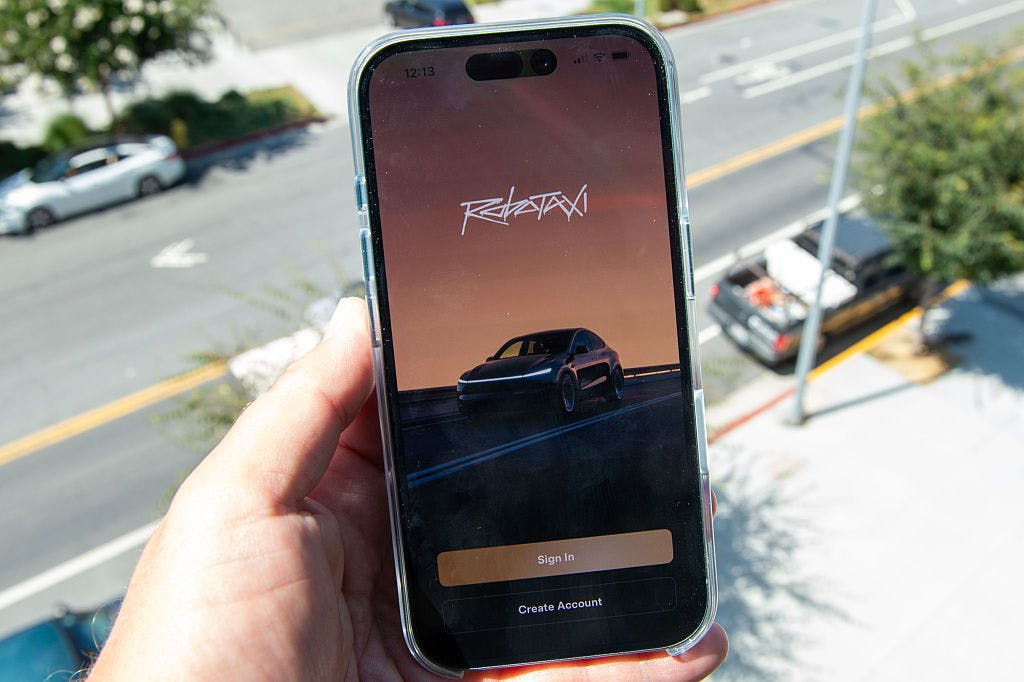
Tesla Robotaxi app person holding
Robotaxi customers are having to wait a bit longer for their rides (Andrej Sokolow/Getty Images)
Waitlist

Tesla Robotaxi demand outpacing supply in Austin and San Francisco

The service finally became available to the public this week.

Rani Molla

Would-be Tesla Robotaxi riders in Austin and the Bay Area are having trouble actually accessing the service, which just became open to the public, instead of invite-only, earlier this week. A number of users are receiving notifications that say, “High service demand. Please come back later,” according to screenshots they’ve sent to us or posted on social media.

When service is available, many are reporting wait times of 40 minutes or more to catch a ride in the autonomous and semi-autonomous vehicles. (They have a safety monitor in the passenger seat in Austin and a driver using supervised Full Self-Driving in the Bay Area.)

It seems demand for the service, whose app briefly neared the top of the App Store rankings when the waitlist became available in September, is outpacing supply.

When Tesla launched its service in Austin this summer, it started out with about 20 vehicles. It has since expanded to the Bay Area, where it operates a service with an unknown number of vehicles that’s more akin to Uber since a person is driving the car. Tesla hasn’t disclosed the current number of vehicles on the road in each market, but CEO Elon Musk recently said he expects there to be 500 in Austin and 1,000 in the Bay Area by the end of the year. For comparison, Google’s Waymo currently has more than 1,000 vehicles in the Bay Area and more than 100 in Austin.

Separately, Musk said on the company’s last earnings call that its Robotaxi service would expand into 8 to 10 markets this year, up from the two it’s currently in. Waymo is operational in five markets and has plans to expand to more than 20 markets.

Read More: Who has the wheel

Tesla’s Robotaxi service area in Austin is about 245 square miles, and in northern California, its coverage spans San Francisco down to San Jose and includes parts of East Bay. For now, however many vehicles it has in service isn’t cutting it.

Of course, scaling up is supposed to be easy for Tesla, whose CEO has repeatedly said much of the company’s existing consumer fleet, which numbers in the millions, could potentially convert to robotaxis at a moment’s notice.

“There are millions of cars out there that, with a software update, become Full Self-Driving cars,” Musk said on Tesla’s recent earnings call.


More Tech

See all Tech
US-TECHNOLOGY-AI-GOOGLE

Google DeepMind’s Hassabis: AGI is 3 to 4 years away

Google DeepMind CEO and Nobel Prize winner Demis Hassabis shortened his prediction for when the era of AGI would be upon us.

tech

Meta jumps after announcing paid subscriptions for Instagram, WhatsApp, Facebook, and AI

On Wednesday, Meta announced that it’s rolling out Meta One, a suite of paid versions of its most popular apps that offer extra features like profile customization, super reactions, and story insights. Instagram Plus and Facebook Plus will cost $3.99 a month, while WhatsApp Plus is going for $2.99, according to TechCrunch.

The company is also launching two AI subscription tiers — one for $7.99 and another for $19.99 for more advanced users. People can continue using the Meta AI chatbot for free, but will now run into limits.

Together, these represent Meta’s first large-scale attempt to monetize everyday consumer use of its flagship apps through subscriptions rather than relying solely on advertising.

The stock is up nearly 3% on the news.

Meta’s head of product, Naomi Gleit, said in an Instagram post that the company has “more plans on the way for creators, businesses, and Meta AI power users.”

Meta has struggled to justify its enormous AI capital expenditure to investors since it lacks the recurring cloud revenue of its peers. New subscription revenue streams could help reassure investors that Meta has additional ways to monetize its AI investments beyond advertising.

TechCrunch reported earlier this year that Meta had been testing premium subscriptions.

Together, these represent Meta’s first large-scale attempt to monetize everyday consumer use of its flagship apps through subscriptions rather than relying solely on advertising.

The stock is up nearly 3% on the news.

Meta’s head of product, Naomi Gleit, said in an Instagram post that the company has “more plans on the way for creators, businesses, and Meta AI power users.”

Meta has struggled to justify its enormous AI capital expenditure to investors since it lacks the recurring cloud revenue of its peers. New subscription revenue streams could help reassure investors that Meta has additional ways to monetize its AI investments beyond advertising.

TechCrunch reported earlier this year that Meta had been testing premium subscriptions.

37%

Uber raised its stake in Germany-based Delivery Hero to nearly 37%, up from the 19.5% the companies disclosed earlier this month, according to reporting by the Financial Times. The rapid share accumulation follows a takeover bid Uber extended to the struggling food delivery company over the weekend, offering essentially no premium over where the stock is trading, a move aimed at aggressively countering DoorDash in international markets.

DoorDash is also circling, with reports suggesting it is primarily interested in carving out Delivery Hero’s lucrative Middle Eastern businesses like Talabat and HungerStation.

tech

Anthropic’s revenue continues to surge, shooting past OpenAI

The drip, drip, drip of leaked financials from OpenAI and Anthropic is turning into a steady flow as the two AI giants jockey for position ahead of their planned IPOs later this year.

The companies’ soaring valuations and annualized recurring revenue (ARR) have been running neck and neck for months, and The Information now reports that Anthropic is generating an estimated 35% more revenue than OpenAI.

According to The Information’s reporting, Anthropic is close to a staggering $45 billion ARR, while OpenAI is at an estimated $33 billion ARR.

Anthropic Nears $45 billion in ARR
(Chartr)

Last month, Anthropic announced that its ARR had reached $30 billion — tripling since the end of 2025. That put it ahead of OpenAI’s $24 billion ARR, which the ChatGPT maker reported at the end of March.

Then last week it was reported that OpenAI held a $1 billion lead in Q1 revenue over Anthropic.

That $45 billion ARR is a whopping 5x the $9 billion Anthropic reported at the end of 2025.

According to The Information’s reporting, Anthropic is close to a staggering $45 billion ARR, while OpenAI is at an estimated $33 billion ARR.

Anthropic Nears $45 billion in ARR
(Chartr)

Last month, Anthropic announced that its ARR had reached $30 billion — tripling since the end of 2025. That put it ahead of OpenAI’s $24 billion ARR, which the ChatGPT maker reported at the end of March.

Then last week it was reported that OpenAI held a $1 billion lead in Q1 revenue over Anthropic.

That $45 billion ARR is a whopping 5x the $9 billion Anthropic reported at the end of 2025.

Latest Stories

Sherwood Media, LLC and Chartr Limited produce fresh and unique perspectives on topical financial news and are fully owned subsidiaries of Robinhood Markets, Inc., and any views expressed here do not necessarily reflect the views of any other Robinhood affiliate, including Robinhood Markets, Inc., Robinhood Financial LLC, Robinhood Securities, LLC, Robinhood Crypto, LLC, Robinhood Money, LLC, Robinhood U.K. Ltd, Robinhood Derivatives, LLC, Robinhood Gold, LLC, Robinhood Asset Management, LLC, Robinhood Credit, Inc., Robinhood Ventures DE, LLC and, where applicable, its managed investment vehicles.
