

Business
Newspaper in fire
Getty Images
print’s pressed

The LA Times’ owner wants to take the struggling newspaper public again

Subscribers, circulation, and staff numbers all slumped at the paper last year.

Tom Jones

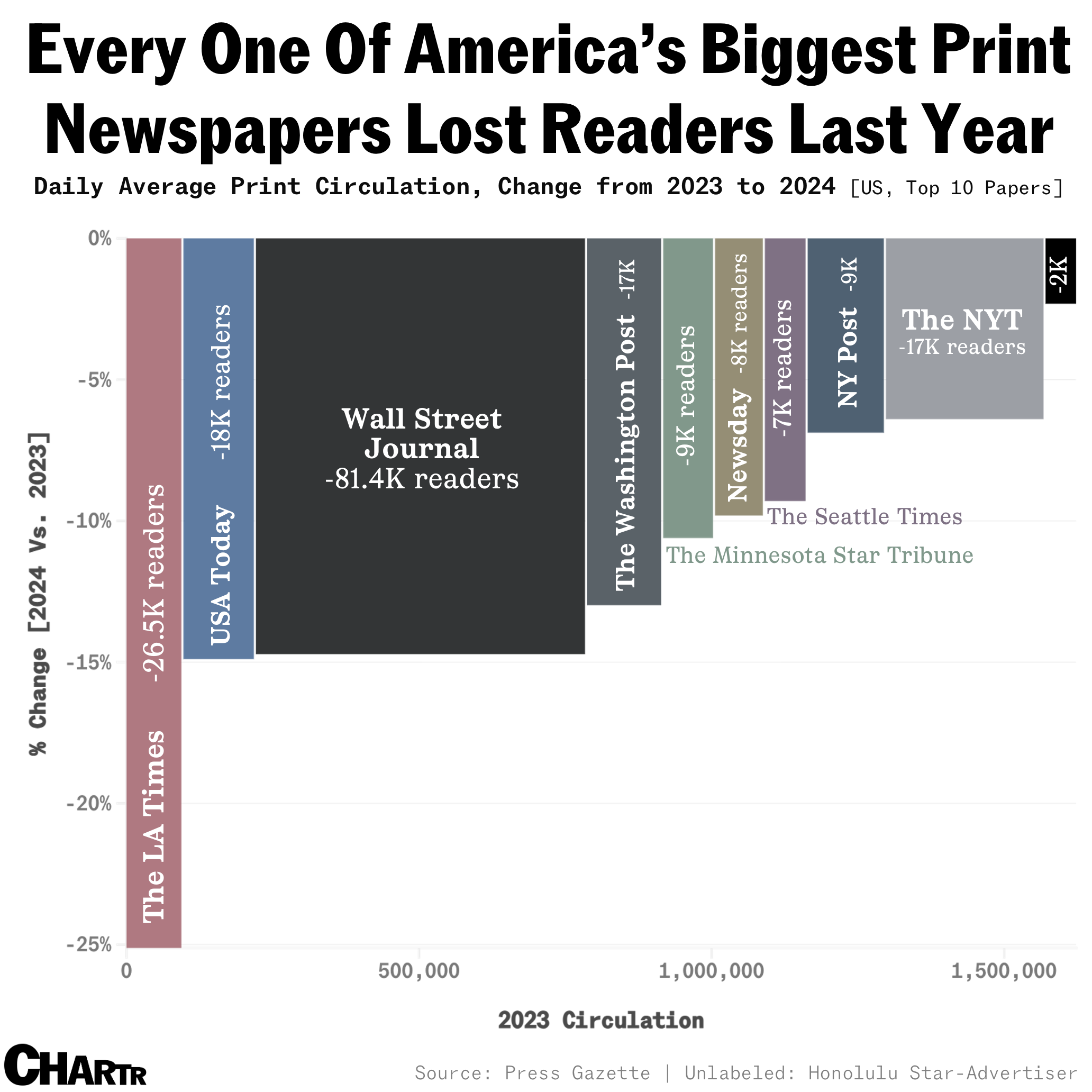
Having reportedly lost $50 million, laid off more than 20% of its newsroom, and shed some 26% of its daily print readers last year, billionaire Dr. Patrick Soon-Shiong’s announcement that he plans to take the Los Angeles Times public “over the next year” came as a bit of a shock to some on Monday’s The Daily Show.”

Jon Stewart and his studio audience cheered the news from Soon-Shiong, who made his money in pharmaceuticals and bought the paper for $500 million in 2018. However, whether investors will share that enthusiasm about the company — where internal tensions have bubbled recently and finances have been shaky for even longer — remains to be seen.

It is, as you might expect, a tough time to be running a newspaper that still depends on its print business.
Newspaper chart
Sherwood News

Read less about it

Per February figures from industry publication Press Gazette, the 25 largest newspapers audited in the US last year saw daily print circulation slip 12.7% on average in the six months through September, with the Los Angeles Times seeing the biggest drop of the lot. Daily print circulation for Soon-Shiong’s paper dropped some 25% from the same period in 2023.

Not one publication posted increasing print circulation compared to the year before, however, with Press Gazette reporting that there isn’t a single US newspaper with a daily average circulation exceeding 500,000 anymore, after The Wall Street Journal slipped by more than 81,000 copies.

Unlike The New York Times, the LA Times doesn’t have a gargantuan games or cooking side hustle to fall back on, and it didn’t even break the top 50 most visited English-language news websites in May, according to Similarweb data via Press Gazette.

There has been much ink spilled (mostly online, naturally) about the death of print newspapers, and it doesn’t seem like the LA Times is any exception, despite the buzz it got on a late-night talk show — another media mainstay in slow decline.

More Business

See all Business
business

China’s EV startup trio have all become profitable

China’s EV startup trio, Nio, Li Auto, and XPeng, are now all profitable, following the latter’s Q4 results released Friday.

XPeng reported a quarterly net profit of about $55 million, compared to rival Nio’s Q4 net profit (also its first) of about $40 million. Li Auto posted Q4 net profit of less than $1 million.

All three companies being profitable offers a stark contrast to the EV market in the US, where Rivian quietly delayed its 2027 profitability target in a filing about its Uber robotaxi partnership yesterday. Lucid is likely further away, and last month cut 12% of its US workforce as part of its “path toward profitability.”

Still, it’s not all rosy for China’s EV startups, either. XPeng ADRs were down more than 6% in Friday morning trading as its Q1 sales forecast came in below estimates. As China rolls back subsidies, auto sales are slumping. Chinese retail EV and hybrid sales fell 32% in February from the same month last year.

9.3%

As the war with Iran produces the biggest spike in US gas prices since Hurricane Katrina, car retailer CarMax is continuing to see heightened interest in EVs, hybrids, and plug-in hybrids.

“From Feb 1st - March 1st (inclusive), compared to March 2nd to March 15th (inclusive), we saw a 9.3% lift in page views for these vehicles,” a spokesperson for the company told Sherwood News.

As industry insiders recently told us, EV interest climbs when gas prices rise. That appears to be holding true even without EV tax credits, which the Trump administration ended under its new budget package.

CarMax also saw EV searches spike in 2022, amid Russia’s invasion of Ukraine and the resulting oil price spike.

Walt Disney Chairman And CEO Bob Iger Rings Opening Bell At NY Stock Exchange

It’s the end of Disney’s Iger era (again)

Incoming CEO Josh D’Amaro is replacing Bob Iger on Wednesday, though Iger will remain a senior adviser through the end of the year.

$35.4B

The tariffs imposed by the Trump administration have cost automakers at least $35.4 billion since the start of 2025, according to a new analysis by Automotive News.

That total will continue to climb this year, since the Supreme Court’s February tariff ruling largely leaves the 25% levy on vehicles and auto parts untouched.

Toyota has taken the biggest hit, projecting more than $9 billion in tariff costs in its fiscal year ending this month, while Detroit’s big three automakers — Ford, GM, and Stellantis — were hit with a combined $6.5 billion tariff charge in 2025.

In the fourth quarter, automakers sold about 8% fewer imported vehicles in the US compared to the same period a year ago, per the Automotive News Research & Data Center.

Tariff charges come at a rough time for legacy carmakers, which are also scaling back EV plans following the Trump administration’s elimination of tax credits and fuel standard goals. According to Automotive News, the cost of EV write-downs and restructuring is, so far, nearly $70 billion.

Latest Stories

Sherwood Media, LLC produces fresh and unique perspectives on topical financial news and is a fully owned subsidiary of Robinhood Markets, Inc., and any views expressed here do not necessarily reflect the views of any other Robinhood affiliate, including Robinhood Markets, Inc., Robinhood Financial LLC, Robinhood Securities, LLC, Robinhood Crypto, LLC, Robinhood Derivatives, LLC, or Robinhood Money, LLC. Futures and event contracts are offered through Robinhood Derivatives, LLC.