US airlines are still doubling down on premium seats, as the K-shaped economy takes off
There’s really not much room in economy these days.
With airports across the nation still seeing delayed security wait times amid ongoing TSA chaos, some travelers might be wishing they had shelled out for a first or business class ticket to get into the “Priority” lane.
And it seems America’s biggest airlines are also betting that passengers are now more willing to upgrade: a new report from The Wall Street Journal, published Sunday, details how airlines have shrunk traditional economy cabins over the last decade to make room for a growing number of premium offerings.
Indeed, according to aviation data from Visual Approach Analytics cited in the report, the number of scheduled first and business class seats on domestic flights has expanded by 27% since January 2020 — almost 3x greater than the 10% growth seen for scheduled economy seats.
That’s not even accounting for premium economy, an intervening class that became a standard option for many major airlines in the 2010s, which, the WSJ wrote, can be “priced at least twice as high as regular economy seats and only take up slightly more room on the plane.”
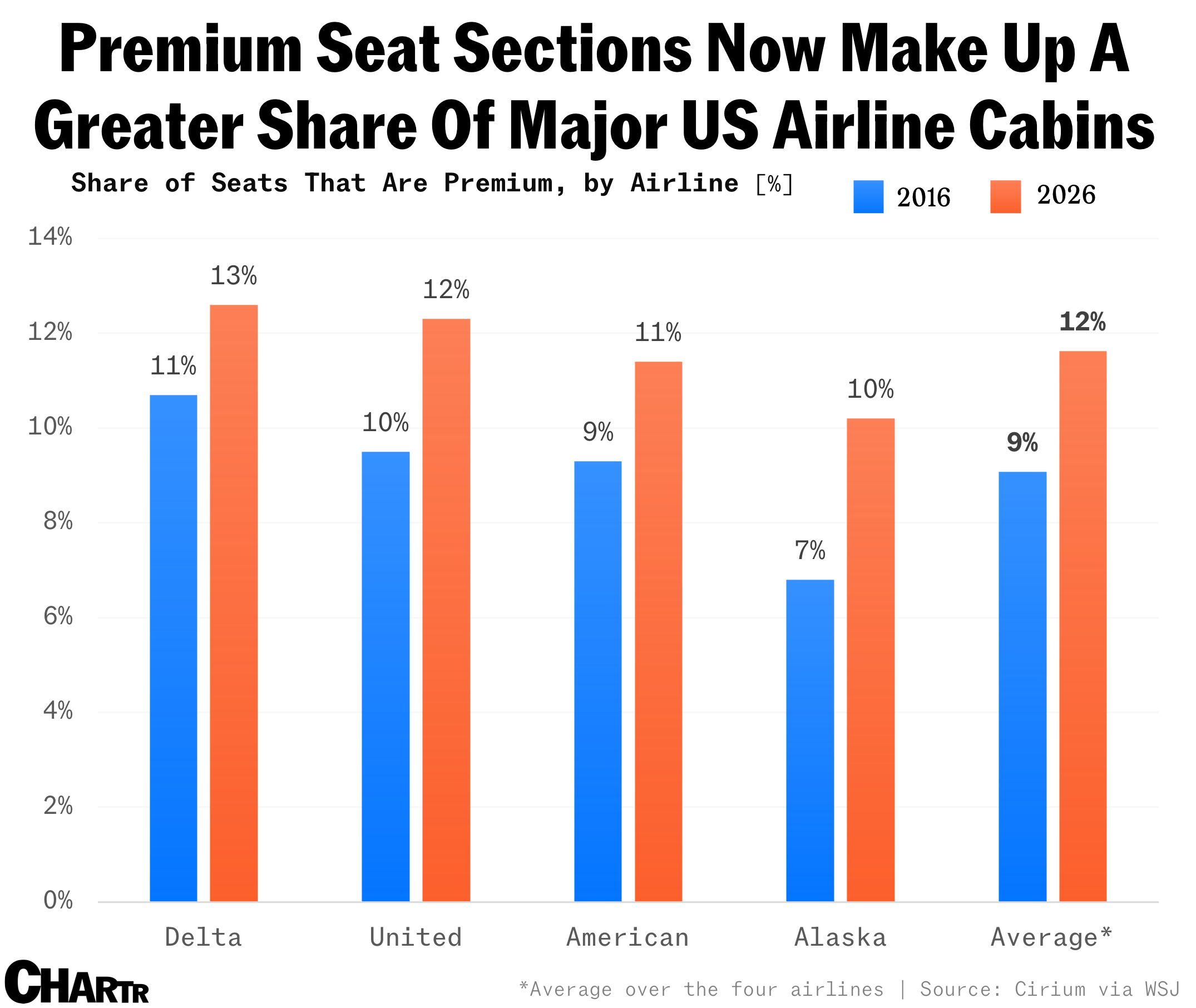
Looking at four of the biggest air carriers in the US — Delta Air Lines, United Airlines, American Airlines, and Alaska Airlines — all have increased their respective shares of premium seats since 2016, with premium offerings now making up 12% of their cabins on average in 2026.
Business end
Many airlines are rolling out redesigned cabins to make planes “financially efficient,” adding room for more expensive tiers by cutting into cheaper sections. The trend speaks to the emergence of America’s K-shaped economy, in which wealthier consumers continue to splurge as lower-income spenders cut back.
For example, United’s new Dreamliner jet layout includes 16 more business class seats, 14 more Premium Plus seats... and 65 fewer seats in the economy section. Delta has already found success squeezing profits from the top, with its premium ticket sales growing more than 7% last year, while main cabin ticket sales fell 5%.