Business
Kreide Tafel - Exit
Getty Images
C-Suite Dreams

US CEO departures are at their highest level in decades

Walmart’s Doug McMillon is the latest to step down, as CEO turnover rises across Corporate America.

Hyunsoo Rim

Last Friday, Walmart announced that its longtime CEO, Doug McMillon, will step down next January, ending nearly 12 years at the helm — a period in which Walmart’s share price rose more than 300%.

Calling it quits

McMillon is hardly alone in calling time on his big job. Fellow retailers have seen turnovers, too, including Kohl’s Ashley Buchanan (who lasted just five months) and Target’s veteran Brian Cornell, who also plans to step down next January. Big Tech has also seen changes at the top: X’s Linda Yaccarino exited in July, and Spotify’s Daniel Ek said in September he’ll shift into the company’s executive chairman role after 20 years as CEO.

Indeed, America’s C-suite is turning over at its fastest pace in decades. CEO exits hit a record high last year, according to outplacement firm Challenger, Gray & Christmas, which has tracked departures since 2002 — and 2025 is looking nearly as intense. So far this year, 1,650 CEOs have departed through September, essentially matching the 1,652 logged in the same period in 2024.
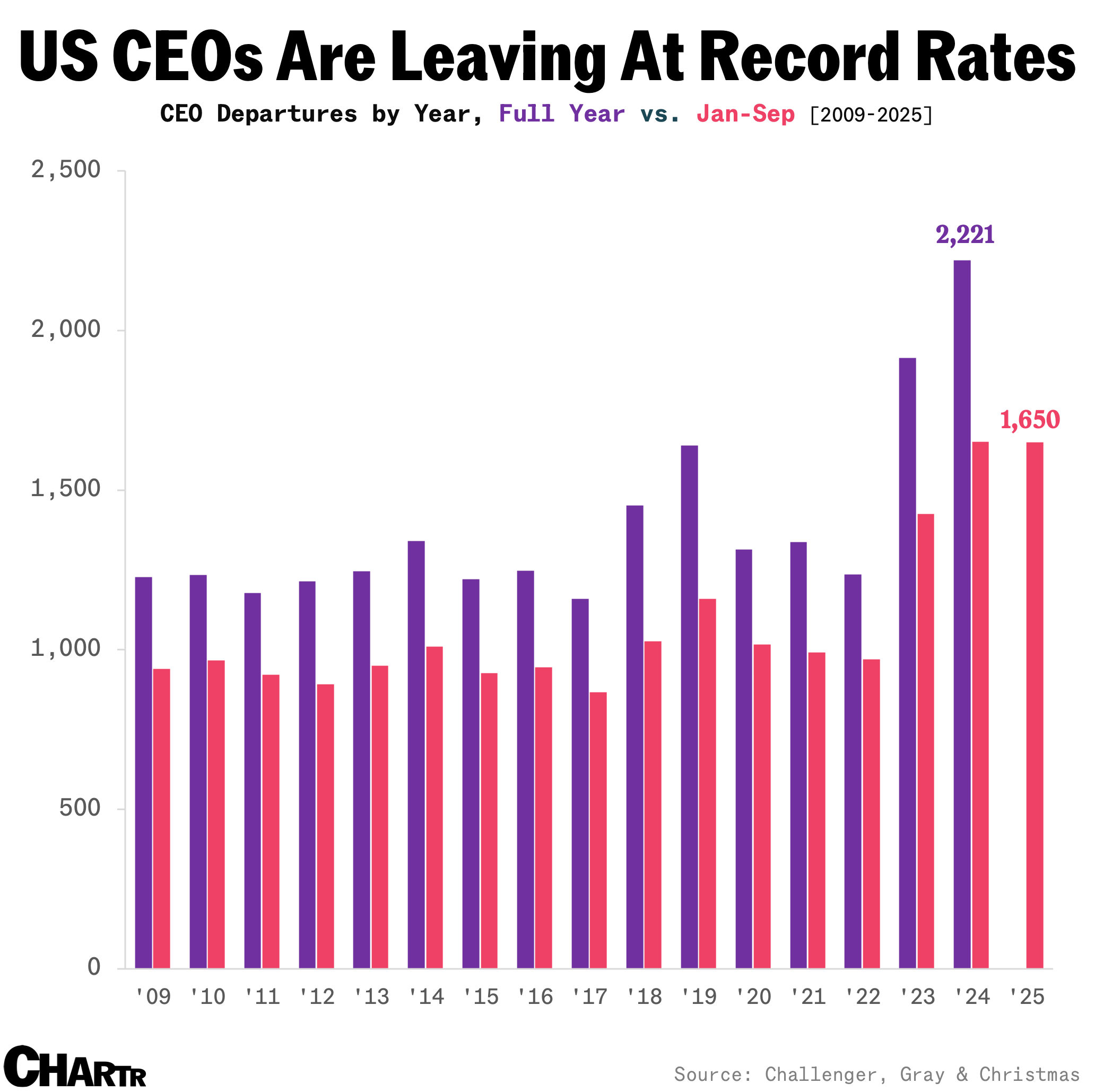
CEO Departure
Sherwood News

So, what’s driving it?

One explanation is that more CEOs are simply hitting retirement age. Last year, for the first time, half of active S&P 1500 CEOs were over 60, executive search firm Spencer Stuart found. 

But the exec-odus isn’t just about aging out. Some sectors are churning far faster than others. Tech CEO exits are running 10x the overall rate, per estimates from Russell Reynolds Associates, as investors raise the bar for tech leaders in the age of AI. Growing activist pressure is another major driver, which forced out a record 27 CEOs last year — well above the four-year average of 16 — often swooping in after just six quarters of lagging returns.

McMillon’s exit, though, reflects perhaps a less dramatic trend: planned successions, which made up 22% of CEO exits last year — the highest share ever, per RRA — as companies opt for experienced insiders in nearly three-quarters (73%) of cases. One of them is Jon Furner, a 30-year Walmart lifer who will take over McMillon’s role next year.

And with many CEOs often compensated primarily in equity, the runaway stock market of the last 24 months will have helped those retirement plans to no end.

More Business

See all Business
Family Watching Baseball On Tv

Netflix and Disney+ probably only added ad-tier subscribers this year, says Morgan Stanley

As streaming prices climb, ad-free subscribers are becoming a rarity.

Aldi Grand Opening

Discount stores are having a moment in America, drawing high- and low-income consumers alike

Everyone loves a deal in 2025 — and Aldi, Walmart, and Dollar Tree are all cashing in.

Millie Giles12/17/25
business

Report: OpenAI won’t pay a dime in cash for its 3-year licensing deal for Disney IP

More financial details behind the landmark deal that will grant OpenAI three years of access to Disney intellectual property are coming out, and they’re pretty surprising.

The deal will reportedly see OpenAI pay zero dollars in licensing fees, instead compensating Disney in stock warrants. It was previously reported that Disney would invest $1 billion into OpenAI as part of the agreement.

It’s very abnormal for Disney to grant anyone access to its massive IP library without a cash payment, and the entertainment juggernaut has been known to strike down even crocheted Etsy Yodas for infringing on its turf. In its fiscal year 2025, Disney booked more than $10 billion in revenue from licensing fees across merchandising, television, and theatrical distribution.

It’s very abnormal for Disney to grant anyone access to its massive IP library without a cash payment, and the entertainment juggernaut has been known to strike down even crocheted Etsy Yodas for infringing on its turf. In its fiscal year 2025, Disney booked more than $10 billion in revenue from licensing fees across merchandising, television, and theatrical distribution.

business

Ford says it will take $19.5 billion in charges in a massive EV write-down

The EV business has marked a long stretch of losing for Ford, and today the automaker announced it will take $19.5 billion in charges tied, for the most part, to its EV division.

Ford said it’s launching a battery energy storage business, leveraging battery plants in Kentucky and Michigan to “provide solutions for energy infrastructure and growing data center demand.”

According to Ford, the changes will drive Ford’s electrified division to profitability by 2029. The company will stop making its electric F-150, the Lightning, and instead shift to an “extended-range electric vehicle” that includes a gas-powered generator.

The Detroit automaker also raised its adjusted earnings before interest and taxes outlook to “about $7 billion” from a range of $6 billion to $6.5 billion.

Ford’s write-down is one of the largest taken by a company as legacy automakers scale back on EVs, giving EV-only automakers a market share boost.

Latest Stories

Sherwood Media, LLC produces fresh and unique perspectives on topical financial news and is a fully owned subsidiary of Robinhood Markets, Inc., and any views expressed here do not necessarily reflect the views of any other Robinhood affiliate, including Robinhood Markets, Inc., Robinhood Financial LLC, Robinhood Securities, LLC, Robinhood Crypto, LLC, or Robinhood Money, LLC.