Business
Feeling zen: Wall Street's "fear index" is at a multi-year low

Feeling zen: Wall Street's "fear index" is at a multi-year low

Not a care in the world

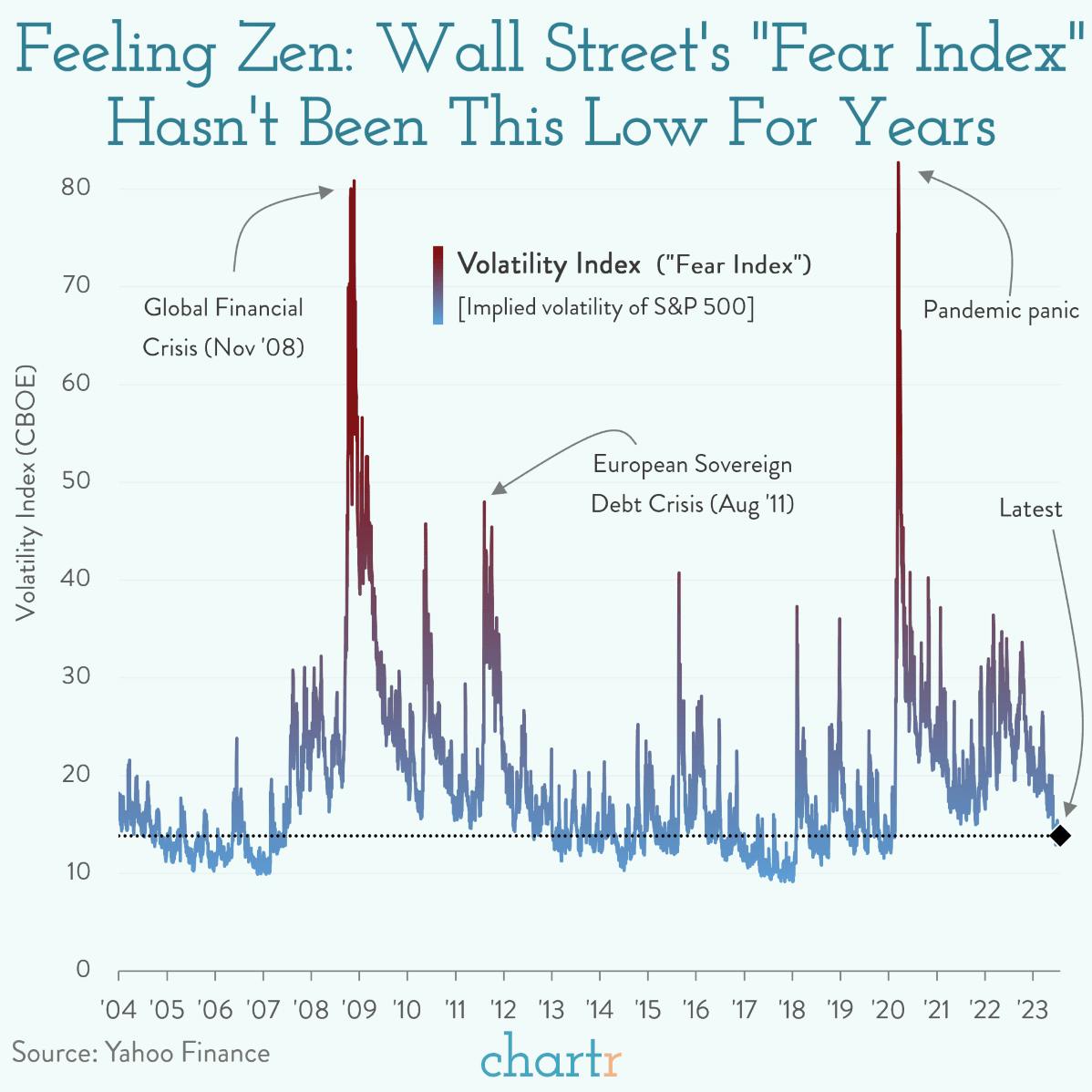
US stocks have climbed 19% already this year, taking the flagship S&P 500 Index to just a few percent below its all-time high from December 2021. Meanwhile, Wall Street’s “Fear Index” — the Volatility Index (VIX) — is scraping new lows.

The VIX tracks how much investors expect stock prices to fluctuate over the coming month. In simple terms, when the VIX is higher, it means investors expect prices to move around a lot (i.e. they're more uncertain), and when it's lower it means they don't expect prices to move around much.

The latest reading is a little over 13. The last time it was this low? February 2020, just before the pandemic sent it above 80 — the kind of "call your family and go full panic mode" readings that are only seen in global crises.

Explaining why stocks are doing what they're doing is notoriously difficult, but at least 3 things seem to be helping investors get comfortable. The big one is inflation, which has peaked and looks to be falling steadily, giving the Federal Reserve leeway to slow down on future interest rate rises. Another is the banking sector, which is reporting strong results after a big wobble earlier this year, when a number of banks suddenly collapsed. More generally, the risk of a recession also seems to have receded, with consumer confidence levels hitting their highest point in 2 years and unemployment hovering near all-time lows in many states.


More Business

See all Business
Delta Airlines empty plane interior

Delta, the K-shaped airline

Delta’s premium ticket sales grew more than 7% in 2025. Its main cabin ticket sales fell 5%.

business

Paramount sues Warner Bros. for more info on its deal with Netflix, says it plans to nominate new directors

It’s a fresh week and that means a fresh bit of escalation in the ongoing Warner Bros. Discovery merger drama.

At an upcoming meeting, Paramount Skydance plans to “nominate a slate of [WBD] directors who, in accordance with their fiduciary duties, will... enter into a transaction with Paramount,” CEO David Ellison wrote in a letter to WBD shareholders disclosed on Monday.

Ellison also said that Paramount sued WBD in Delaware court in an effort to force the board to disclose “basic information” that will allow shareholders to make an informed decision between Paramount’s offer and one from Netflix. WBD shares dipped about 2% on Monday morning.

The latest update follows Paramount’s move last week to reaffirm — but not raise — its $30-per-share offer for WBD. Some saw that decision as Paramount effectively throwing in the towel on its merger hopes, given that the same deal has been rejected twice by the WBD board and winning over shareholders directly is a difficult process. Monday’s disclosure appears to signal that whether it loses or not, Paramount isn’t going to make Netflix’s acquisition easy.

Latest Stories

Sherwood Media, LLC produces fresh and unique perspectives on topical financial news and is a fully owned subsidiary of Robinhood Markets, Inc., and any views expressed here do not necessarily reflect the views of any other Robinhood affiliate, including Robinhood Markets, Inc., Robinhood Financial LLC, Robinhood Securities, LLC, Robinhood Crypto, LLC, or Robinhood Money, LLC.