Business
Wheels Up business model

Why is Wheels Up stock so volatile?

The company has laid off pilots, after racking up major losses in 2023

In the last month, the second most volatile US stock worth more than $2 billion has been the headline-hogging meme stock GameStop. The most volatile, per data from FinViz, is "on-demand" private aviation company Wheels Up, which has seen its share price move: +36%, +7%, +23%, -24%, and +11% in the last 5 days alone, with the stock having doubled since June 21st.

Part of the reason for that volatility is that only a small portion of its shares are available for public trading (what’s known as a low float). Another is that the company’s business model remains unproven at scale.

The 30,000 foot view

The first rule of business is that you usually shouldn’t sell a product for less than it costs to produce.

Restaurants, for example, make healthy profits — or specifically gross profits — on their sales. Salad chain Sweetgreen only spends about $4.15 out of a $15 salad on the ingredients and packaging of the food. Nike makes a ~45% gross margin, leaving itself a healthy buffer to cover marketing, admin expenses, and other overheads.

Now, the premise gets a little bit more complicated when you’re trying to be “Uber for the sky”, as you juggle planes, pilots, software, and fuel, but the fundamental rule remains: try not to lose money on each flight. Wheels Up, which opens up access to private jets not just to the super-wealthy but to the moderately super-wealthy, doesn’t make the math work.
Wheels Up

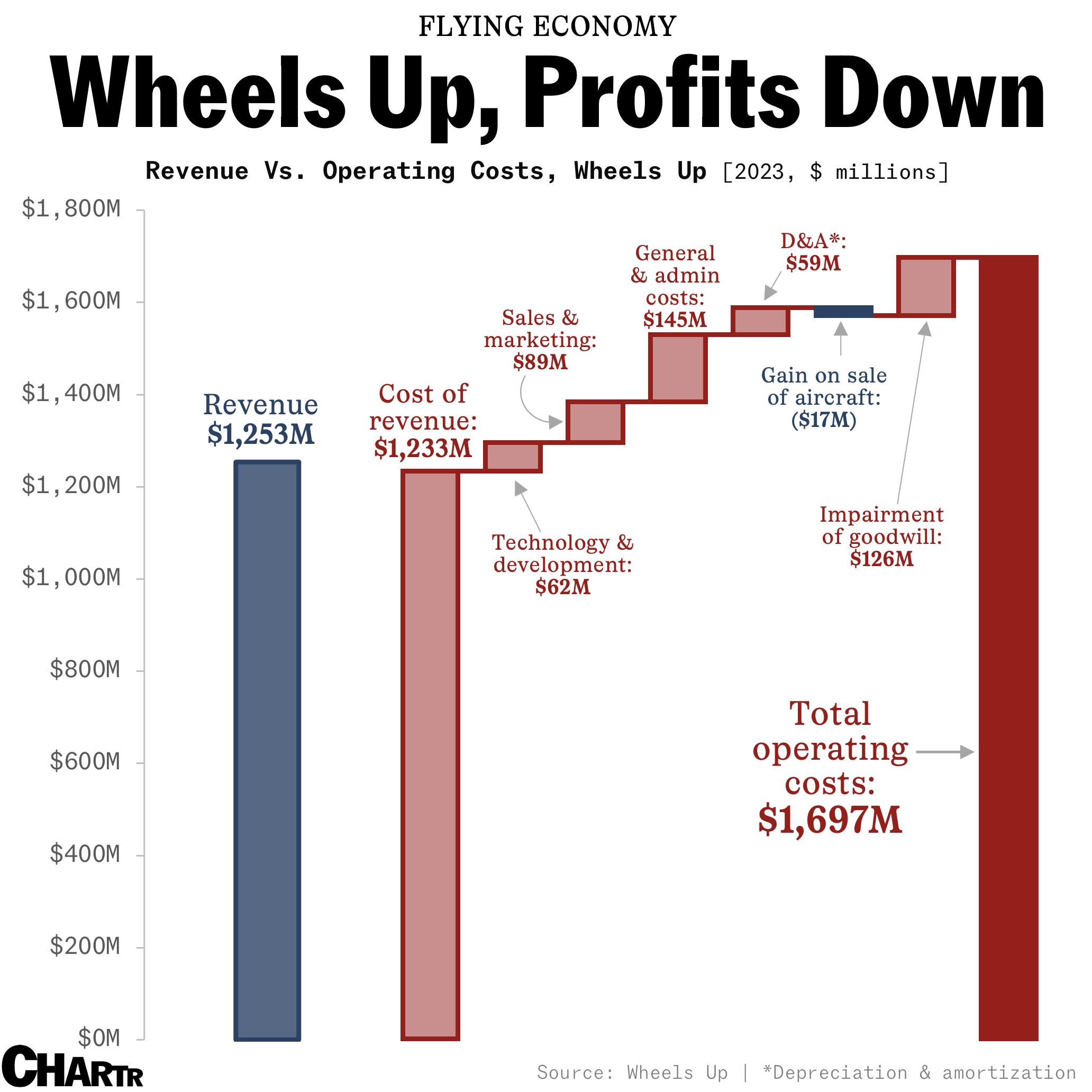
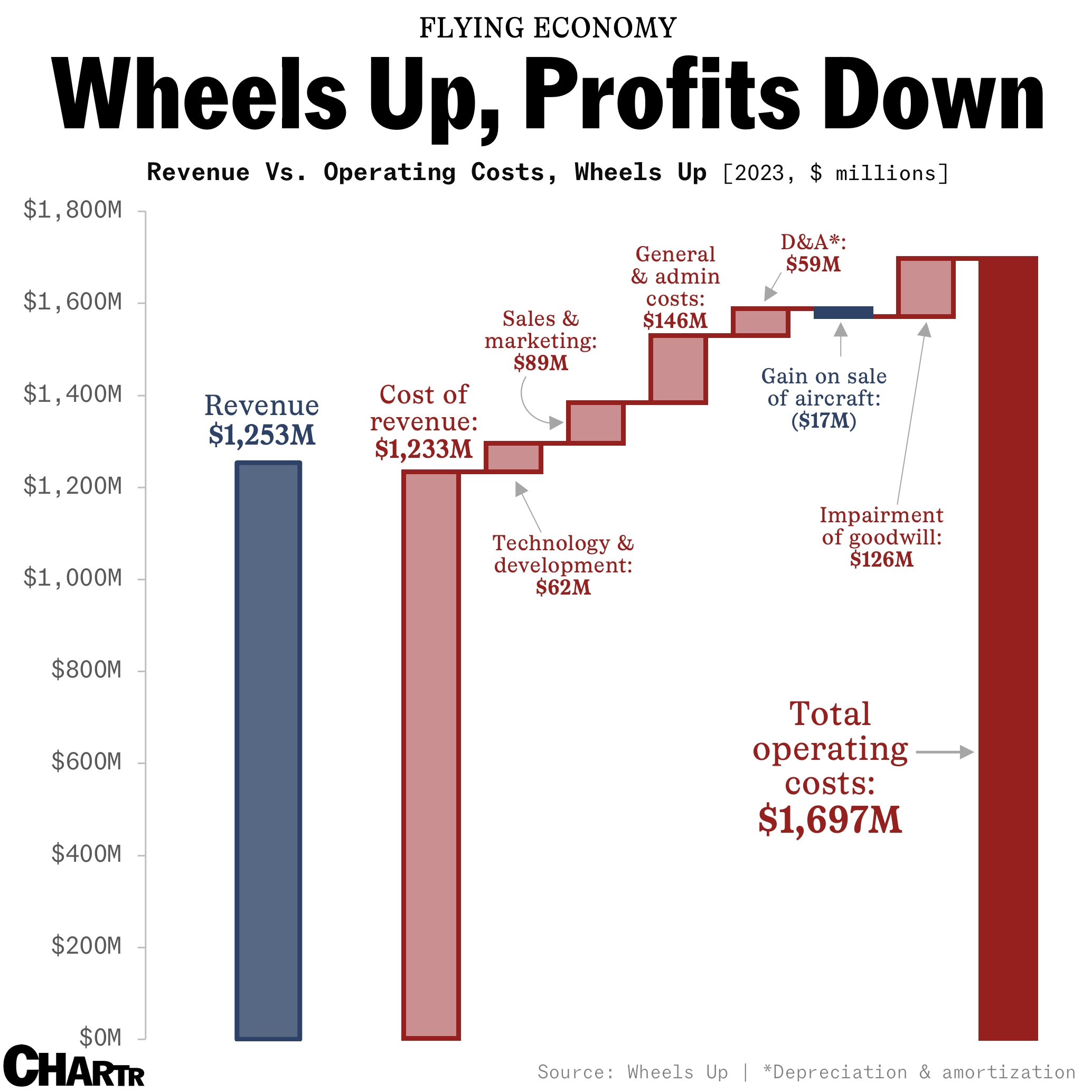
Last year, the company reported $1,253 million in revenue. However, just delivering on its service cost it almost its entire takings, with aircraft leases, fuel, maintenance, fees, cabin crew labor, plane parking, and more setting it back $1,233 million. Once other overheads were accounted for, that left the company deeply in the red.

Turbulent times

Wheels Up landed on the public markets in 2021 as part of a wave of SPACs during the pandemic. It’s time as a public company has not been smooth — despite the recent uptick, the stock is down more than 96% from its peak. Last year, Delta and a group of investors stepped in with a $500 million lifeline for the company, but UP’s woes have continued. Revenue dropped 44% year-on-year in Q1, and the company reportedly laid off around 11% of its pilots as it moves to reduce its fleet size.

More Business

See all Business
Capsule Pill and Dots

Justice Department accuses telehealth Zealthy of fraud, says remedy may bankrupt it

The feds say they don’t think Zealthy has the liquidity to pay what it owes customers.

Netflix playground

Will investing in kids games finally make Netflix Games “the Netflix of games”?

Netflix is launching a game for preschoolers, its latest foray into stuff-you-play instead of stuff-you-watch.

business

American Airlines joins the flock, hiking bag fees amid higher jet fuel prices

American Airlines on Thursday announced that it, too, will be hiking the fees it charges customers to check luggage.

With the move, all four of the major US airlines, which together control about 80% of the US market, have now hiked their baggage fees in recent days amid surging jet fuel prices.

The change will go into effect on tickets bought on or after Thursday, the same day Southwest’s hike begins.

Since late March, JetBlue, Delta Air Lines, United Airlines, Canada’s WestJet, and Southwest have hiked their fees. Experts expect more major carriers to follow, and to potentially tweak the pricing of other ancillary revenue sources like seat assignments and carry-on luggage.

The change will go into effect on tickets bought on or after Thursday, the same day Southwest’s hike begins.

Since late March, JetBlue, Delta Air Lines, United Airlines, Canada’s WestJet, and Southwest have hiked their fees. Experts expect more major carriers to follow, and to potentially tweak the pricing of other ancillary revenue sources like seat assignments and carry-on luggage.

business

Less than a year after implementing them, Southwest is also hiking its bag fees

Southwest Airlines has joined the growing list of airlines opting to hike their bag fees amid sustained higher jet fuel costs.

Starting today, the first checked bag at the carrier — which implemented bag fees less than a year ago — will jump from $35 to $45, and the second from $45 to $55. Southwest quietly disclosed the change Tuesday.

Southwest assigned the decision to “part of an ongoing analysis of the business and against the evolving global backdrop.”

As of Wednesday, jet fuel prices dropped to $4.16 a gallon, per the Argus US Jet Fuel Index, down from $4.81 on Tuesday following President Trump’s ceasefire announcement, which sent travel stocks soaring. Major airlines have shed some of those gains in premarket trading Thursday.

With the move to hike bag fees, Southwest joins JetBlue, United Airlines, Delta Air Lines, and Canada’s WestJet, all of which also boosted fees this month. Experts expect more major carriers to follow, and to potentially tweak the pricing of other ancillary revenue sources like seat assignments and carry-on luggage.

Southwest assigned the decision to “part of an ongoing analysis of the business and against the evolving global backdrop.”

As of Wednesday, jet fuel prices dropped to $4.16 a gallon, per the Argus US Jet Fuel Index, down from $4.81 on Tuesday following President Trump’s ceasefire announcement, which sent travel stocks soaring. Major airlines have shed some of those gains in premarket trading Thursday.

With the move to hike bag fees, Southwest joins JetBlue, United Airlines, Delta Air Lines, and Canada’s WestJet, all of which also boosted fees this month. Experts expect more major carriers to follow, and to potentially tweak the pricing of other ancillary revenue sources like seat assignments and carry-on luggage.

Latest Stories

Sherwood Media, LLC produces fresh and unique perspectives on topical financial news and is a fully owned subsidiary of Robinhood Markets, Inc., and any views expressed here do not necessarily reflect the views of any other Robinhood affiliate, including Robinhood Markets, Inc., Robinhood Financial LLC, Robinhood Securities, LLC, Robinhood Crypto, LLC, Robinhood Derivatives, LLC, or Robinhood Money, LLC. Futures and event contracts are offered through Robinhood Derivatives, LLC.