Crypto
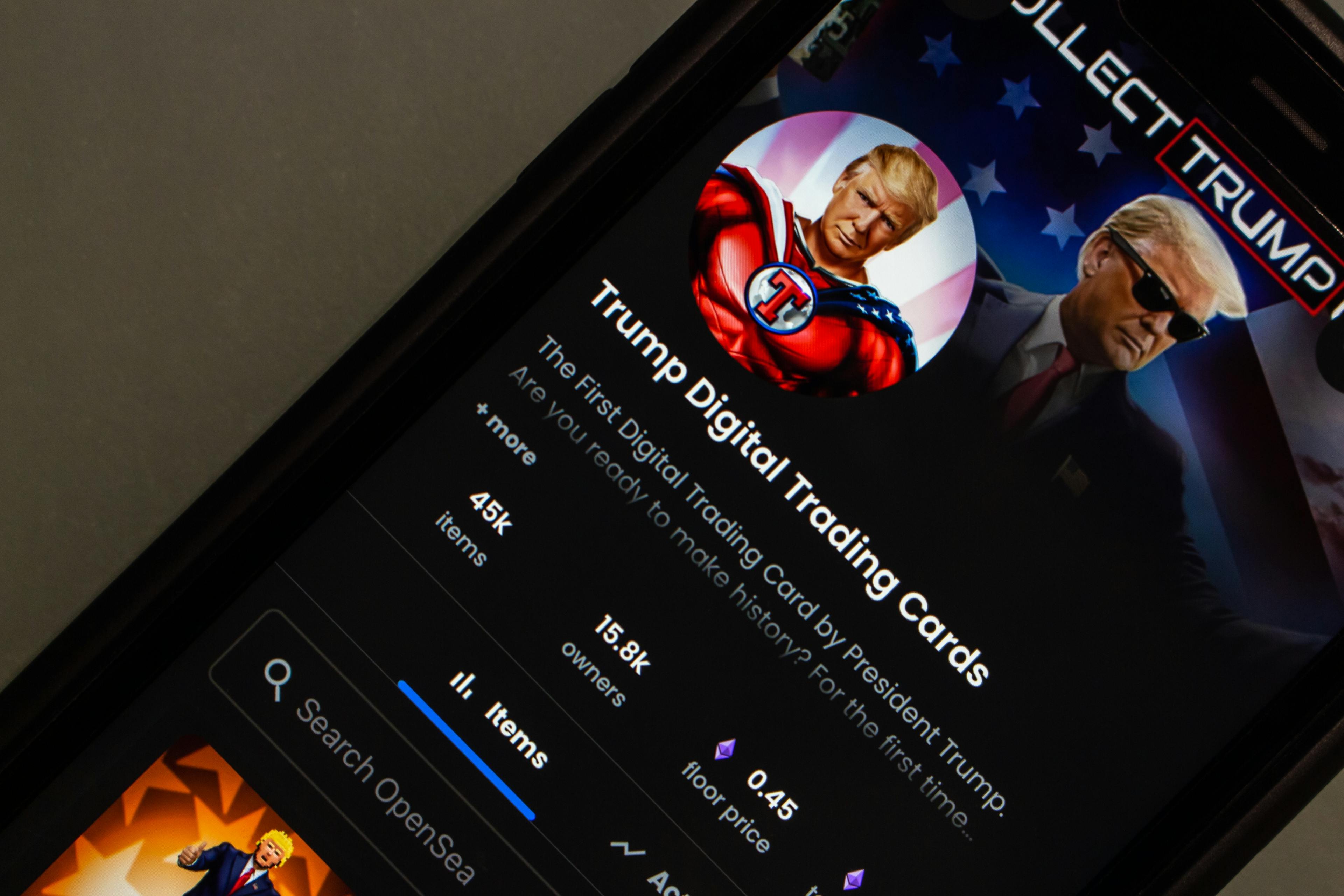
Trump NFTs on a phone
(Shutterstock)

Trump is good for crypto, but are Trump’s crypto projects doing well?

We took a look at World Liberty Financial and Trump’s NFTs since the election

Donald Trump’s election win has set the stage for a massive crypto rally that is already gaining momentum with bullish investors betting on the incoming crypto-friendly administration.

The numbers speak for themselves: the total crypto market cap stood at $2.43 trillion on November 1 and has jumped to $3.41 trillion today. Bitcoin’s was hovering around $68,000 on Election Day. Today, it hit over $99,000 in the wee hours of the morning.

But the story is not all positive for the crypto endeavors of the self-proclaimed “crypto president.”

World Liberty Financial, the DeFi crypto project associated with Trump, and its token, WLFI, debuted in October to great fanfare but dismal interest. While the project is not dead in the water, it has been struggling. 

Just before the election, the company said it planned to sell “up to $30 million” worth of tokens “before terminating sale,” according to an October 31 Securities and Exchange Commission filing — a dramatic cut from the original $300 million ambition for sales.

World Liberty Financial’s website shows that 18.644 billion tokens remain. The project has sold 1.36 billion since its launch.

The token has enjoyed a mini bump since the election, but it’s a far cry from the market rally the crypto ecosystem has been enjoying since November 5. Data on Dune Analytics shows that from Election Day to November 18, the company sold about $6 million worth of tokens, bringing the total raised to just over $20 million, an amount that represents 67% of the smaller, revised target.

What happened?

First, many experts raised red flags about the project, from Anthony Scaramucci calling it a “full-on scam” to Galaxy Digital analysts saying that the launch occurred “not with a bang, but a whimper.”

On top of that, technical problems plagued the site on launch day. The token is available only to accredited investors — limiting the pool of individuals who have access to it — and it’s “nontransferable,” which means that “it is locked indefinitely in a wallet or smart contract,” according to its “gold paper” (most projects have a white paper). 

All these factors have dampened investor enthusiasm, said Jon Alper, an estate and wealth management lawyer.

“While it’s premature to declare the project a complete failure, these setbacks suggest a challenging path forward,” Alper said.

How Trump’s NFT collections are doing

Trump’s digital trading-card collections enjoyed a postelection sales volume spike… but it didn’t last.

Trump has released four batches of NFTs, the last one in August, the “America First” collection, which includes a whopping 360,000 cards. As with previous collections, NFTs were priced initially at $99 and buying a lot of them came with perks, like a dinner with him at Mar-a-Lago or a “piece of the actual suit from his famous debate!” The sale of this edition “has ended,” according the website, which gives no further details.

The first collection, with 44,000 cards, and the second one, with 46,000, sold out. Meanwhile, the third collection, aka “The Mugshot Collection,” of 100,000 NFTs did not, nor did the “America First” edition.

The first NFT collection saw a 963% spike in sales volume 24 hours after the election, but netted just $17,714 in sales, a relatively tiny amount in the NFT market.

“Typically, top collections on Magic Eden or OpenSea get hundreds of thousands if not millions of dollars in daily volume,” Harrison Seletsky, director of business development at digital-identity platform Space ID, told Sherwood News. 

And the Trump bump didn’t last. While sales look good for the first and second collection if you consider the last 30 days, with both reporting sales increases of over 200%, it looks a lot worse if you just consider the past seven days, with a 73% drop for the first collection and the second edition seeing a 69% decline in sales.

Similarly, that first collection’s floor price (the lowest price available for any NFT in the collection) saw a huge jump on Election Day to $253 from $135, but it’s back to $104 on November 22, just $5 over its 2022 price. 

In comparison, other NFT collections have been able to ride the postelection crypto wave. Popular NFT collections like CryptoPunks are seeing a resurgence of interest, with its floor price hitting over $125,000 today, a rise of nearly 45% since Election Day. The NFT market as a whole saw $181 million in trading volume from November 11 to 17, a 94% week-over-week increase. 

Taking the “past performance does not indicate future” results mantra to heart, Trump is still giving new crypto ideas a try. Trump Media & Technology Group is reportedly trying to buy crypto-trading platform Bakkt and filed a trademark for a crypto-payments service called TruthFi on Monday.

Yaël Bizouati-Kennedy is a financial journalist who’s written for Dow Jones, The Financial Times Group, and Business Insider, among others.

More Crypto

See all Crypto
crypto

XRP tops 24-hour chart on South Korean crypto exchange

XRP is among South Korea’s favorite coins.

In the last 24 hours, XRP saw the highest trading volume on South Korean exchange Upbit at over $105.3 million, a figure exceeding bitcoin’s $102.6 million, ethereum’s $62.9 million, and dogecoin’s $27.7 million, data from CoinGecko shows.

Meanwhile, spot XRP ETFs saw $5.3 million worth of inflows on Tuesday, bringing monthly inflows to more than $65.3 million, according to SoSoValue.

The activity has not, however, translated into positive momentum for the token, with XRP remaining flat at the $1.43 level in the period.

Prediction market-implied odds of XRP rising above $1.50 in May (a level that hasn’t been surpassed in over two months) now stand at 70%, up from as low as 9% at the start of the week.

(Event contracts are offered through Robinhood Derivatives, LLC — probabilities referenced or sourced from KalshiEx LLC or ForecastEx LLC.)

Loading...
 

XRP returning to Upbit’s leadership position in trading volume follows the news earlier this week that Ripple’s prime brokerage unit secured a $200 million debt facility from global investment management firm Neuberger Berman to aid with the unit’s margin financing solutions.

Elsewhere, the XRP Ledger notched a new record of 332,000 addresses holding at least 10,000 tokens, worth $14,300, per data analytics platform Santiment. “Historically, rising numbers of mid-to-large wallets suggest increasing conviction from investors who are less focused on short-term price swings and more interested in long-term positioning,” Santiment posted Tuesday night on X.

“This is especially notable because XRP has spent much of 2026 trading below previous highs, meaning many holders appear willing to accumulate during fear rather than chase momentum,” Santiment added.

Loading...
 

XRP returning to Upbit’s leadership position in trading volume follows the news earlier this week that Ripple’s prime brokerage unit secured a $200 million debt facility from global investment management firm Neuberger Berman to aid with the unit’s margin financing solutions.

Elsewhere, the XRP Ledger notched a new record of 332,000 addresses holding at least 10,000 tokens, worth $14,300, per data analytics platform Santiment. “Historically, rising numbers of mid-to-large wallets suggest increasing conviction from investors who are less focused on short-term price swings and more interested in long-term positioning,” Santiment posted Tuesday night on X.

“This is especially notable because XRP has spent much of 2026 trading below previous highs, meaning many holders appear willing to accumulate during fear rather than chase momentum,” Santiment added.

$6.75B

Cryptocurrency theft has become a huge source of state revenue for North Korea.

Between 2016 and early 2026, threat actors linked to the Democratic Peoples Republic of Korea (DPRK) have stolen ~$6.75 billion across 263 documented incidents, security services provider CertiK estimated in a report published Tuesday morning.

The data likely falls short of the actual magnitude, as hundreds of smaller exploits against individuals and early-stage projects remain underreported.

DPRK actors have consistently targeted humans and supply chain weaknesses rather than smart contract code vulnerabilities, the report stated. Across nearly a decade of operations, their primary attack vector has rarely been code. It has almost always been people.

For example, North Koreas more than $270 million exploit on solana-based protocol Drift was six months in the making. It involved Drift contributors physically meeting in multiple industry conferences across several countries with people claiming to be part of a quantitative trading firm.

DPRK actors who siphoned $625 million from the Ronin network in 2022 also used a social element: an exploiter impersonated a job recruiter on LinkedIn and provided a fake offer to an employee at Sky Mavis, the firm backing Ronin, through a PDF infected with malicious spyware.

They are state employees executing a strategic mandate with the full backing of a nuclear-armed government. Their persistence, resources, and willingness to invest months in a single operation reflect institutional incentives that no criminal enterprise can match, the report added.

The fundamental challenge remains: North Korea has weaponized cryptocurrency theft as an essential revenue stream for regime survival. Until that incentive structure changes, the threat will persist and evolve.

Last month, the decentralized finance ecosystem saw 28 hacks, the highest monthly number of exploits ever, totaling $635.2 million, with the largest coming from ethereum-native protocol KelpDAO.

crypto

BitMine, the largest ethereum treasury firm, will slow down pace of accumulation

After acquiring more than 5.2 million ethereum tokens, worth $12 billion at current prices, BitMine Immersion Technologies announced it will dial back its weekly buying.

The company commands 4.3% of the total supply of ethereum and will likely meet its target of 5% this year.

If ETH closes above $2,100 at the end of May 2026, this would be the third consecutive monthly gain — this has never been seen in a crypto bear market, according to BitMine Chairman Tom Lee. Thus, a close above $2,100 would validate crypto spring has arrived, Lee continued in a statement.

Meanwhile, SharpLink Gaming, the second-largest ethereum treasury company, announced a nonbinding agreement with Galaxy Digital to roll out a $125 million liquidity fund that will deploy capital into on-chain yield strategies.

This marks an extension of our treasury strategy into more active strategies, aimed at providing sustainable term structures to great projects, SharpLink CIO Matthew Sheffield said in a press release.

SharpLink also released its Q1 earnings results Monday morning, reporting total quarterly revenue of $12.1 million and a net loss of $685.6 million, below analyst expectations, “primarily driven by non-cash unrealized losses and impairments offset by net realized gains.

In other ethereum ecosystem news, Ronin, a gaming-based blockchain known for Axie Infinity, will be migrating on Tuesday to a layer 2 network on ethereum. Ronin was previously exploited for around $625 million by North Koreas Lazarus Group in March 2022.

Latest Stories

Sherwood Media, LLC and Chartr Limited produce fresh and unique perspectives on topical financial news and are fully owned subsidiaries of Robinhood Markets, Inc., and any views expressed here do not necessarily reflect the views of any other Robinhood affiliate, including Robinhood Markets, Inc., Robinhood Financial LLC, Robinhood Securities, LLC, Robinhood Crypto, LLC, Robinhood Money, LLC, Robinhood U.K. Ltd, Robinhood Derivatives, LLC, Robinhood Gold, LLC, Robinhood Asset Management, LLC, Robinhood Credit, Inc., Robinhood Ventures DE, LLC and, where applicable, its managed investment vehicles.