Crypto
Bitcoin Conference 2023
Jack Mallers (Jason Koerner/Getty Images)
Shots fired

Twenty One says it can be “superior” bitcoin vehicle than Strategy

The Tether- and Cantor-backed new company led by Jack Mallers isn’t trying to be a copy of Michael Saylor’s firm.

Yaël Bizouati-Kennedy

Many companies are emulating Michael Saylor’s bitcoin accumulation mission at Strategy. One is taking a direct shot at it.

Twenty One, the new bitcoin-native company launched by Tether, SoftBank Group, and Strike CEO Jack Mallers via a merger with Cantor Equity Partners, intends to offer a “potentially superior vehicle for investors seeking capital-efficient bitcoin exposure,” its SEC filing reads, titled “Project Mystery Investor Presentation.”

Twenty One, whose name is a nod to bitcoin’s finite supply of 21 million and will trade on the Nasdaq under ticker symbol XXI, plans to launch with more than 42,000 bitcoin. This would make it the third-largest bitcoin treasury in the world, following Strategy, which holds 538,200 bitcoin, and MARA Holdings, which holds 47,531 bitcoin.

According to a press release, at the closing of the business combination, the company “will be majority-owned by Tether, co-founder of Twenty One and the world’s largest stablecoin issuer, and Bitfinex, with significant minority ownership by SoftBank Group Corp.”

Twenty One’s arguments for being a superior vehicle to Saylor’s bitcoin-holding company, Strategy, include:

  • Strategy’s sheer size “poses questions about potential diminishing returns as it continues to purchase bitcoin.” 

  • Its simple balance sheet will allow for flexibility in capital raises.

A graphic in the presentation helps show other advantages Twenty One says it has:
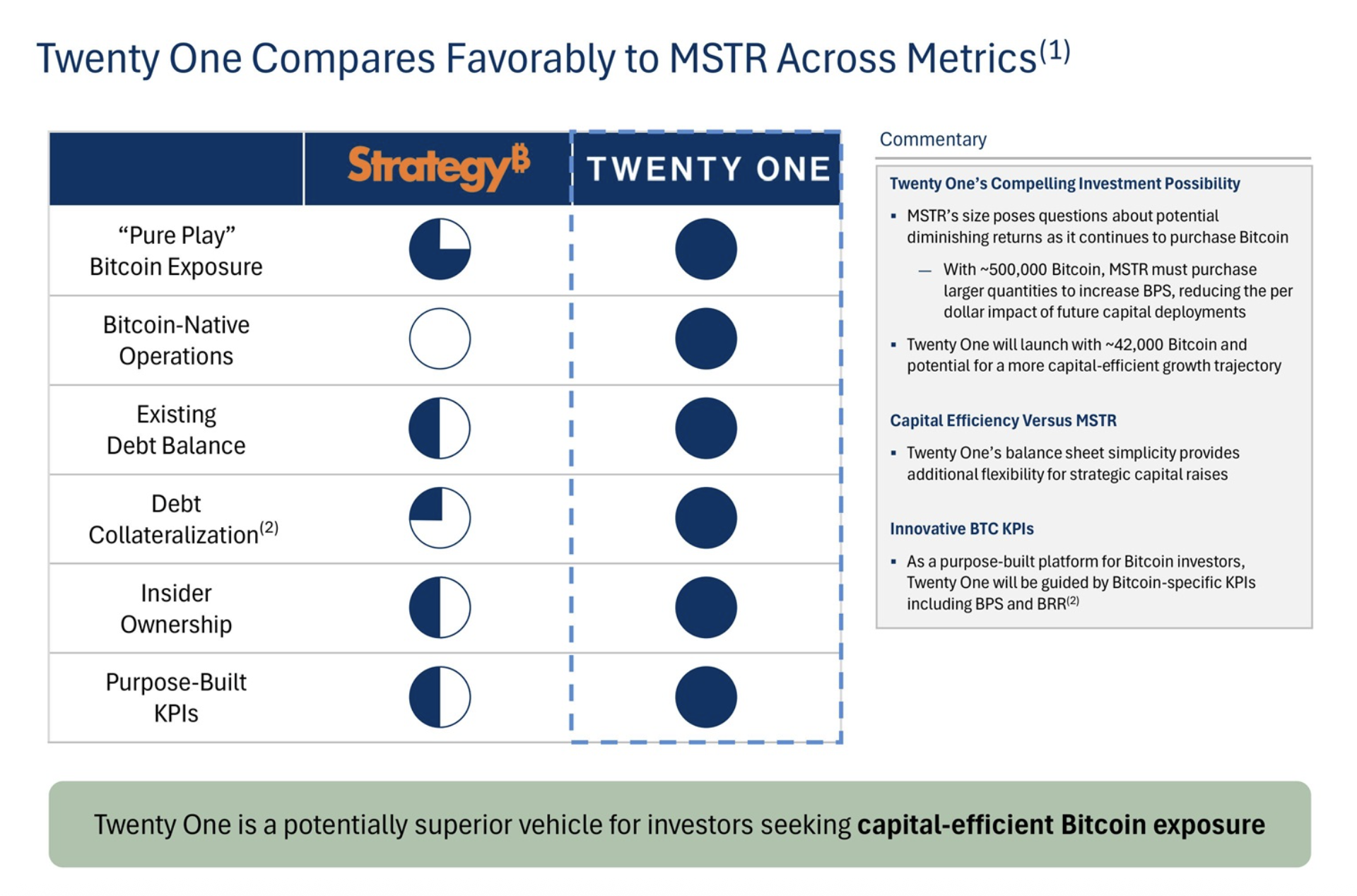
screenshot from Twenty One’s SEC document
Look at all those filled-in circles! (Source: Twenty One’s SEC filing)

Fei Chen, CEO of Intellectia AI, said that Twenty One is deliberately designed as a publicly traded bitcoin-accumulation vehicle with well-capitalized partners including Cantor Fitzgerald.

“This indicates institutional-grade design with transparency and long-term accumulation as a primary mandate — whereas MSTR is more of a leveraged bet on BTC through a business shell,” Chen added.

Another factor that could benefit Twenty One is that it can attract retail and RIAs wanting one-to-one bitcoin exposure in their portfolios who shy away from the tech-company-hinged volatility and debt strategy inherent in Strategy’s model, Chen said.

Meanwhile, TD Securities analysts deemed the launch as “the most-meaningful validation of Strategy’s bitcoin treasury operations to date,” adding that it leaves them bullish on Strategy. TD Securities has assigned a “buy” rating to Strategy, with a $550 price target, representing a 58% premium over today’s price of $348, as of writing.

It “could mark a turning point in institutional investor sentiment around MSTR shares, which despite Strategy’s strong performance has remained largely skeptical,” they wrote. “We continue to model Strategy holding 757k bitcoins by the end of FY27, representing 3.6% of all bitcoin ever to be mined.”

Whether the new entrant will affect the price of bitcoin remains to be seen. The emergence of another large buyer creates competition and increases demand, potentially boosting the price.

“At the same time, the offering here is essentially for retail and institutional investors to buy shares of a stock, instead of buying bitcoin directly,” Two Prime CEO Alexander Blume said. “This means huge purchases don’t actually move the price much in the short term, as you don’t see true price discovery on the open market.”

Meanwhile, Saylor remains unbothered, posting that “the first $100 billion is the hardest.”

More Crypto

See all Crypto
crypto

Hyperliquid ETFs top inflows as HYPE soars

While investors are opting out of ETFs focused on the two largest cryptocurrencies, some are adding ETFs of alternative coins, chief among them, hype, the native token for Hyperliquid. 

Digital asset managers 21shares and Bitwise rolled out HYPE ETFs last week and have yet to notch any outflows. Tuesday saw the highest level of inflows so far at over $11 million, outpacing XRP and solana ETF’s combined inflow of nearly $5.3 million, meanwhile bitcoin and ethereum saw $393 million exit their funds yesterday, according to SoSoValue.

Bloomberg senior ETF analyst Eric Balchunas noted the 21shares Hyperliquid ETF “is growing volume each day since launch in the tens of millions now, 8x over day one, which is [a] really good sign of organic interest.”

The ETF flows coincide with the token's outperformance, jumping 5.7% in the last 24 hours, 29.5% in the past seven days, and more than 100% year to date, data from CoinMarketCap shows. Meanwhile, bitcoin, ethereum, solana, and XRP are all down double digits in 2026.

HYPE began trading a week after former SEC chairman Gary Gensler announced ending his tenure and has an all-time high price of $59.30 set in September 2025.

Hyperliquid, the perpetual futures exchange built on its own blockchain gained traction among users who wanted to trade assets, such as commodities, cryptocurrencies, and equities with leverage in hours when traditional venues are closed. 

Treasury firm Hyperliquid Strategies has also rallied on news the SEC will soon greenlight trading tokenized versions of stocks.

Bitwise CIO Matt Hougan believes investors are underestimating Hyperliquid’s impact and value. “The market is valuing Hyperliquid as a perpetual crypto futures exchange that happens to be growing quickly. But it should be valued as a global super-app covering all assets,” Hougan said in a Tuesday memo.

“Its addressable universe is not the $3 trillion crypto market, but the $600 trillion market for global assets. Those are two completely different businesses," Hougan continued. “Today’s prices suggest you’re being offered the second at the cost of the first."

99% of fees generated on Hyperliquid are dedicated to token buybacks, which, annualized, comes to $618 million, data from DefiLlama shows. The market capitalization of HYPE stands at $12.3 billion. 

crypto

Ethereum exits: Investors depart its ETFs and the Ethereum Foundation shrinks (again)

On Monday, two researchers announced they were leaving the nonprofit organization tasked with supporting the second-largest blockchain network, adding to a growing exodus from the Ethereum Foundation.

Carl Beek, who helped architect the early design of ethereum’s beacon chain, will end his seven-year tenure with the foundation at the end of the month, while research scientist Julian Ma, who focused on product and growth work, has also decided to leave after four years.

Beek and Ma deepen a recent bout of turnover. Last week, the foundation said in a blog post that lead developers Barnabé Monnot and Tim Beiko are moving on from the organization. In April, Josh Stark, who was on the Ethereum Foundation leadership team for five years, left, as did Trent Van Epps, who organized Protocol Guild, which provides funding to core developers. The string of departures has raised concerns among those in the ecosystem.

“There have been a lot of disagreements about where ETH should move, whether from an issuance or architectural standpoint,” Laurens Fraussen, a research analyst at data provider Kaiko, told Sherwood News. “I’d assume the people leaving are either looking for greener pastures or don’t agree with the way the EF is being run.”

The foundation exodus comes as investors exit from ethereum ETFs. The investment vehicles saw more than $86 million in outflows on Monday, making six straight days of outflows, the longest streak since March, according to SoSoValue.

Meanwhile, an address identified as Galaxy Digital has a $2.3 million short position on ethereum using 20x leverage on Hyperliquid, data from blockchain analytics firm Nansen shows. The price of ethereum stands just under $2,110 as of 12:10 p.m. ET. With an entry point of $2,203, the firm has an unrealized gain of $102,000.

crypto

Ethereum falls faster than bitcoin as crypto tape turns red

The second-largest cryptocurrency is nearing the $2,100 mark, declining more than 9% in the last seven days, a steeper decrease than its older sibling bitcoin, which is also suffering.

Ethereum ETFs have had five consecutive days of outflows combining for $255 million, data from SoSoValue shows.

Meanwhile, Goldman Sachs and Harvard University both filed 13Fs showing each pulled back their exposure to ethereum.

Goldman now holds nearly $178 million in BlackRocks iShares Ethereum Trust ETF, down from $679 million, according to its latest 13F filing. It also exited its $394 million position in the Fidelity Ethereum Fund as well as a smaller position in ETHZilla, while adding $67 million of the iShares Staked Ethereum Trust ETF.

Harvard completely trimmed its ethereum exposure. The endowment did not report any ethereum ETF holdings in its latest 13F filing, submitted Friday, but showed an $86.8 million position in BlackRocks iShares Ethereum Trust ETF in its previous 13F filing in February.

But ethereum bulls remain: treasury behemoth BitMine Immersion Technologies continued its accumlation of ethereum, albeit at a slower pace. Over the past week, we acquired 71,672 ETH, Chairman Tom Lee said in a Monday press release. We view the recent pullback of ETH to below $2,200 as an attractive opportunity. The firms unrealized loss now exceeds more than $7.3 billion.

Traders aren’t so bullish: prediction market-implied odds of ethereum breaking $2,500 in May stand at just 7%, a sharp drop-off from a week ago, when the probability was at 57%.

(Event contracts are offered through Robinhood Derivatives, LLC — probabilities referenced or sourced from KalshiEx LLC or ForecastEx LLC.)

Latest Stories

Sherwood Media, LLC and Chartr Limited produce fresh and unique perspectives on topical financial news and are fully owned subsidiaries of Robinhood Markets, Inc., and any views expressed here do not necessarily reflect the views of any other Robinhood affiliate, including Robinhood Markets, Inc., Robinhood Financial LLC, Robinhood Securities, LLC, Robinhood Crypto, LLC, Robinhood Money, LLC, Robinhood U.K. Ltd, Robinhood Derivatives, LLC, Robinhood Gold, LLC, Robinhood Asset Management, LLC, Robinhood Credit, Inc., Robinhood Ventures DE, LLC and, where applicable, its managed investment vehicles.