Crypto
People walk past an advertisement feature Donald Trump with...
An advertisement featuring Donald Trump with bitcoin (May James/Getty Images)

Bitcoin ETFs suffer near $1 billion in outflows in 2 days, as Trump Media withdraws bitcoin ETF application

Bitcoin’s price is “trapped between 76,000 and 78,000,” with analysts saying the dip reflects “a deeper structural problem beneath crypto markets.”

Yaël Bizouati-Kennedy

Bitcoin ETFs have bled out almost $1 billion in just two days this week, on track to surpass last week’s $1 billion exit, according to SoSoValue.

And in an increasingly competitive ETF landscape, Trump Media & Technology Group withdrew its application for a bitcoin ETF on Tuesday, which it had filed in June 2025.

Bitcoin ETFs have been a strong support for bitcoin since the war began, helping the asset navigate geopolitical and macro headwinds. But analysts have warned that a sustained reversal in flows could weaken support and drag the price lower.

Bitcoin, which lost the key $80,000 level, has been trading in the $76,100 to $77,550 range in the past 24 hours. Rising bond yields coupled with uncertainty over the war in Iran are among the factors weighing on bitcoin.

“Bitcoin has recently remained trapped between 76,000 and 78,000, reflecting a market that is still waiting for macro direction. If global long-end yields continue moving higher, volatility across risk assets could accelerate sharply once again,” Dean Chen, a Bitunix analyst, told Sherwood News.

Tim Sun, a senior researcher at HashKey, told Sherwood that the past two weeks’ outflows, which came on the heels of six consecutive weeks of inflows, suggest the early May rebound lacked sustainability.

“This indicates that institutional capital was actually reducing positions rather than adding to them as prices spiked,” Sun said.

Bitfinex analysts echoed the sentiment, saying that bitcoin’s latest breakdown below $78,000 is exposing a deeper structural problem beneath crypto markets: the two largest sources of marginal demand, spot ETFs and leveraged yield vehicles, are both beginning to weaken simultaneously just as macro conditions turn more hostile.

In other words, on-chain capital flows no longer show the aggressive institutional conviction that sustained previous bull phases, making bitcoin vulnerable to exogenous shocks, they said.
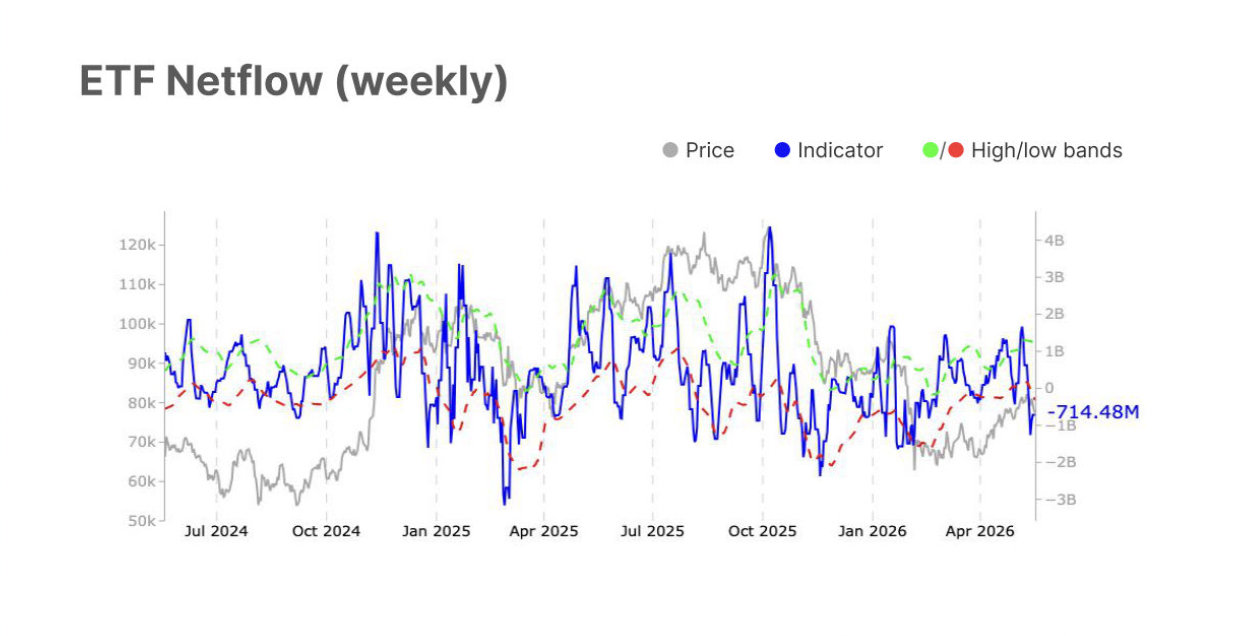
etf netflow
(Glassnode)

“We’ve been saying that STRC and other similar products are driving the demand side, combined with the ETF inflows. Now that the ETF inflows are tinier, and institutional demand isn’t as strong, STRC’s demand isn’t enough, so the overall institutional demand we’re framing is weaker,” they told Sherwood.

Glassnode analysts also said that TradFi sentiment is softening, with “US Spot ETF MVRV [market value to realized value] falling 6.1% and ETF Netflows deteriorating sharply, pointing to weaker institutional conviction.”
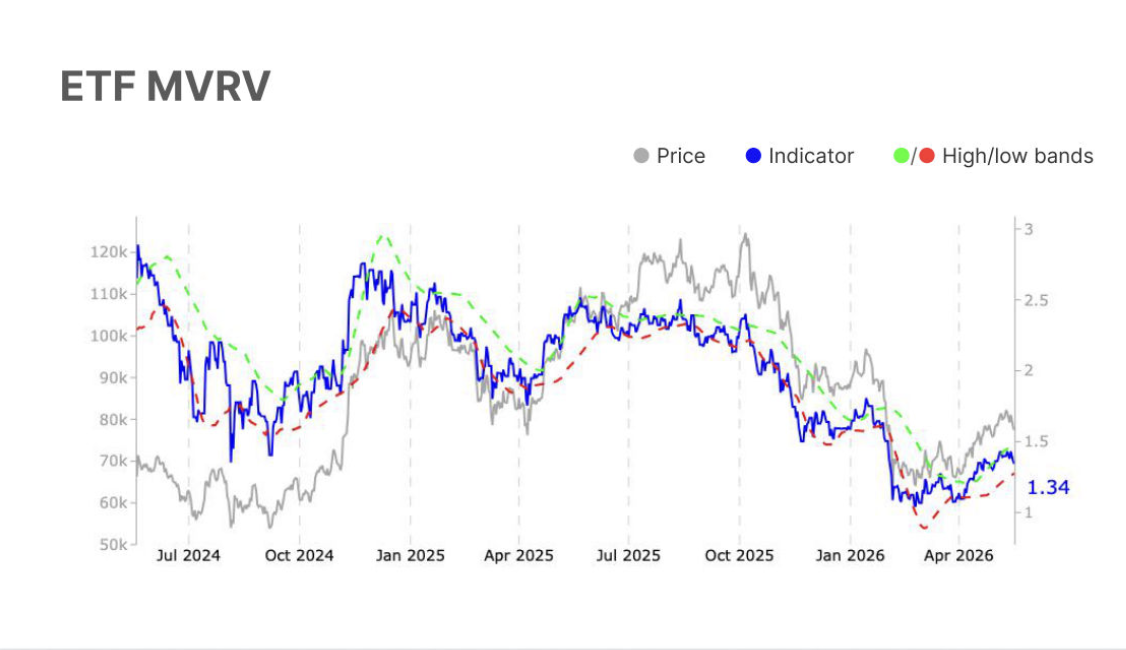
ETF MVRV
(Glassnode)

The ratio represents a 6.11% reduction in the unrealized gains of ETF positions, they said in a report.

Taking a step back, Ishmael Asad, a Bitwise research analyst, told Sherwood that while the outflows are in tandem with bitcoin’s rally cooling off as investors reposition, “YTD net flows for bitcoin ETFs remain slightly positive at about +$432 million, despite a negative YTD return for Bitcoin of -12.3%.”

Concurrently with the brutal outflows, Trump Media & Technology Group withdrew its Bitcoin ETF application on Tuesday, as well as its Bitcoin and Ethereum ETF and its Crypto Blue Chip ETF.

Yorkville America Digital, the sponsor of the Truth Social Bitcoin ETF, said in a press release that “the withdrawal of the ’33 Act filings is a proactive strategic decision,” adding that a 40 Act structure would be more beneficial.

However, Bloomberg Intelligence analyst James Seyffart pointed out another probable reason for the withdrawal: the increasingly competitive bitcoin ETF landscape.

“Of course, a 33 act ETP is different from a 40 act ETF and it has less protections. Anyone in this space knows that. Nothing has changed,” Seyffart posted on X.

In April, Morgan Stanley launched its Morgan Stanley Bitcoin TRUST fund on the New York Stock Exchange. The fund has $232.69 million in assets under management — small potatoes compared to BlackRock’s iShares Bitcoin ETF, which leads the pack with $61.99 billion AUM.

Yet, a major differentiator is that Morgan Stanley’s fund charges a 0.14% fee, the lowest among bitcoin ETFs. In comparison, BlackRock’s iShares Bitcoin Trust charges a 0.25% fee, while Grayscale’s Bitcoin Mini Trust ETF has a 0.15% fee.

More Crypto

See all Crypto
crypto

Hyperliquid reclaims all-time high

HYPE, the native token powering perpetuals exchange Hyperliquid and its underlying blockchain, rebounded to reclaim its all-time high previously set at the start of the month.

Treasury firms Hyperliquid Strategies and Hyperion DeFi have also rallied as the token increased double digits in the last 24 hours to trade as high as $76.70, rising past its record price set nearly two weeks ago, according to CoinGecko. In the interim between all-time highs, HYPE pulled back to around $53.

The token has several tailwinds, the first coming from ETF flows. Since their inception in May, HYPE ETFs have yet to record negative weekly outflows, posting a cumulative total net inflow of $171.8 million, per SoSoValue.

The second comes from Hyperliquid spending basically everything it earns in fees to buy HYPE, a mechanism embedded into the protocol’s codebase.

The venue’s buyback funding mechanism is set to add a new source of yield. Validators of the network activated “AQAv2,” which means stablecoin deployers will share about 90% of reserve yield revenue on their supply within the protocol.

Around $6.1 billion of Circle’s USDC resides in Hyperliquid, per DefiLlama. Accrual begins on August 26 and the first payment is made on October 3, the network announced in its Discord channel last week.

A substantial amount of capital is riding on different positions of HYPE. In total, a move down to under $53 would result in the liquidation nearly 1.8 million HYPE worth of leveraged long positions on the on-chain perps venue, or $131.7 million, data from CoinGlass shows. For the upside, a climb above $100 results in the liquidation of more than 3 million worth of leveraged HYPE short positions, or $221.5 million.

HYPE’s rebound to all-time high comes after Michael Selig, chair of the Commodity Futures Trading Commission, defended his agency’s decision to approve regulated perpetuals, or futures contracts without expiration dates, CNBC reported on Monday.

Last month, the CFTC approved bitcoin perpetual futures trading in the US through regulated prediction markets firm Kalshi and an affiliate of centralized exchange Coinbase.

“Perps are highly likely to become lightly regulated and thus approved in the US,” said David Pakman, head of venture investments at CoinFund.

“We expect to see perps for many different types of assets, from commodities to equities,” Pakman told Sherwood News.

crypto

Crypto market snaps back as sentiment lifts, with altcoins from ethereum to XRP soaring

The market capitalization of the crypto industry has jumped around $83.2 billion in the last 24 hours, with privacy-focused token Zcash and worldcoin, the native cryptocurrency of the network backed by OpenAI CEO Sam Altman, leading market gains, jumping over 22%.

But the last 24 hours have been good across the board:

Investors have been eager to see some positive signs around the Iranian conflict ending, coupled with hopeful outlooks around the CLARITY act, both breathing some life into assets, Kairos Research cofounder Ian Unsworth told Sherwood News.

Simon Shockey, a crypto strategist at crypto wallet infrastructure firm Privy, said the upswing stems from several things converging. He pointed to how alt markets broadly were very oversold following the bug found in Zcash that shook confidence.

Friday, Zcash founder Zooko Wilcox said Anthropic didn’t find any more serious bugs with the Zcash protocol after Shielded Labs requested the AI firm run a security audit of the network with Mythos.

Shockey added that the pool of willing sellers has dwindled. Even if structurally, AI is a much more compelling and asymmetric bet in the eyes of allocators, many of these crypto assets have simply run out of marginal sellers despite some shorter-term narrative-driven pumps. The only people left to sell at this point are the teams themselves and VCs.

Net-net: oversold conditions plus exhausted seller bases plus a macro backdrop thats stabilized equals a snapback, especially in names that have real usage or community conviction behind them,” Shockey told Sherwood.

Latest Stories

Sherwood Media, LLC and Chartr Limited produce fresh and unique perspectives on topical financial news and are fully owned subsidiaries of Robinhood Markets, Inc., and any views expressed here do not necessarily reflect the views of any other Robinhood affiliate, including Robinhood Markets, Inc., Robinhood Financial LLC, Robinhood Securities, LLC, Robinhood Crypto, LLC, Robinhood Money, LLC, Robinhood U.K. Ltd, Robinhood Derivatives, LLC, Robinhood Gold, LLC, Robinhood Asset Management, LLC, Robinhood Credit, Inc., Robinhood Ventures DE, LLC and, where applicable, its managed investment vehicles.