Crypto
Bitcoin ATM In Madrid
A bitcoin ATM (Cristina Arias/Getty Images)
Pain point

$14 billion of bitcoin options expire tomorrow, but geopolitical tensions remain key driver of volatility

The expiries create a gravitational pull in the days leading up to them as market makers hedging their books push bitcoin’s price toward “max pain.”

Bitcoin is down 3.5% over the past 24 hours, trading at the $69,000 level as increased uncertainty about the direction of the conflict in the Middle East, underscored by President Trump’s post warning Iran to “get serious soon, before it is too late,” weighs on the market.

But there’s another event that could add volatility to bitcoin: $14 billion of options, representing 40% of open interest on Deribit, will expire Friday.

Sidrah Fariq, global head of retail at Deribit, told Sherwood News that $75,000 is the “max pain level.”

For those unfamiliar, Arkham explains the max pain level is “a price level where, theoretically, the maximum number of options expire worthless, resulting in the greatest loss for option buyers and the greatest gain for option sellers.”

Fariq said that going into large expiries, hedging flows tend to pull spot trading toward max pain, making it “a natural magnet.”

“With a put/call ratio around 0.63, positioning looks orderly despite geopolitical noise. We’re seeing a controlled setup, volumes have compressed, and institutions continue to overwrite calls higher, capping near-term upside,” Fariq said.

Fariq added that BTC DVOL (Deribit’s 30-day forward-looking index that measures bitcoin volatility based on option prices) in the low 50s reinforces the muted tone.

“Bitcoin had held up well through uncertainty, but a sustained move higher likely needs a fresh catalyst post-expiry,” Fariq said.

Bitcoin has been searching for a catalyst for months, and despite investors clinging to any bit of good news, the asset has remained stuck in a tight range.

Max Kahn, CEO of Digital Wealth Partners, told Sherwood that while Friday’s $14 billion bitcoin options expiry is big, the size doesn’t make it a turning point by itself.

What these expiries actually do, Kahn said, is create gravitational pull in the days leading up to them, as market makers hedging their books push price toward max pain, which is why bitcoin tends to go sideways before a major expiry.

“Dealers are just managing exposure,” he said.

Kahn said that the more interesting moment is what happens after, since once the expiry clears, that hedging pressure disappears and you can get a volatility spike as positions unwind.

“How sharp depends on the calls-to-puts ratio and whether dealers have to scramble to rebalance. A lopsided book means more aggressive hedging, which means bigger moves either way,” he said.

However, he added that this expiry wont override the macro picture.

“ETF flows and broader liquidity are whats actually driving the trend. The expiry accelerates whatevers already happening; it doesnt flip it,” he said.

Several experts agreed, saying the expiry won’t be a factor in bitcoin’s price movement in the long term, as macro and geopolitical drivers continue to dictate its trajectory.

Nic Puckrin, CEO and cofounder of Coin Bureau, told Sherwood that hed expect to see range-bound trading around the $75,000 level, rather than a clear breakout higher. That’s only if bitcoin is trading close to that level already on Friday, as $75,000 can act as a magnet, but there’s no guarantee we will get there.

Puckrin added that the max pain point is a theoretical construct, with the idea that option dealers will try to influence the price to keep it close to that level.

“So its a short-term thing. Once those options expire, its right back to the exact same fundamentals that were driving the price beforehand,” he said, adding that volatility will likely pick up, but this event isnt a long-term driver for BTC price — macro conditions and ETF flows have a far bigger influence overall.

Finally, Glassnode analysts said that what stands out in this expiry is market makers positioned within a corridor of short gamma (which amplifies volatility), concentrated between $70,000 and $75,000 — a zone where price can accelerate in either direction, they said in a report.
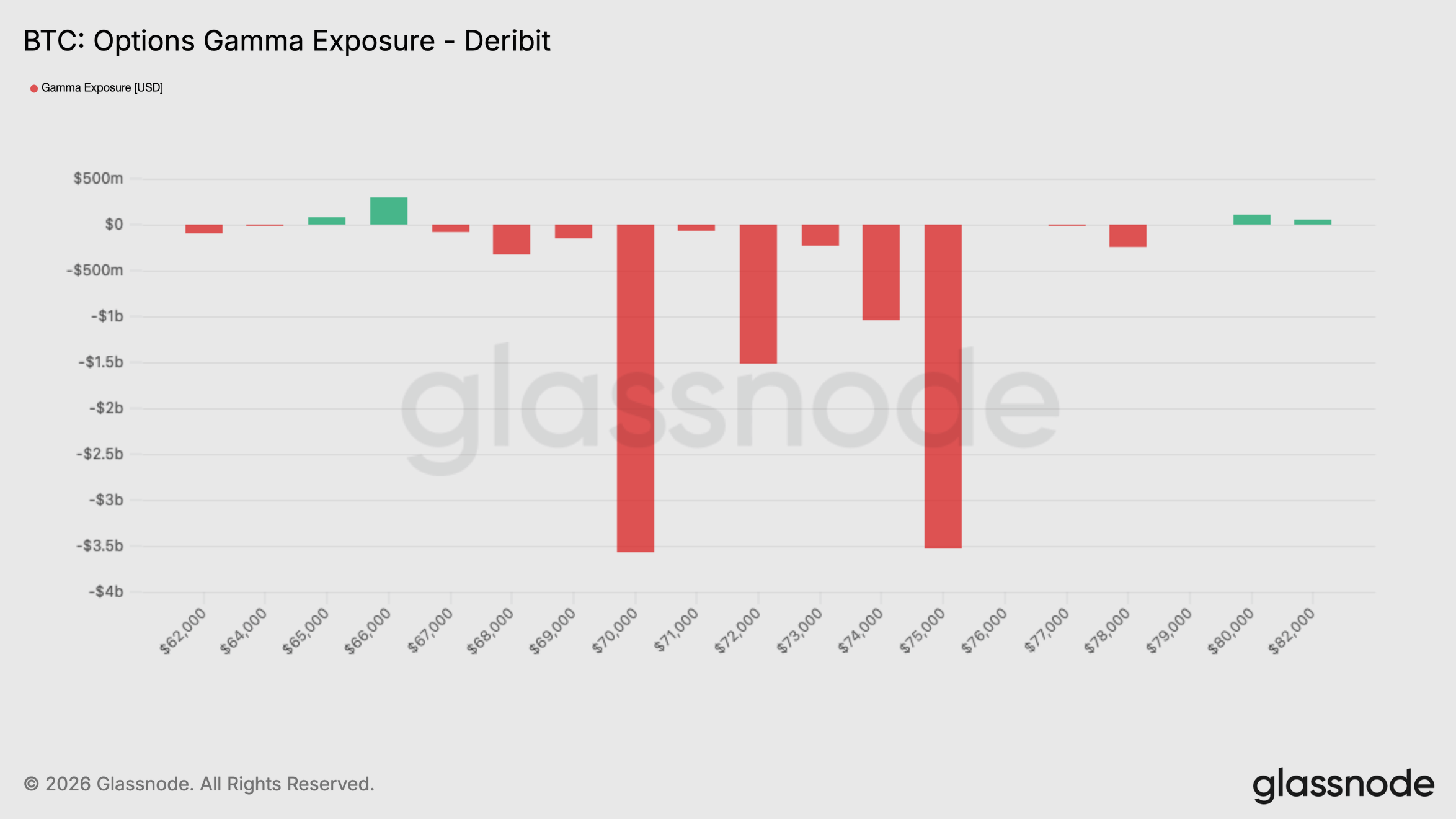
Max pain level btc
(Glassnode)

“Once this positioning clears, the market is likely to become less constrained by hedging flows and more responsive to external drivers. In that context, broader macro conditions are expected to play a larger role in determining where BTC finds its next equilibrium,” they said.

More Crypto

See all Crypto
crypto

For the first time, Fannie Mae will allow mortgages to be backed by crypto

Fannie Mae, the government-backed mortgage finance giant, will start accepting mortgages backed by cryptocurrencies — namely bitcoin and Circle’s stablecoin, USDC. 

Mortgage firm Better Home & Finance and US-based crypto exchange Coinbase Global are rolling out a new product that enables prospective homebuyers to pledge their digital assets as down payment collateral when obtaining a mortgage backed by Fannie Mae, The Wall Street Journal reported

This means homebuyers can secure a standard conforming mortgage without liquidating tokenized assets, which potentially triggers a taxable event.

“If BTC drops in value, the mortgage terms remain unchanged, and no additional collateral is required. Market movements alone never trigger liquidation,” per a joint press release from Better and Coinbase.

“Token-backed mortgages originated by Better are designed in accordance with Fannie Mae guidelines and remain as standard conforming mortgage loans, identical to other conforming mortgages,” the announcement continued.

Max Branzburg, head of consumer and business products at Coinbase, said, “Token-backed mortgages are a major first step to unlocking homeownership for the younger generations that have struggled with barriers to saving for a traditional downpayment.”

The announcement comes more than nine months after William Pulte, the director of the Federal Housing Agency, ordered Fannie Mae and Freddie Mac to prepare a proposal that considers cryptocurrency as a reserve asset in single-family mortgage loan risk assessment. 

This means homebuyers can secure a standard conforming mortgage without liquidating tokenized assets, which potentially triggers a taxable event.

“If BTC drops in value, the mortgage terms remain unchanged, and no additional collateral is required. Market movements alone never trigger liquidation,” per a joint press release from Better and Coinbase.

“Token-backed mortgages originated by Better are designed in accordance with Fannie Mae guidelines and remain as standard conforming mortgage loans, identical to other conforming mortgages,” the announcement continued.

Max Branzburg, head of consumer and business products at Coinbase, said, “Token-backed mortgages are a major first step to unlocking homeownership for the younger generations that have struggled with barriers to saving for a traditional downpayment.”

The announcement comes more than nine months after William Pulte, the director of the Federal Housing Agency, ordered Fannie Mae and Freddie Mac to prepare a proposal that considers cryptocurrency as a reserve asset in single-family mortgage loan risk assessment. 

crypto

GameStop transfers all but 1 bitcoin to Coinbase as collateral

It’s been one year since GameStop added bitcoin as a treasury reserve asset, but the company has since halted its accumulation strategy, joining a fray of companies pivoting away from HODLing the cryptocurrency.

The gaming and collectibles retailer was at one point the 21st-largest bitcoin treasury company, but has since dropped to 190th after pledging all but one of its 4,710 bitcoin as collateral for its covered-call strategy with Coinbase Credit, data from Bitcoin Treasuries shows. Earlier this year, GameStop moved 51% of its bitcoin to Coinbase Prime, triggering speculation that it would offload the asset.

Coinbase Credit has the “right to rehypothecate, commingle, or unilaterally sell the Pledged Bitcoin,” per GameStop’s 10K filing with the SEC on Tuesday. “As a result of these rights, we concluded that control of the Pledged Bitcoin transferred to the counterparty. Accordingly, we derecognized the Pledged Bitcoin as an intangible asset.” That said, GameStop also “recognized digital assets receivable of $368.3 million... representing our contractual right to receive equivalent amount of Bitcoin in the future.”

GameStop sold covered‑call option contracts, which have strike prices ranging from $105,000 to $110,000 and maturities extending through March 2026, to mitigate its exposure to bitcoin’s price volatility and generate incremental yield. 

The move comes as a number of other bitcoin firms have reached a tipping point and sold part of their stockpile. 

  • Empery Digital, the 23rd-largest bitcoin treasury firm, announced in a March press release that it sold $4.2 million worth of BTC to fund share repurchases. DL News also reported that a shareholder who owns 9.8% of Empery Digital demanded the company sell its entire bitcoin stockpile and the immediate resignation of its CEO and entire board of directors. 

  • GD Culture Group approved the sale of an unspecified amount of its 7,500-bitcoin reserve to fund its share repurchase program, according to a press release last month. 

  • Elsewhere, Cango sold 4,451 BTC to reduce its overall finance leverage and strengthen its balance sheet, while Riot Platforms sold around $200 million worth of bitcoin in November and December.

Despite GameStop’s pledge to Coinbase Credit, the company has technically left the door open to resume its bitcoin strategy: the gaming firm said it intends to use net proceeds from its convertible 2030 notes for general corporate purposes, including the acquisition of bitcoin. 

Shares of GameStop are up 2.7% today after posting lackluster Q4 results yesterday.

The move comes as a number of other bitcoin firms have reached a tipping point and sold part of their stockpile. 

  • Empery Digital, the 23rd-largest bitcoin treasury firm, announced in a March press release that it sold $4.2 million worth of BTC to fund share repurchases. DL News also reported that a shareholder who owns 9.8% of Empery Digital demanded the company sell its entire bitcoin stockpile and the immediate resignation of its CEO and entire board of directors. 

  • GD Culture Group approved the sale of an unspecified amount of its 7,500-bitcoin reserve to fund its share repurchase program, according to a press release last month. 

  • Elsewhere, Cango sold 4,451 BTC to reduce its overall finance leverage and strengthen its balance sheet, while Riot Platforms sold around $200 million worth of bitcoin in November and December.

Despite GameStop’s pledge to Coinbase Credit, the company has technically left the door open to resume its bitcoin strategy: the gaming firm said it intends to use net proceeds from its convertible 2030 notes for general corporate purposes, including the acquisition of bitcoin. 

Shares of GameStop are up 2.7% today after posting lackluster Q4 results yesterday.

crypto

Circle plunges on report of proposal prohibiting platforms from offering yield payments

Circle, the firm behind the second-largest stablecoin, USDC, sank over 18.5% after journalist Eleanor Terrett posted on X that lawmakers are considering a proposal that would prohibit platforms such as exchanges and brokers from offering yield payments for holding stablecoins. Shares of US-based crypto exchange Coinbase, which has benefited from its ties to Circle and holds a minority interest in the stablecoin issuer, also fell on the report.

Stablecoin competitor Tether also announced signing a “Big Four” accounting firm to complete a full independent financial statement audit today, aimed at providing assurance that USDT is fully backed and highly liquid, the company’s press release said. The firm has never before allowed an independent audit, which has long plagued the company as investors questioned whether USDT is actually backed by its reserves.

The amount of Circle’s USDC in circulation sits at $81 billion, less than half the figure of the industry leader, Tether, whose USDT stablecoin sits at $184.2 billion, data from blockchain analytics firm Artemis shows

Stablecoin competitor Tether also announced signing a “Big Four” accounting firm to complete a full independent financial statement audit today, aimed at providing assurance that USDT is fully backed and highly liquid, the company’s press release said. The firm has never before allowed an independent audit, which has long plagued the company as investors questioned whether USDT is actually backed by its reserves.

The amount of Circle’s USDC in circulation sits at $81 billion, less than half the figure of the industry leader, Tether, whose USDT stablecoin sits at $184.2 billion, data from blockchain analytics firm Artemis shows

crypto

NYSE teams up with Securitize to create 24/7 tokenized securities market

Securitize, known for bringing real-world assets onto blockchain rails, has signed a memorandum of understanding with the New York Stock Exchange to develop 24/7 tokenized securities markets. 

The tokenization company will become NYSE’s first digital transfer agent, enabling it to mint digital tokens native on a blockchain that represent shares for stocks and ETFs, The Wall Street Journal reports

“This is about building tokenization in a way that works within real market structure, with the protections, controls, and operational integrity required for public securities,” Securitize cofounder and CEO Carlos Domingo said in a statement. 

The news comes after Securitize, backed by BlackRock and Ark Invest, announced plans last year to go public through a SPAC deal with Cantor Equity Partners at a $1.25 billion valuation. 

The partnership between Securitize and the NYSE makes the tokenization ecosystem increasingly crowded — crypto exchange Kraken is working with Nasdaq to offer tokenized stocks and other exchange-traded products, while S&P Dow Jones announced last week licensing the S&P 500 for a derivative contract on perpetual blockchain network Hyperliquid

Tokenization refers to the process of representing financial assets, such as stocks and private credit, through digital tokens that live on blockchain networks. The global market for tokenization stands at $26.5 billion, multiples higher from one year ago, when the figure sat at $7.8 billion, per data from analytics platform rwa.xyz.

“This is about building tokenization in a way that works within real market structure, with the protections, controls, and operational integrity required for public securities,” Securitize cofounder and CEO Carlos Domingo said in a statement. 

The news comes after Securitize, backed by BlackRock and Ark Invest, announced plans last year to go public through a SPAC deal with Cantor Equity Partners at a $1.25 billion valuation. 

The partnership between Securitize and the NYSE makes the tokenization ecosystem increasingly crowded — crypto exchange Kraken is working with Nasdaq to offer tokenized stocks and other exchange-traded products, while S&P Dow Jones announced last week licensing the S&P 500 for a derivative contract on perpetual blockchain network Hyperliquid

Tokenization refers to the process of representing financial assets, such as stocks and private credit, through digital tokens that live on blockchain networks. The global market for tokenization stands at $26.5 billion, multiples higher from one year ago, when the figure sat at $7.8 billion, per data from analytics platform rwa.xyz.

Latest Stories

Sherwood Media, LLC produces fresh and unique perspectives on topical financial news and is a fully owned subsidiary of Robinhood Markets, Inc., and any views expressed here do not necessarily reflect the views of any other Robinhood affiliate, including Robinhood Markets, Inc., Robinhood Financial LLC, Robinhood Securities, LLC, Robinhood Crypto, LLC, Robinhood Derivatives, LLC, or Robinhood Money, LLC. Futures and event contracts are offered through Robinhood Derivatives, LLC.