

BigCheese
America’s love of cheese only seems to grow

America is eating, and exporting, more cheese than ever before
American exports of cheese are tracking 28% ahead of where they were last year, per the USDA
Topping off a pizza. Eyeballing a slice for cracker-stacking. Perfecting your own combination for a grilled sandwich. Many of us have spent time ruminating on one of life’s great questions: what’s the right amount of cheese?
The answer turns out to be exactly the same reply you’d give to a Parmesan-doling server: just a little more…
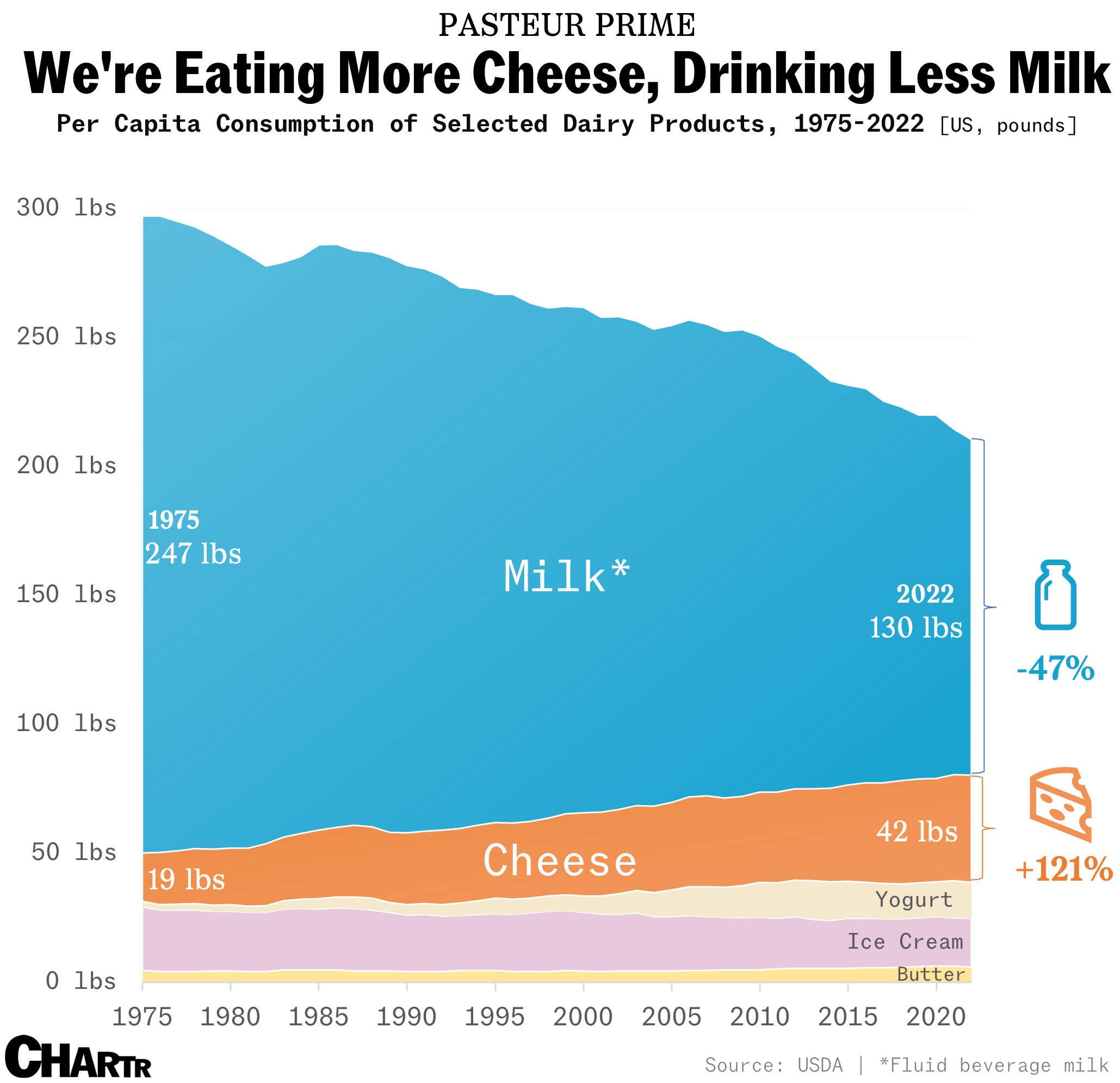
A great report from Bloomberg’s Ilena Peng last week outlined how America’s dairy processors are planning to build new facilities across the US to meet surging demand, which is a headline that could have been from just about any decade in the last 50 years. Indeed, data from the US Department of Agriculture shows that American consumption of cheese amounted to a record-breaking ~42 pounds per year for the average person in 2022, the latest figure available — more than double the amount reported in 1975.
Not milk?
Interestingly, cheese is something of an exception in the world of dairy. As America has sprinkled, grated, and sliced its way through more and more cheese, there’s also been a concurrent 47% decline in fluid milk consumption observed over the same period. In the 20th century, drinking milk was a mainstay of daily life, with its nutritional completeness cementing its place in the American ideal of “growing big and strong” (as well as giving us arguably the best ad campaign of the ‘90s).
Today, a considerable number of people have ditched dairy in favor of plant-based milks like almond, soy, and oat for ethical and dietary reasons (parallel with a counterculture of anti-milk drinking, which some people think is simply “gross”). The boom in alt-milks created a lucrative landscape for fledgling brands like Oatly, which at one point was worth an eye-watering $13 billion (although it is now worth just a tiny fraction of that, some $530 million).
Meanwhile, non-dairy cheeses haven’t taken off in quite the same way. Iterations have struggled to recreate the flavor and texture, with some people, frankly, scarred by sampling a few of these pseudo-cheese attempts, as even VeganCheese.co itself admits.
The discrepancy between these dairy dupes might boil down to one of the unique selling points of regular dairy cheese. As outlined by Bloomberg, the process of making a complex, artisan-derived product from a few simple ingredients, which is hard to do at home, carries weight with an increasingly organic-oriented public.
As well as this, the high protein content of dairy cheese is resonating with a growing number of “gains-conscious” consumers. For example, typically divisive but protein-dense cottage cheese has recently blown up on social media. The longer list of generally viral TikTok recipes also has a very high hit rate for having cheese as a main ingredient.
As Americans dine out more, they may also err on the side of their favorite foods — many of which involve at least some degree of cheese (think: pizza, burgers, pasta).
The Next Great American Cheese
Hard, soft, mild, sharp, nutty, crumbly, salty, smelly, gooey, funky… one of the great wonders of cheese is the sheer scope of its varieties. But, what is America’s favorite?
Americans eat mozzarella more than any other cheese, with the average citizen getting through 12.55 pounds in 2022, per the USDA.
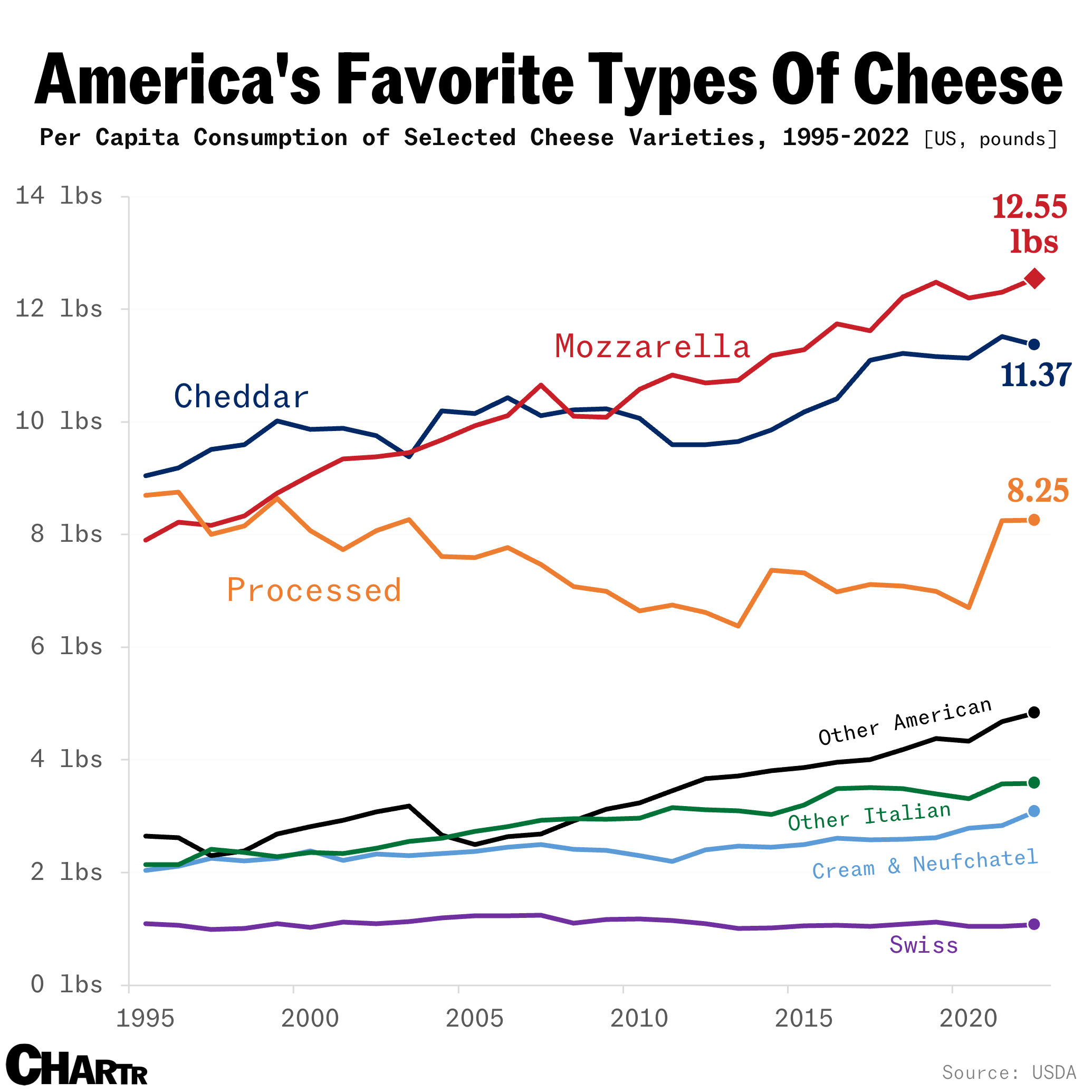
Consumption of the semi-soft Italian cheese has been sharply on the rise since it knocked cheddar off the top spot back in 2010; though, cheddar has hardly fallen out of favor, with the average person eating over 11 pounds of it each year. Interestingly, processed cheese (think: melty slices) has been mounting a comeback since 2020, after consumption dropped at the turn of the millennium.
Maturing markets
What do crude oil and cheese have in common? Not a lot, except that America can’t seem to function without either... and, in recent years, they’ve both become an important American export.
Indeed, while most of America’s favorite cheeses originally derive from elsewhere in the world, the US still makes much of its own supply, accounting for some 29% of the world’s cheese production, second only to the European Union, per the USDA. And, in recent years, it’s started selling more of it abroad.
The US has been a net exporter of cheese since 2010, sending over 450,000 metric tons at its 2022 peak to large international markets like Mexico, where America accounts for 87% of all imported cheese.
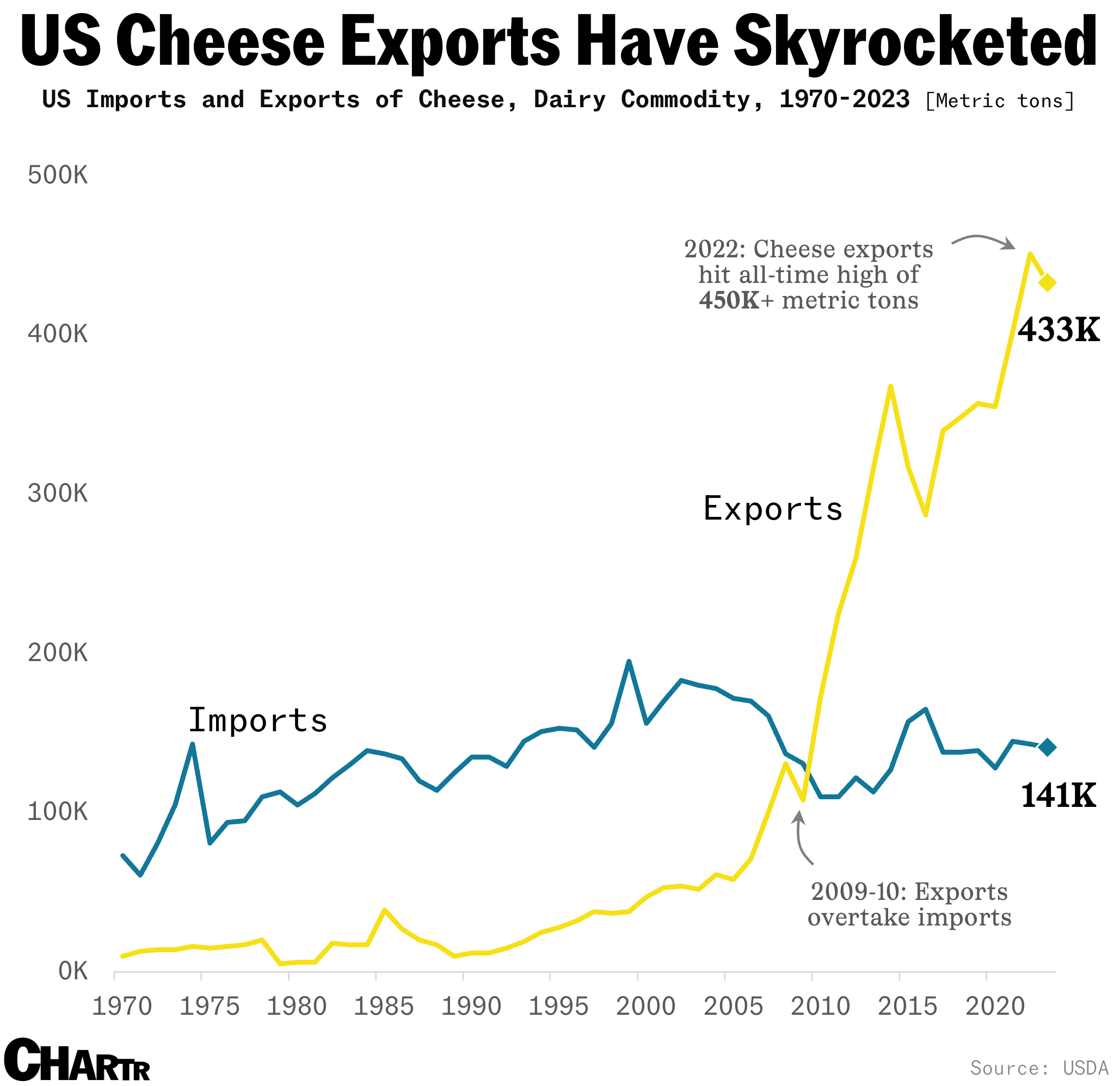
Furthermore, sales of American cheese abroad are only expected to grow, with the USDA forecasting cheese exports to rise 17% from 2023-24 to 507,000 tons. Per the July report:
The outlook for U.S. cheese exports in 2024 is promising, with exports through May already 28 percent higher than the same period in 2023, bolstered by global economic recovery and a significant price advantage against competitors in the first quarter of the year.
While authentic varieties from places like France and Italy must still be shipped into the country, the US has gone all-in on its own overseas sales. Part of this can be chalked up to the continued drive in global demand for cheese, but the US also has a history of having too much of it lying around.
Make America Grate Again
In 1981, when faced with a milk surplus, the federal government under Ronald Reagan began storing the product as cheese in huge quantities. In fact, the ~560 million pounds of cheese mostly kept in subterranean facilities was at one point costing the government ~$1 million a day in storage and interest costs, according to the Washington Post.
While many countries follow the same food stockpiling rulebook to stabilize prices, a recent surge in milk production, alongside the decline in milk consumption, has meant that America’s cheese pile hasn’t gone anywhere. New, tariff-subsidized deals and a greater national appetite for the yellow stuff have helped… but not by enough. As of August 2024, the total cheese cold in storage holdings in the US was reported to be ~1.4 billion pounds.