
Culture
A German Shepherd dog lies with a thoughtful look on the veranda.
Getty Images
TAIL RISKS

Pet spending has soared since Covid, but some Americans can’t afford to keep their cats and dogs

Owner surrenders have soared across the US this year as families grapple with higher costs. Does that say anything about the economy?

David Crowther

America loves its pets.

According to the American Pet Products Association (APPA), some 49 million households have a cat, and a whopping 68 million households have a dog. That means — without even counting fish, reptiles, horses, or birds — a large majority of American households have a pet. That love only intensified during the pandemic, as we sought companionship wherever we could find it.

But now, some owners are having to give up their furry friends, with CNN reporting a rise in “owner surrenders” as the increasing cost of ownership bites. One animal shelter in North Carolina reported that owner surrenders are up 43% this year. Meanwhile, Ruff Start Rescue in Minnesota has seen applications rise 16%, and the Animal Care Centers of New York says it has reached a “breaking point,” suspending its intake entirely.

Fur-saken

Per the APPA, Americans are on track to drop $157 billion on their pets this year, 62% more than they spent in 2019. About 43% of that is on people sustaining their pets day to day with food and treats, while the rest is spent on vet care, medicines, supplies, and more.
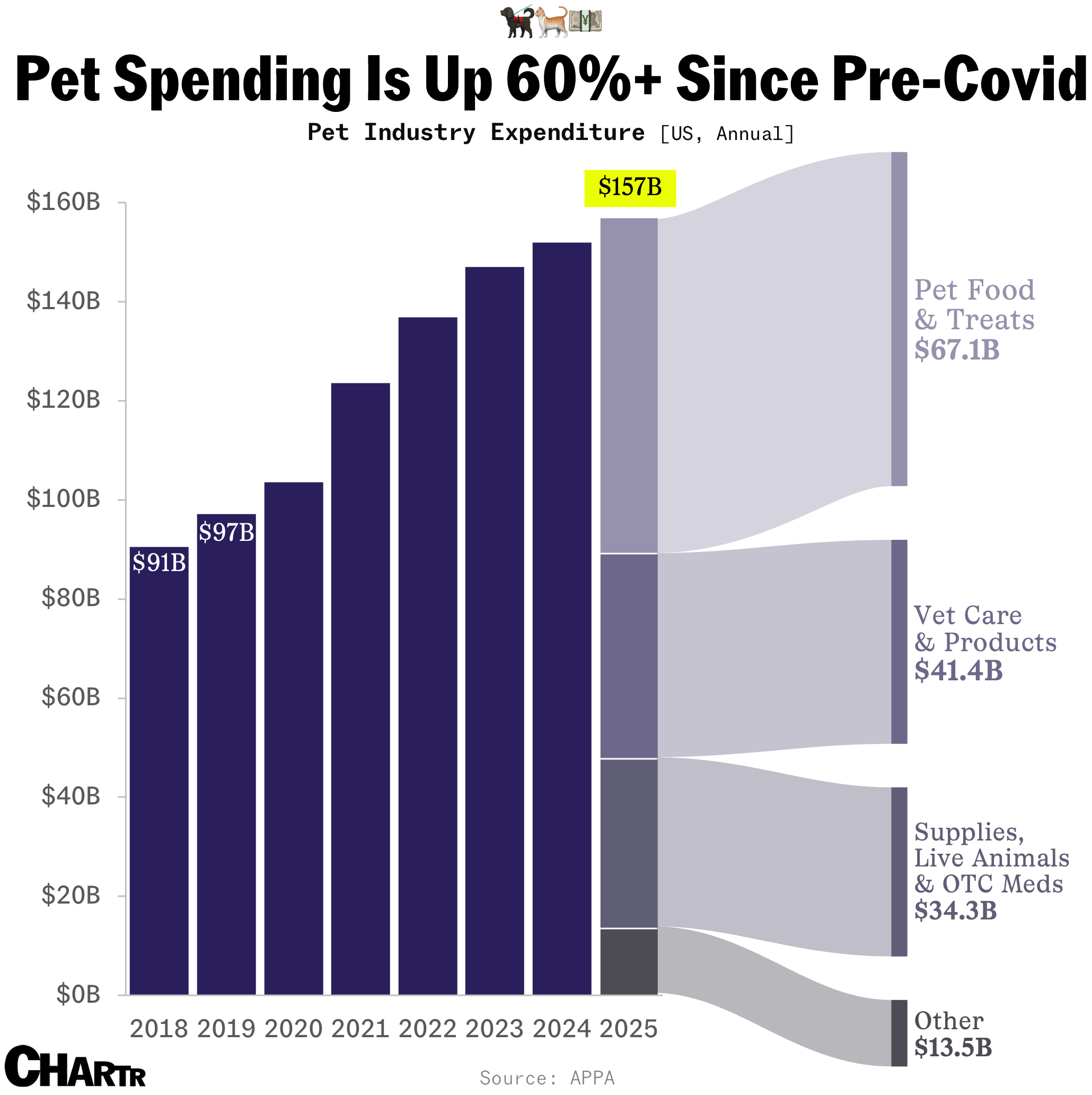
Pet expenditure
Sherwood News

Indeed, though pet food costs are up more than 20% since the pandemic, it seems to be pet services like veterinary access and grooming that are breaking the bank. Per Bank of America analysis, pet services are 42% more expensive in 2025 than they were in 2019.

Pets as a recession indicator?

It might sound barking mad, but given the emotional connection involved, any decision to surrender a pet is presumably never taken lightly — suggesting serious economic hardship is likely at play when so many Americans make the difficult choice to give up their companions.

More Culture

See all Culture
Family in front of TV

Hollywood may have its best year at the box office since 2019, but streaming audiences are still obsessed with old content

Viewers are opting for catalog content over new shows and movies across (pretty much) every major streamer.

Tom Jones6/29/26
culture
Tom Jones

The BBC has become the world’s top news website... by collapsing a little less than its competition

Press Gazette just published its annual look at the biggest news sites in the world across all languages; for the most part, it doesn’t make for particularly pretty reading.

The journalism industry publication’s latest update, which is based on estimates provided by Similarweb for May, found that 37 of the world’s 50 most visited news sites saw their reach shrink. Press Gazette highlighted that American outlets have been hit particularly hard by declining Google traffic compared to European counterparts, owing to the platform’s AI features rolling out earlier in the US.

Even the BBC, having climbed the rankings from last year to top the 2026 chart — reportedly in part thanks to Similarweb’s decision to combine the “.co.uk” and “.com” versions of the URL, given that the sites redirect to each other depending on the user’s location — showed a 1.9% decline from last year.

Latest Stories

Sherwood Media, LLC and Chartr Limited produce fresh and unique perspectives on topical financial news and are fully owned subsidiaries of Robinhood Markets, Inc., and any views expressed here do not necessarily reflect the views of any other Robinhood affiliate, including Robinhood Markets, Inc., Robinhood Financial LLC, Robinhood Securities, LLC, Robinhood Crypto, LLC, Robinhood Money, LLC, Robinhood U.K. Ltd, Robinhood Derivatives, LLC, Robinhood Gold, LLC, Robinhood Asset Management, LLC, Robinhood Credit, Inc., Robinhood Ventures DE, LLC and, where applicable, its managed investment vehicles.