

Markets
markets
Luke Kawa

AMD soars as HSBC hikes price target to a Street high of $310

Shares of Advanced Micro Devices are soaring after HSBC analyst Frank Lee strapped his price target for the chip designer to a rocket ship, hiking it to $310 from $185. The new price target ties that of Arete Research’s Brett Simpson for the highest on Wall Street, per data from Bloomberg.

The recently announced deal with OpenAI, which was followed by news that AMD will deploy 50,000 AI chips in Oracle’s data centers, catalyzed a massive wave of Wall Street love for AMD.

But that’s just nowhere near enough compared to what the stock deserves, per Lee, who sees AMD’s MI450 series of AI chips as being sufficiently competitive to Nvidia’s offerings. Through 2030, he sees the revenue opportunity of the OpenAI deal to be $80 billion.

“We believe the Street has underestimated the AI GPU revenue with our estimates 50% and 45% above consensus for 2026e and 2027e, respectively,” he wrote. “We believe there could be further upside driven by pricing premium as well as additional AI GPU volume.”
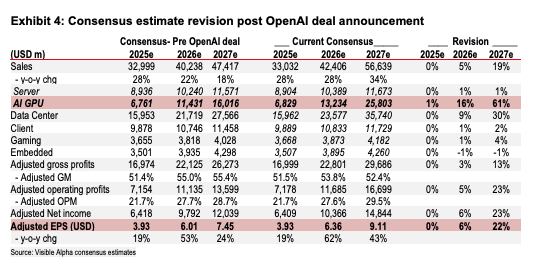
HSBC on AMD revisions
Source; HSBC

More Markets

See all Markets
markets

Michael Burry flags “troubling” jump in Nvidia’s supply commitments

The Big Short investor Michael Burry — famous for betting against the 2008 housing bubble — just warned of a major risk in Nvidia’s latest annual report, pointing to a sixfold surge in purchase obligations over the past year.

In a Substack post Thursday, Burry called the increase from $16.1 billion to $95.2 billion in just 12 months troubling, noting that Nvidia has been forced to place noncancelable purchase orders well before knowing the final demand for its AI chips. The surge is partly tied to supplier TSMC requiring longer-term contracts, he added.

markets

Vistra beats Q4 earnings expectations for adjusted EBITDA, but dips on income decline

Power provider Vistra, a key player in the AI energy trade, reported better-than-expected adjusted earnings results early Thursday, but shares dipped in early trading as Q4 net income dropped.

The Texas-based company, which supplies nuclear- and natural gas-fueled power to wholesale and retail markets, reported:

  • Net income of $233 million, a decline of 52% from Q4 2024.

  • Adjusted EBITDA from ongoing operations of $1.74 billion vs. the $1.71 billion expected by Wall Street analysts.

  • Vistra maintained previously issued guidance for full-year EBITDA from ongoing operations and adjusted free cash flow from ongoing operations.

Vistra shares soared 258% in 2024 amid a flurry of excitement over the AI energy boom. Last year was more muted, with the stock rising 17%. So far in 2026, shares were up roughly 9% before the report.

  • Net income of $233 million, a decline of 52% from Q4 2024.

  • Adjusted EBITDA from ongoing operations of $1.74 billion vs. the $1.71 billion expected by Wall Street analysts.

  • Vistra maintained previously issued guidance for full-year EBITDA from ongoing operations and adjusted free cash flow from ongoing operations.

Vistra shares soared 258% in 2024 amid a flurry of excitement over the AI energy boom. Last year was more muted, with the stock rising 17%. So far in 2026, shares were up roughly 9% before the report.

markets

Sandisk rises on partnership with SK Hynix to standardize memory chip architecture tailored for AI data centers

Sandisk is up 3% in premarket trading on Thursday after it began its global standardization strategy of high-bandwidth flash (HBF) memory solutions with SK Hynix.

SK Hynix commented in a press release on Thursday that by making HBF an industry standard, together with Sandisk, we will lay the foundation for the entire AI ecosystem to grow together,” adding that the companies will set up a dedicated workstream to work on the standardization under the Open Compute Project, the world’s largest organization dealing with data center technologies.

First debuted last February, Sandisk’s HBF technology lies in between ultrafast high-bandwidth memory (HBM) and high-capacity SSDs. That is, these have more storage capacity than HBMs, but are still fast enough to be utilized in AI inferencing (albeit not as quick as HBM).

Sandisk has previously argued that this hybrid architecture is central to AI services that need user applications but require a significant amount of fast interconnect between GPUs. The latest announcement also notes that HBF technology is expected to be more cost-efficient compared to alternatives of similar scale.

The launch, which was shared in an kickoff event on Thursday evening, starts SK Hynix and Sandisk’s workflow, which was announced when the two companies signed a memorandum of understanding “to standardize the specification, define technology requirements and explore the creation of a technology ecosystem” last August, per Sandisk’s press release at the time. Ultimately, by collaborating with SK Hynix, one of the three key HBM suppliers, to standardize and commercialize the technology, Sandisk is manufacturing somewhat of a first-mover advantage to offer the system-level “AI-optimized memory architecture” required for AI inference markets, rather than focusing on the performance of a single chip element.

Latest Stories

Sherwood Media, LLC produces fresh and unique perspectives on topical financial news and is a fully owned subsidiary of Robinhood Markets, Inc., and any views expressed here do not necessarily reflect the views of any other Robinhood affiliate, including Robinhood Markets, Inc., Robinhood Financial LLC, Robinhood Securities, LLC, Robinhood Crypto, LLC, or Robinhood Money, LLC.