
Markets
Apollo robot
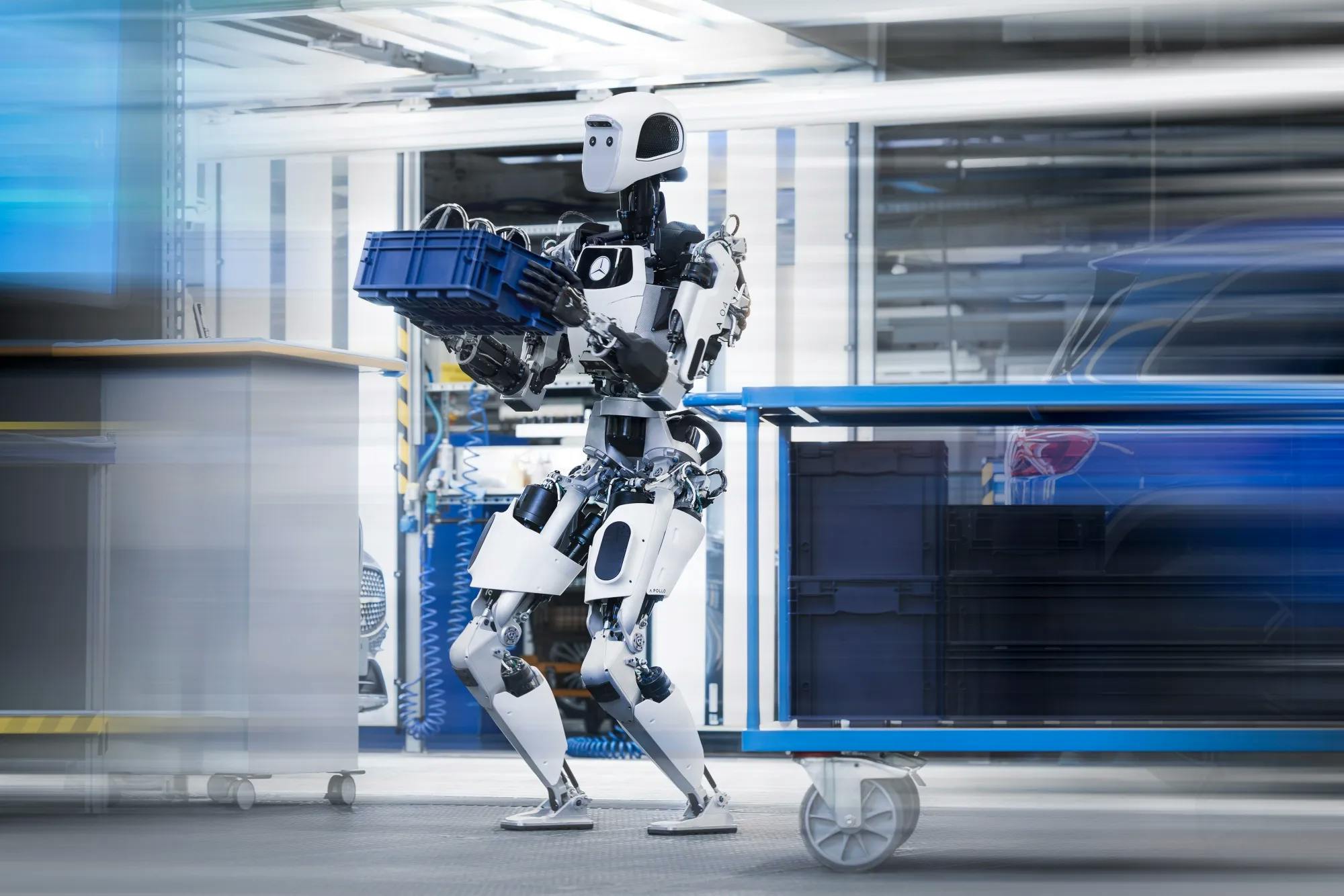
Apptronik’s Apollo humanoid robot (Apptronik)

The threat of AI disruption has dawned on the bond market

22V Research economist Peter Williams noted that medium-term rate expectations have disconnected from recent encouraging labor market data.

Luke Kawa

The stock market was ready to countenance and price in the notion of full-blown AI dystopia — if only for a day.

That was the message from this week’s Citrini Crash (potentially the Citrini Capitulation?) in software stocks.

But stocks aren’t the only asset class willing to price in the disruptive medium-term impacts from the aggressive data center build-out and potential widespread deployment of AI agents. It’s happening in the bond market, too — an asset class that encompasses a much wider set of views on economic activity than any particular sector or industry.

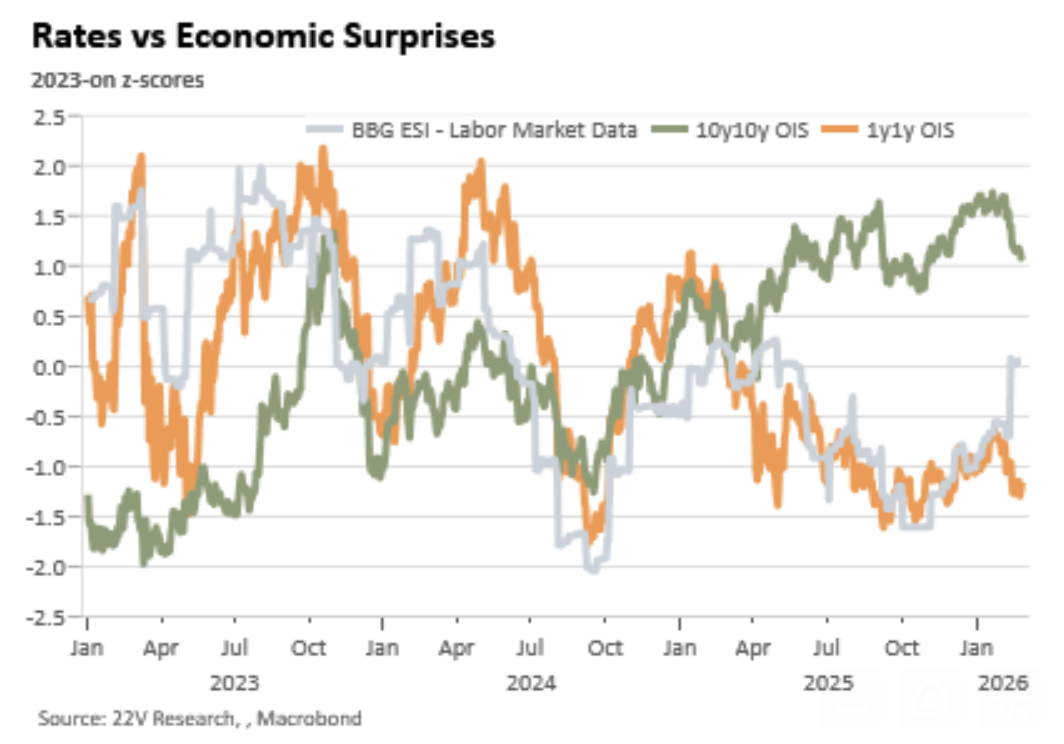
Peter Williams, an economist at 22V Research, wrote that short- and medium-term interest rates have been driven largely by labor market surprises over the past two years, but that this typically strong relationship has recently broken down.

“We’ve gone from the risk of a nonlinear weakening in the current labor market to the risk of a future productivity shock that is so dramatic it dislocates many formerly secure workers starting in a few years and building from there,” Williams told us.
Rates vs Economic Surprises

What is happening to the job market is influencing where rates will be in the near term, but what AI might do to employment is shaping where rates might end up down the line.

That is, expectations for where interest rates will be in July have crept higher as January’s jobs report helped further diminish fears about previous rises in unemployment, but the pricing of interest rates at the end of next year has gone down amid fears that the so-called SaaS-pocalypse is also effectively a white-collar wipeout, with negative economic consequences.

“Farther out the curve where the concerns raised by the Citrini scenario, and similar AI-related cyclical and structural pessimism, more plausibly play a role fed funds expectations have moved notably lower,” Williams wrote. “It’s a rare enough combo to see markets push rates at these horizons 30-40bps in opposite directions given the usual tight links.”

More Markets

See all Markets
markets

Intel is having its best year since 1987

Intel is up for its ninth straight session on Monday, continuing the romp that has made it the top performer in the S&P 500 this month, ganing roughly 46% in April so far.

The series of deals Intel has recently struck with Alphabet on a custom chip collaboration and with Elon Musk on his Terafab project seem to be helping reshape traders’ views on what was seen only a few months ago as an ailing American tech icon.

That turnaround in perception has been nothing short of historic.

Intel is now up almost 230% over the last year. You have to go back to 1987 to find a better 12-month run for the stock.

Still, the forward-looking market is giving Intel credit for a turnaround that really hasn’t happened yet on an operational level. Wall Street analysts expect another year-on-year sales decline when Intel reports results on April 23, while anticipating that Intel can cobble together adjusted earnings per share of a penny.

All the same, the market clearly sees a future that, at least for now, it likes.

markets

Neoclouds surge as Anthropic’s deals mean the scramble for compute is on

Just because software stocks are crushing semiconductors on Monday in a reversal of recent trends doesn’t mean the AI trade is taking a nosedive.

CoreWeave is on fire yet again, with strong follow-through after having reached deals to provide AI compute to Anthropic and Meta last week. Other data center companies like Nebius, IREN, Cipher Digital, and Applied Digital are also up big.

A scramble for compute is particularly great news for these providers of “surge capacity.”

Anthropic is producing AI tools and capabilities that people love. What people have been less than enamored with about Anthropic (especially as of late!) is access to compute, with myriad complaints of stealth token rationing.

OpenAI has reportedly argued that its immense cash burn to accumulate compute is therefore its competitive advantage over the Claude developer. Anthropic is now under pressure to spend a lot more on compute so that its customers are happy with the ability and availability of its offerings.

Similarly, a lot of networking/connectivity stocks that spiked on Friday, like Astera Labs and POET Technologies, are building on that momentum, with flash memory standout Sandisk up strongly as well.

Separately, PJM warned after the close on Friday that the US grid operator is looking to add 15 gigawatts of new power supply due to expected increases in demand tied to AI through Q1 2027. It’s seemingly clearer that there’s strong visibility into increased appetite for compute, power, and the other materials needed to facilitate the boom.

As such, AI energy plays like Vistra, Bloom Energy, Oklo, and Plug Power are also enjoying a solid start to the week.

US-POLITICS-ECONOMY-CONGRESS-BANKING

What to watch as the biggest US banks report earnings

Private credit exposure will be in focus, but banks haven’t been trading in lockstep with BDCs.

markets

Unloved software stocks have their day in the sun

Call it a dead-cat bounce — or for the more optimistically inclined, beaten-down growth stocks finally offering some value:

The iShares Expanded Tech Software ETF is catching a bid on Monday morning, up nearly 3% as of 10 a.m. ET, while the VanEck Semiconductor ETF is trading roughly flat.

As a compromise, you could say that software’s trading like nobody owns it and investors have decided to maybe not short it so much.

The likes of Workday, ServiceNow, AppLovin, CrowdStrike, Atlassian, Palantir, and Circle are posting massive gains to kick off the week.

In the five sessions ended Friday, the semis ETF outperformed its software counterpart by a whopping 18.4 percentage points, the most on record.

For what it’s worth, the chart also shows that semis vs. software has had some very significant, tradable reversals despite how poorly the latter has performed this year. In fact, software’s best-ever five-session stretch relative to semis came in early March, when traders were digesting the US-Israeli attacks against Iran.

These two major parts of the tech sector have never traded more out of step with one another than they have been lately.

Latest Stories

Sherwood Media, LLC produces fresh and unique perspectives on topical financial news and is a fully owned subsidiary of Robinhood Markets, Inc., and any views expressed here do not necessarily reflect the views of any other Robinhood affiliate, including Robinhood Markets, Inc., Robinhood Financial LLC, Robinhood Securities, LLC, Robinhood Crypto, LLC, Robinhood Derivatives, LLC, or Robinhood Money, LLC. Futures and event contracts are offered through Robinhood Derivatives, LLC.

