
Markets
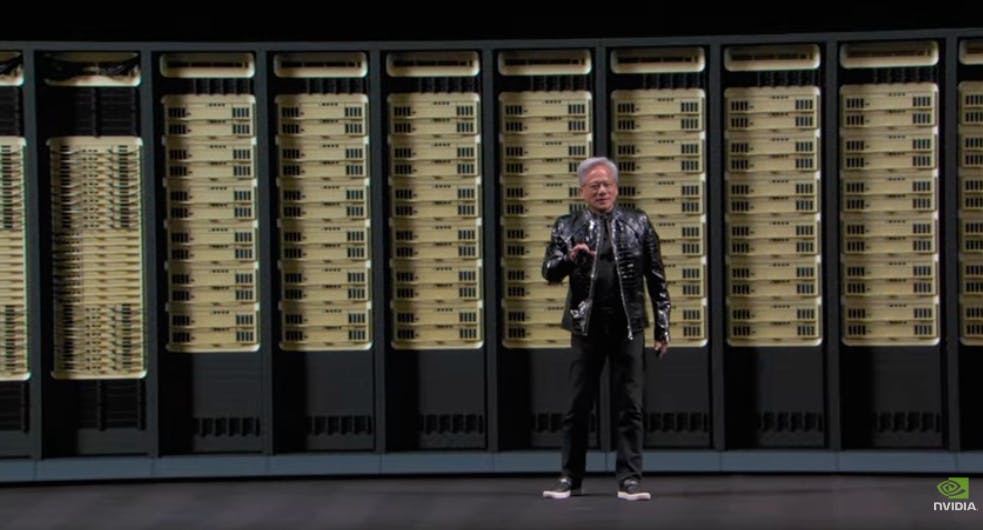
Jensen Huang in front of Vera Rubin at CES 2026
(Nvidia)

Why Nvidia’s terrific quarter is getting a terrible reaction

Nvidia’s CEO gave a deeply unsatisfying answer about his biggest customers’ ability to generate cash. But they might be investing more in AI GPUs in 2027 anyway.

Luke Kawa

Terrific quarter, terrible reaction.

That’s Wall Street’s read on another Nvidia earnings report that beat expectations and offered very optimistic sales guidance for the current quarter.

Shares were up as much as 4% after the release of its Q4 financials and Q1 outlook, but lost nearly all of that advance during the conference call. The stock is down 3% as of 10 a.m. ET.

“We aren’t sure what else investors want to hear at this point,” said Bernstein analyst Stacy Rasgon. “But we like what we heard.”

Management indicated high visibility into demand for not just this year, but 2027 as well — and they’re so confident in it that they’re already locking down the supply to be able to meet it. However, there still seems to be lingering doubt about the willingness of Nvidia’s biggest customers to enhance their multiyear capex binges, given the performance of their share prices and the pressure on their cash flow generation.

While it’s tough to ascribe strong causality, downward momentum on Nvidia shares during the conference call started as CFO Colette Kress talked about challenges accessing the Chinese market as well as rising competition from the AI players there, and then as CEO Jensen Huang responded to the first question from analysts.

BofA’s Vivek Arya asked Huang if he was confident in hyperscalers’ ability to grow capex going forward given how much their cash flows have come under pressure.

Huang said he was confident that hyperscalers’ cash flows would improve, and suggested that without more compute, these megacap tech giants would see their top lines stagnate.

“Without compute, there’s no way to generate tokens. Without tokens, there’s no way to grow revenues,” he said. “So in this new world of AI, compute equals revenues.”

But the thing about the cash flows...

They’re expected to grow for most publicly traded hyperscalers this year. And to be better in 2027 versus 2026. But the expectations for cash flow generation have been universally revised to the downside since the AI boom started.

Cumulative free cash flows for hyperscalers have been expected to be “better next year” at every point in time in the AI boom. And they never have.

It doesn’t take a rocket scientist or AGI to tell you that this probably has something to do with how much capex keeps going up, and surprising to the upside.

“The stock response suggests investors were left wanting more, which we think is tied to continued uncertainty around the growth trajectory for NVDA’s Data Center business in calendar year 27, given massively expanded capex budgets for key customers (aggregate capex for the top 5 US hyperscalers is now forecast to grow ~70% Y/Y to $650B+ in CY26) alongside significantly compressed free cash flow profiles,” JPMorgan analyst Harlan Sur wrote.

Meanwhile, Morgan Stanley analyst Joseph Moore noted that Huang’s answer appearing to be deeply unsatisfying (my words, not his!) may simply be immaterial to the company’s 2027 sales outlook.

“Nvidia believes that these cash issues will be resolved by the cash flows of AI factories being much better than expected — but that in turn requires token monetization that is also better than expected,” he wrote. “While we would stop short of believing the most bullish five year views, we do continue to think that there is no visibility to any pause in the current levels of strong demand.”

A more realistic answer from Huang might have gone something like: “I’m not sure what their free cash flows are going to, but they’re hell-bent on spending more. Look at the agreement we just reached with Meta!”

As such, we have a mediocre reaction to an objectively stellar set of numbers from a company that is not trading at an absurd valuation.

That tells us something important:

It’s a reminder that while Big Tech execs’ imagination over what this potentially transformative technology can be is boundless, the willingness of investors to buy into and fund that vision is not.

Capital markets will be the constraint on capital investment.

More Markets

See all Markets
markets

Neoclouds surge as Anthropic’s deals mean the scramble for compute is on

Just because software stocks are crushing semiconductors on Monday in a reversal of recent trends doesn’t mean the AI trade is taking a nosedive.

CoreWeave is on fire yet again, with strong follow-through after having reached deals to provide AI compute to Anthropic and Meta last week. Other data center companies like Nebius, IREN, Cipher Digital, and Applied Digital are also up big.

A scramble for compute is particularly great news for these providers of “surge capacity.”

Anthropic is producing AI tools and capabilities that people love. What people have been less than enamored with about Anthropic (especially as of late!) is access to compute, with myriad complaints of stealth token rationing.

OpenAI has reportedly argued that its immense cash burn to accumulate compute is therefore its competitive advantage over the Claude developer. Anthropic is now under pressure to spend a lot more on compute so that its customers are happy with the ability and availability of its offerings.

Similarly, a lot of networking/connectivity stocks that spiked on Friday, like Astera Labs and POET Technologies, are building on that momentum, with flash memory standout Sandisk up strongly as well.

Separately, PJM warned after the close on Friday that the US grid operator is looking to add 15 gigawatts of new power supply due to expected increases in demand tied to AI through Q1 2027. It’s seemingly clearer that there’s strong visibility into increased appetite for compute, power, and the other materials needed to facilitate the boom.

As such, AI energy plays like Vistra, Bloom Energy, Oklo, and Plug Power are also enjoying a solid start to the week.

US-POLITICS-ECONOMY-CONGRESS-BANKING

What to watch as the biggest US banks report earnings

Private credit exposure will be in focus, but banks haven’t been trading in lockstep with BDCs.

markets

Unloved software stocks have their day in the sun

Call it a dead-cat bounce — or for the more optimistically inclined, beaten-down growth stocks finally offering some value:

The iShares Expanded Tech Software ETF is catching a bid on Monday morning, up nearly 3% as of 10 a.m. ET, while the VanEck Semiconductor ETF is trading roughly flat.

As a compromise, you could say that software’s trading like nobody owns it and investors have decided to maybe not short it so much.

The likes of Workday, ServiceNow, AppLovin, CrowdStrike, Atlassian, Palantir, and Circle are posting massive gains to kick off the week.

In the five sessions ended Friday, the semis ETF outperformed its software counterpart by a whopping 18.4 percentage points, the most on record.

For what it’s worth, the chart also shows that semis vs. software has had some very significant, tradable reversals despite how poorly the latter has performed this year. In fact, software’s best-ever five-session stretch relative to semis came in early March, when traders were digesting the US-Israeli attacks against Iran.

These two major parts of the tech sector have never traded more out of step with one another than they have been lately.

markets

Goldman analysts are watching these non-software growth stocks

It’s been a rough run for what Wall Street calls secular growth stocks: companies that can boost sales because of long-term shifts in their sector, almost regardless of broader economic conditions.

Software stocks, longtime secular growth poster children, have recently been creamed by worries their days are numbered due to AI. Despite weathering the market shocks from the war with Iran relatively well, software remains down sharply, with the iShares Expanded Tech Software ETF down roughly 30% for the year.

But software hasn’t been the only problem.

“Even excluding Software, many secular growth stocks have recently
underperformed and trade at discounted valuation multiples relative to the
past decade,” Goldman analysts wrote in a note published Friday.

That could be an opportunity, they suggested.

“The median non-software stock in our Rule of 10 secular growth screen trades at a P/E of 29x, a 53% premium to the median S&P 500 stock that is close to the bottom of the range during the past 10 years. Consensus 2027 sales growth for the median company in the screen is 3x the growth rate for the median S&P 500 company. PEG ratios are also similar to levels reached during recent troughs.”

The company noted that power infrastructure is a particularly interesting place to prospect for non-software-related growth at something of a discount.

It also provided a helpful list of non-software growth stocks based on its screen for companies that have notched 10% sales growth in 2024 and 2025 and are expected to do the same through 2028.

It includes familiar AI-related names like Broadcom, Advanced Micro Devices, Vertiv Holdings, Arista Networks, and Nvidia, as well as a couple outliers such as DoorDash and Axon.

We’ve thrown in the dates of their upcoming earnings reports, which will be interesting to keep an eye on over the next few weeks.

markets

Brent crude surges past $100 again and stocks tick lower after Trump orders Hormuz blockade

Oil prices topped $100 a barrel once again and stocks fell in early trading after President Trump announced the US will blockade the Strait of Hormuz starting Monday.

After US-Iran peace talks in Pakistan failed to reach a deal over the weekend, Trump said Sunday morning in a Truth Social post that the Navy would block any and all Ships trying to enter, or leave, the Strait of Hormuz.” US Central Command later confirmed the blockade would begin at 10 a.m. ET Monday, adding that vessels transiting the strait to and from non-Iranian ports would not be impeded.

Futures on international benchmark Brent crude rose nearly 8% to $103 per barrel, while US West Texas Intermediate crude also gained ~8% to $104 per barrel as of 5:30 a.m. Asia markets traded lower, with Japan’s Nikkei 225 and South Korea’s KOSPI falling 0.7% and 0.9%, respectively. Europe’s STOXX 600 was also modestly in the red, while S&P 500 futures were off 0.5%.

The early morning action is reminiscent of the early days of the war, with energy stocks catching a bid as oil prices jumped. Oil and gas producers including Occidental Petroleum, Devon Energy, Diamondback Energy, ConocoPhillips, APA Corporation, Coterra Energy, and EOG Resources all rose in premarket trading, alongside oil majors Exxon and Chevron, as well as refiners Marathon Petroleum, Valero, and Phillips 66.

Oil field services company Halliburton and natural gas producer EQT Corp. also gained, along with chemical makers Dow, Inc. and LyondellBasell, fertilizer company CF Industries, and natural gas exporter Cheniere Energy.

Airline and cruise stocks moved in the opposite direction, giving back last week’s ceasefire-driven gains as the anticipation of higher fuel costs once again weighed on both sectors. Delta Air Lines, United Airlines, and American Airlines were all down 2% to 3% in premarket trading, along with Royal Caribbean, Carnival, and Norwegian.

Latest Stories

Sherwood Media, LLC produces fresh and unique perspectives on topical financial news and is a fully owned subsidiary of Robinhood Markets, Inc., and any views expressed here do not necessarily reflect the views of any other Robinhood affiliate, including Robinhood Markets, Inc., Robinhood Financial LLC, Robinhood Securities, LLC, Robinhood Crypto, LLC, Robinhood Derivatives, LLC, or Robinhood Money, LLC. Futures and event contracts are offered through Robinhood Derivatives, LLC.

