
Markets
ETHICS act congressional stock trading
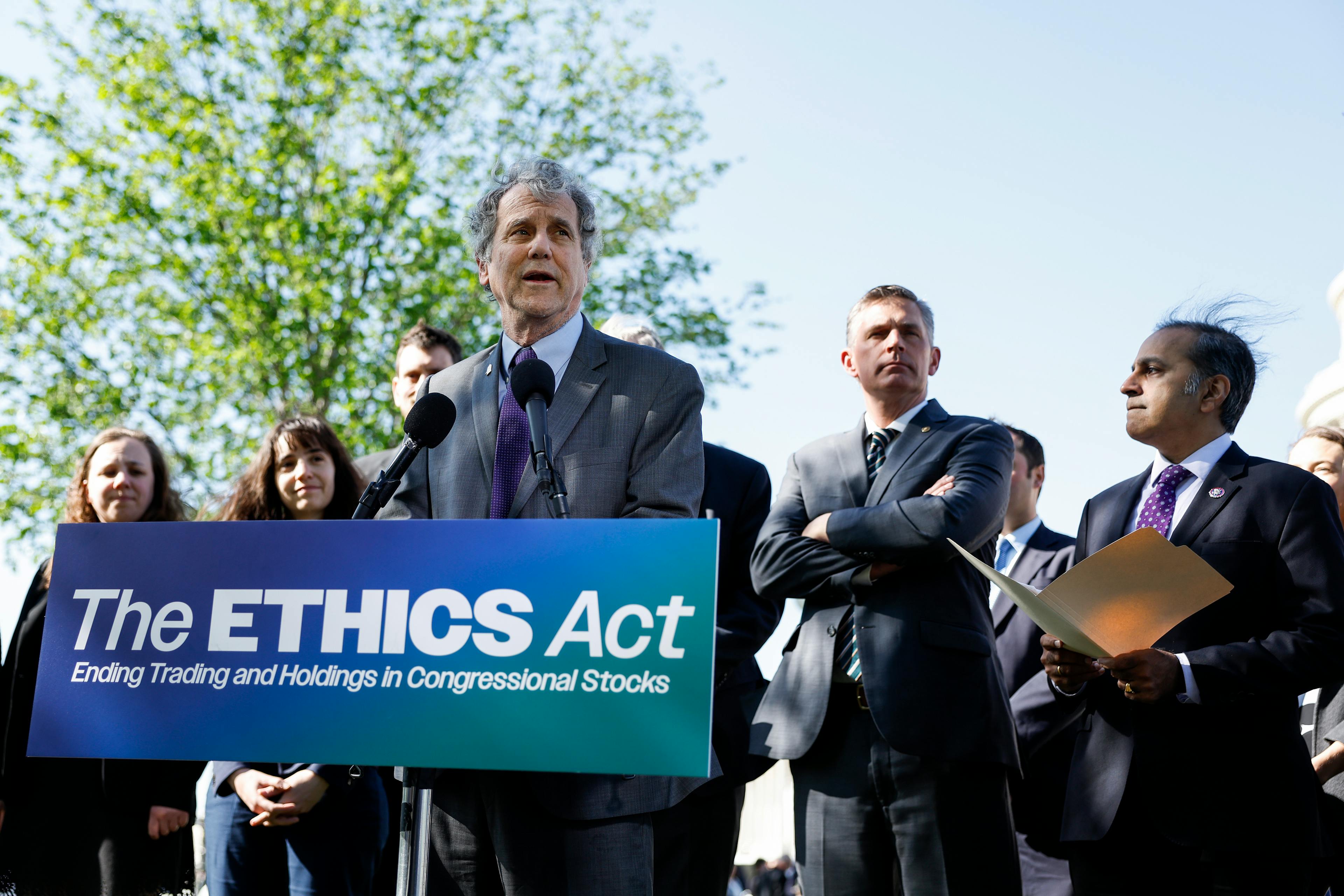
Sen. Sherrod Brown (D-OH) at a April 2023 press conference on the introduction of the Senate ETHICS Act. (Photo by Anna Moneymaker/Getty Images)

When Congress sells a stock short, it makes money

The infuriating yet unsurprising results of a new academic study

Don’t sell yourself short. Great advice in life.

When a member of Congress sells something short, they’re probably on to something.

Also great advice, according to a new paper from a pair of well-respected law and finance professors that shines additional light on the lunacy of continuing to permit stock trading by elected officials in Congress.

The analysis, from Berkeley Law’s Frank Partnoy and Peter Molk, of the College of Law at the University of Florida, uses a newly available dataset — based upon required disclosures by members of Congress in the aftermath of trading scandals over a decade ago — to gauge whether the success of their trades could indicate these public officials are basing their trade on access to better information than the public at large.

The upshot? It seems pretty likely when they’re betting that the price of a stock will fall, a technique known as “shorting.” The authors write:

Based on a new comprehensive dataset of trades by members of Congress, that negative trading not only is common, but also is associated with positive abnormal financial returns. Simply put, members of Congress’s bets on stock price drops make money...The evidence is consistent with a story that some members of Congress make money on, and are guided by material nonpublic information in, their negative trades but not their positive ones.

This stands to reason, as elected officials are regularly privy to nonpublic information concerning companies, such as regulatory actions or potential legislative changes that could influence how much money companies make. (On the other hand, these academics don’t find that Congressmen and women do much better than average when they are betting on a rise in prices.)

Despite the depressing regularity of dopey, and bipartisan, Congressional trading scandals — remember Buffalo area Congressman Chris Collins? North Carolina Senator Richard Burr? New Jersey’s Tom Malinowski? Or the members who thought it was a good idea to trade bank stocks in the midst of the 2023 regional banking crisis? — the practice continues to the allowed.

The STOCK Act was passed in 2012, after SEC investigations into the trading activity of Tennessee Republican Bill Frist, the former majority leader of the Senate, as well as a high profile “60 Minutes” examination of trading from prominent members of congress such as then House Speaker John Boehner (R-OH) and his predecessor as speaker, California Democrat Nancy Pelosi, among others. (I would note that a former colleague, the Wall Street Journal’s Jason Zweig, was well ahead of the curve on issues with Congressional trading, spotlighting it in his column way back in 2010.)

But the STOCK Act is largely a disclosure-based law that requires reporting after selling shares and, essentially, clarifies that insider trading laws also extend to members of Congress who trade on nonpublic information. There has been little sign that the law has deterred members’ trading activity that poses conflicts of interest.

But hope springs eternal. Last April, a bipartisan Congressional group unveiled the ETHICS (Ending Trading and Holdings in Congressional Stocks) Act, that aims to “prohibit members of Congress, their spouses and dependent children from abusing their positions for personal financial gain by owning or trading securities, commodities, or futures.” And just this month, the Senate introduced its version of the bill.

"The truth is Congress should not be here to make a buck. Congress should be here to serve the American people,” Sen. Josh Hawley, of Missouri, told reporters, upon the introduction of the bill.

Seems simple enough.

More Markets

See all Markets
markets

With their recent surge, Intel shares just hit their highest level since the dot-com era

Intel’s surge of nearly 60% this month has the iconic American chipmaker’s stock price approaching levels last seen during the dot-com era. Bloomberg noted that shares just touched their highest intraday level since the turn of the century:

The stock rose as much as 1.5% to $69.55, topping a peak it hit on Jan. 24, 2020. The shares are up 90% this year, after soaring 84% in 2025. Intel is now roughly 8% from its all-time closing high of $74.88, established on Aug. 31, 2000.

That’s just the most recent late-’90s-era throwback we’ve been seeing in tech shares lately. Oracle is currently pacing for its best week since late 1999.

What’s even more remarkable, however, is that Intel’s forward price-to-earnings ratio today dwarfs the premiums the market was putting on the stock during the nuttiness of the dot-com mania.

That reflects the fact that the recent run-up in Intel shares is, essentially, giving the chip giant credit for a massive turnaround that hasn’t actually happened yet.

One also might wonder if the fact that Intel is partially owned by the US government means it’s more attractive — and therefore worth a higher premium — than other chipmakers without the state imprimatur.

Still, kind of startling.

markets

Eli Lilly’s GLP-1 pill hit nearly 1,400 prescriptions in first week

Eli Lilly rose after preliminary numbers cited by Wall Street analysts showed strong uptake of its new weight-loss pill.

The FDA approved Foundayo on April 1 and shipments began on April 9. In its first week, roughly 1,400 US prescriptions were written for the drug, according to IQVIA data cited by Deustche Bank analysts in a Friday note.

Novo Nordisk, Lilly’s rival in the GLP-1 market, released its GLP-1 pill earlier this year, and early signs show that it’s expanding the market, inviting patients who were turned off by weekly injections. Novo’s pill had a stronger first week than Lilly’s, with its Wegovy pill hitting 3,071 US prescriptions in the first four days after its launch on January 5.

Lilly’s pill has an advantage over Novo’s, which is that it can be taken at any time of day, with or without food. Lilly disclosed in a February regulatory filing that it had $1.5 billion worth of prelaunch inventory ready ahead of the FDA approval — which is about as much as analysts polled by FactSet expect it to sell this year.

Novo Nordisk, Lilly’s rival in the GLP-1 market, released its GLP-1 pill earlier this year, and early signs show that it’s expanding the market, inviting patients who were turned off by weekly injections. Novo’s pill had a stronger first week than Lilly’s, with its Wegovy pill hitting 3,071 US prescriptions in the first four days after its launch on January 5.

Lilly’s pill has an advantage over Novo’s, which is that it can be taken at any time of day, with or without food. Lilly disclosed in a February regulatory filing that it had $1.5 billion worth of prelaunch inventory ready ahead of the FDA approval — which is about as much as analysts polled by FactSet expect it to sell this year.

markets

Critical Metals jumps after Greenland’s government approves CRML to take majority control of the Tanbreez mining project

Critical Metals is up more than 25% in premarket trading on Friday after the critical mining company announced that it now owns 92.5% of the Tanbreez rare earth deposit following an approval from the government of Greenland.

With that latest government support, Critical Minerals added an additional 50.5% stake to its ownership, reportedly acquired from Rimbal Pty Ltd, per Bloomberg News. With access to eight heavy rare earth elements often used in consumer electronics and defense, the site is one of the world’s largest undeveloped rare earth deposits and a key source of rare earth supply outside of China, according to the company.

In Critical Metals’ press release, Chairman Tony Sage commented that the approval “removes the most significant structural overhang on the project and provides the clarity to advance Tanbreez to production with confidence,” especially as Tanbreez’s location offers a significant logistical advantage through its year-round direct shipping access, compared to rival projects.

With 92.5% of the project now vested in Critical Metals Corp., and the remainder owned by European Lithium Ltd., CRML now has full control of the project and is seeking to accelerate development there, with plans for a new international airport and a 150-tonne bulk sample program, which is slated for June 2026.

Latest Stories

Sherwood Media, LLC produces fresh and unique perspectives on topical financial news and is a fully owned subsidiary of Robinhood Markets, Inc., and any views expressed here do not necessarily reflect the views of any other Robinhood affiliate, including Robinhood Markets, Inc., Robinhood Financial LLC, Robinhood Securities, LLC, Robinhood Crypto, LLC, Robinhood Derivatives, LLC, or Robinhood Money, LLC. Futures and event contracts are offered through Robinhood Derivatives, LLC.

