
Markets
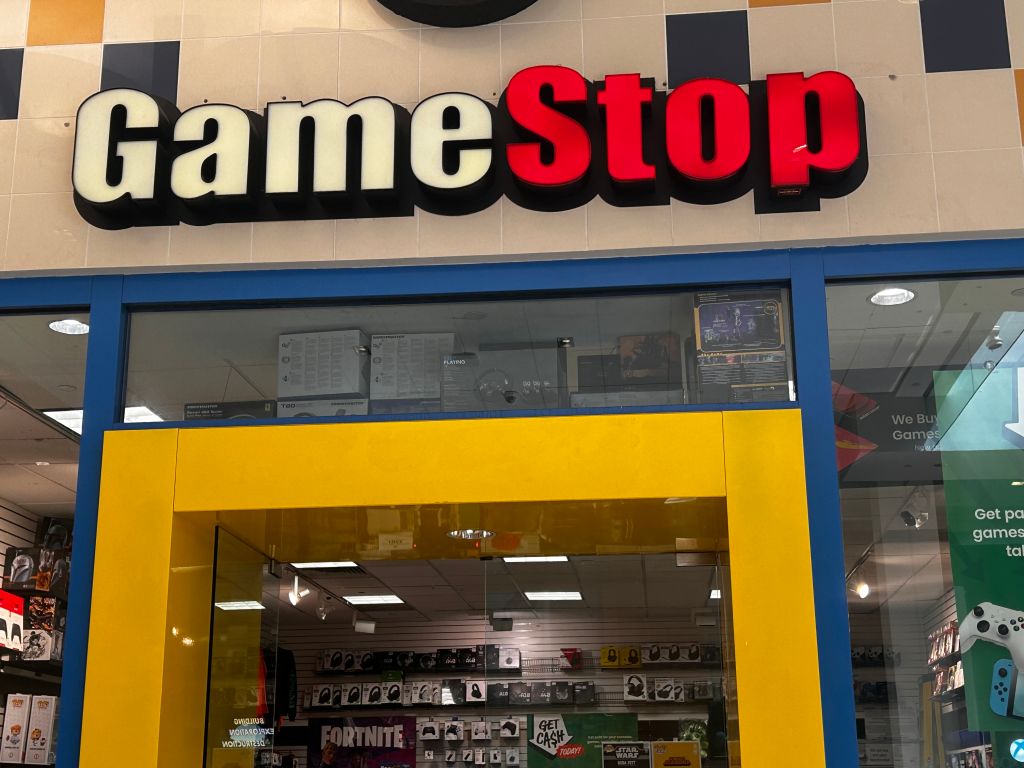
GameStop store entrance at Rego Center shopping mall, Queens, New York
(Photo by Lindsey Nicholson/UCG/Universal Images Group via Getty Images)

GameStop says its stock went up for no good reason and it's trying to take advantage

We had to ask: What took them so long?

Luke Kawa
Updated 5/17/24 9:51AM

Shares of GameStop are down more than 20% in the pre-market as the company joins AMC in using this period of market exuberance to improve its financial position.

The company announced plans to work with Jefferies to sell up to 45 million shares on the open market to raise money. As part of the prospectus supplement, the firm comments on the recent frenzy (emphasis added):

During such period, we did not experience any material changes in our financial condition or results of operations that would explain such price volatility or trading volume. Furthermore, since January 2021 through the date hereof, the market price of our common stock has seen extreme price fluctuations that do not appear to be based on the underlying fundamentals of our business or results of operations. Investors that purchase shares of our common stock in this offering may lose a significant portion of their investments if the price of our common stock subsequently declines.

One question is, what took them so long? It’s the duty of management to obviously run the company well, be operationally sound, look for efficiencies on the cost side and drive growth on the revenue side, and all that. But it’s also their responsibility to make shrewd financing decisions and, perhaps in this case, to have been better prepared for lightning to strike twice.

Both AMC and GME enjoyed parabolic rises in their share prices to open this week; by Tuesday, AMC had taken advantage by issuing more equity to reduce debt. GME may be only able to get in on the game now because it was somewhat constrained by a so-called “blackout period” ahead of the release of its quarterly earnings report, which had been scheduled for June 7. During blackout periods, bringing offerings to market is generally a no-no. One way to get around this is to come forward with your results early.

As such, GameStop also released preliminary unaudited quarterly results for the three months ending May 4, 2024. Though net sales shrank roughly 30% year-on-year, the net loss actually slimmed by about 35% to an estimate of around $32 million for the quarter versus the prior year. Getting these figures together was likely the bottleneck delaying this offering from coming to market.

A second question revolves around whether GME will miss their window of opportunity. This type of frenzy doesn’t come around every day, and in the very short term, both price and volumes are not trending in the right direction.

We can infer that management didn’t necessarily feel an urgent need to sell shares at the start of the month, when the stock was trading around $11 and roughly 4 million shares changed hands, on average, during the month of April.

Just before this offering, shares were trading around $30 in the pre-market, and they’re now much closer to $20. Volumes traded peaked on Tuesday at more than 200 million shares, and dipped to 76 million by Thursday. Options traders who pre-positioned for massive gains in GameStop appear to have been much more nimble and successful in taking advantage of this rally than management.

UPDATE: Added details around “blackout period” constraints ahead of earnings reports.

More Markets

See all Markets
markets

SpaceX gets a wave of bullish ratings from Wall Street analysts

SpaceX received more than a dozen positive analyst calls on Tuesday — including from major Wall Street banks — as they initiate coverage on Elon Musk’s space and AI company.

SpaceX went public on June 12 at a $2.2 trillion valuation, the largest debut in history. While the company hasn’t yet posted a profit, it seems to have convinced Wall Street that it will get there and grow its valuation on the way.

Of the at least 17 analysts that gave a rating on Tuesday, all but one gave it a “buy” or “outperform” rating. MoffettNathanson was "neutral."

The ratings come as SpaceX joined the Nasdaq 100 index, a benchmark tech-heavy basket of companies that underpins millions of portfolios. The inclusion adds built-in demand for the stock from index funds and ETFs.

Still, SpaceX fell more than 5% on Tuesday amid a broader sell-off, and is currently effectively flat from its opening price of $150 a share.

markets

Nike sinks to lowest level since 2014 after warning of “challenged” sales environment in Q4 report

Did Nike do it?

Investors had a mixed reaction after the global sports apparel company reported its fourth quarter earnings on Tuesday after the bell. Shares initially rose 5% as Nike beat out Wall Street expectations amid a hefty tariff refund bonus. However, the stock then sank to its lowest level since August 2014 in postmarket trading.

Here are the Q4 numbers:

  • Revenue of $11.0 billion (estimate: $10.8 billion).

  • Adjusted earnings per share of $0.20 (estimate: $0.12).

Ahead of this report, Nike warned that results would be flattered by a one-time tariff refund (now estimated at roughly $0.52 per share for the bottom line). That gave the company an extra cushion in snapping its streak of seven quarters of year-over-year profit declines.

Over the past year, the company had been punished by tariffs on imported goods, stagnant consumer spending, and increasing competition from other footwear brands like New Balance, Adidas, and Hoka.

Outgoing CFO Matthew Friend deemed it an “increasingly challenging operating environment, where sell-through remains challenged.”

markets

Rocket Lab deal lifts space stocks

Shares of Rocket Lab are surging after announcing an $8 billion acquisition of satellite communications operator Iridium Communications, helping lift a broader basket of space-related stocks as investors piled back into the sector.

Planet Labs, AST SpaceMobile and Redwire all traded higher alongside Rocket Lab, extending gains in an industry that has drawn enhanced investor attention in recent months in light of the strategic importance that governments place on space and satellite communications infrastructure.

In a presentation, Rocket Lab’s management called the purchase “a shortcut” for its satellite communications business.

Under the terms of the agreement, Iridium shareholders will receive $27 in cash and Rocket Lab stock, valuing Iridium at $54 per share. Backed by a $3.6 billion bridge loan committed by Deutsche Bank and Wells Fargo, Rocket Lab absorbs Iridium’s globally licensed spectrum and an active base of 2.5 million subscribers.

Rocket Lab has also remained one of the most active launch providers in the sector. The company completed its 12th launch of the year last week, maintaining one of the highest launch cadences among commercial space companies.

Today's rally helps offset a brutal stretch for the group. Rocket Lab shares had fallen over 35% over the prior month, while Planet Labs stock was down more than 40% and AST SpaceMobile stock was down around 30% over the same window.

Latest Stories

Sherwood Media, LLC and Chartr Limited produce fresh and unique perspectives on topical financial news and are fully owned subsidiaries of Robinhood Markets, Inc., and any views expressed here do not necessarily reflect the views of any other Robinhood affiliate, including Robinhood Markets, Inc., Robinhood Financial LLC, Robinhood Securities, LLC, Robinhood Crypto, LLC, Robinhood Money, LLC, Robinhood U.K. Ltd, Robinhood Derivatives, LLC, Robinhood Gold, LLC, Robinhood Asset Management, LLC, Robinhood Credit, Inc., Robinhood Ventures DE, LLC and, where applicable, its managed investment vehicles.

