Markets
markets

CoreWeave jumps after expanding its AI compute sales deal with Meta to $21 billion

CoreWeave is popping in premarket trading after announcing it is boosting its deal to offer AI computing capacity to Meta.

The neocloud will now provide approximately $21 billion in AI compute to the social media giant through December 2032.

That increases the size of the agreement by about 50% and the length of the deal by a year when compared to the original pact the two sides inked back in September, which had included an option to expand this commitment — which has been exercised with today’s announcement.

CoreWeave recently closed a financing deal that management billed as the first of its kind, as it was backed by its chips and Meta’s AI compute purchase. This ability to effectively borrow Meta’s superior creditworthiness helped CoreWeave reduce its cost of debt.

Separately, CoreWeave also announced that it intends to issue $3 billion in senior convertible notes due in 2032 and $1.25 billion in senior notes due in 2031 in separate private offerings.

“As spending on AI infrastructure continues to accelerate so does the need for additional debt funding, with both Meta and CoreWeave likely to continue to tap debt markets as their cloud capacity agreement expands,” wrote Bloomberg Intelligence credit analysts Robert Schiffman and Alex Reid.


More Markets

See all Markets
markets

STAAR Surgical soars after company reported preliminary sales that crushed expecations

STAAR Surgical rose more than 20% in premarket trading after it gave preliminary Q1 sales numbers that crushed Wall Street expectations, which it attributed to booming sales in China and the Americas.

The company, which sells eye implants, said in a press release published Wednesday that it expects to report revenue north of $90 million in the current quarter, compared to the $73 million analysts polled by FactSet are currently penciling in.

The company said sales in China "accounted for the majority of the increase in net sales, along with continued double-digit growth in the Americas." It also noted that sales in the Middle East "were negatively affected by significant geopolitical and macroeconomic challenges, resulting in a decline in sales in parts of those regions."

The stock is up nearly 21% as of 6:25 a.m. ET, having fallen more than 11% from the start of the year to yesterday’s close.

markets

Infleqtion targets revenue growth of 23% in 2026, up from 12% in 2025

Quantum computing firm Infleqtion said it’s aiming to book $40 million in sales this year as it released its 2025 results after the close on Wednesday.

That would be an increase of roughly 23% compared to the $32.5 million in revenues the company generated in 2025, and would mark an acceleration from growth of 12% last year.

The seller of quantum sensors and computers went public via a SPAC in February after carrying a pre-money valuation of $1.8 billion (well below other pure-play peers like Rigetti Computing, IonQ, and D-Wave Quantum).

“We did $29 million in revenue in 2024, and then we announced that we did $50 million of booked and awarded business in 2025. I think that sets a good foundation for significant revenue growth going forward,” CEO Matthew Kinsella told us in February. “I’ve always deeply believed that we need to develop that muscle of commercialization.”

markets

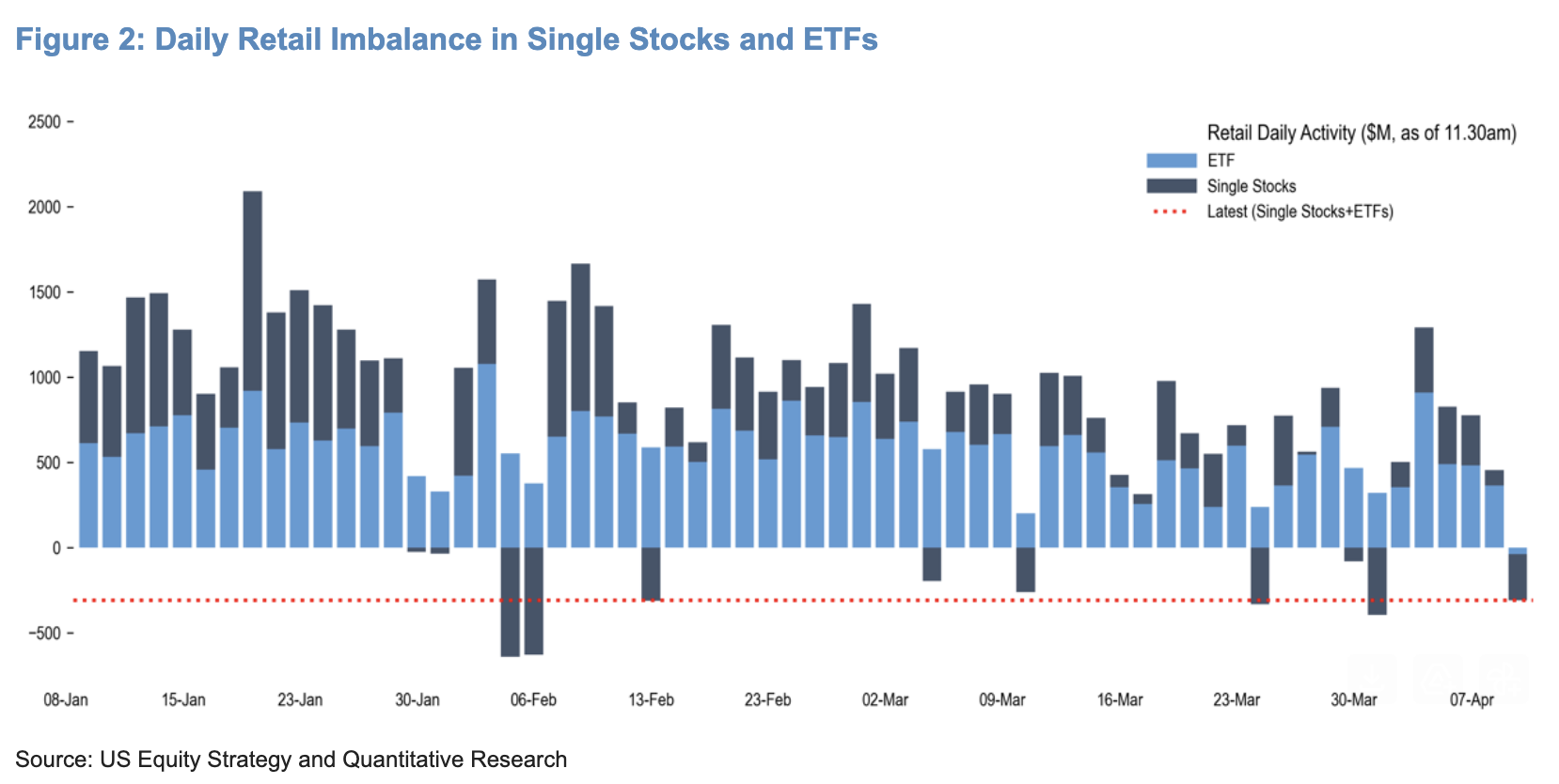
Retail traders are selling everything but the Magnificent 7, per JPMorgan

JPMorgan strategist Arun Jain with the skinny on retail trading activity through 11:30 a.m. ET today:

“Retail investors are selling into today’s strength in both ETFs and Single Stocks. In ETFs, they are trimming their broad-based exposure — a major departure from their typical pattern.”

The SPDR S&P 500 ETF and ProShares UltraPro QQQ suffered particularly large outflows, per Jain.

The exceptions to the selling pressure are the Magnificent 7 stocks, he wrote, with Nvidia, Tesla, Meta, and Microsoft enjoying “small net purchases,” while Micron, TSMC, Exxon, and Chevron were the most dumped names.

Retail trading 4/8

Last week, Jain noted that retail traders had been “skipping the dips, selling into rallies, and positioning more defensively” with markets jittery amid the ongoing Mideast war.

Latest Stories

Sherwood Media, LLC produces fresh and unique perspectives on topical financial news and is a fully owned subsidiary of Robinhood Markets, Inc., and any views expressed here do not necessarily reflect the views of any other Robinhood affiliate, including Robinhood Markets, Inc., Robinhood Financial LLC, Robinhood Securities, LLC, Robinhood Crypto, LLC, Robinhood Derivatives, LLC, or Robinhood Money, LLC. Futures and event contracts are offered through Robinhood Derivatives, LLC.