

Markets
markets
Luke Kawa

Earnings revisions no longer favor US tech heavyweights relative to the rest of the S&P 500, warns RBC

We’ve spilled a bit of ink lately on how abysmal S&P 500 earnings revision momentum has been lately — there are many more cuts than raises by the analyst community — with even the US megacap giants whose earnings growth has powered the bull market seeing estimates come under the knife.

RBC Capital Markets chief US equity strategist Lori Calvasina put these two themes together in her most recent note to clients, which has some unsettling implications for the market’s leaders.

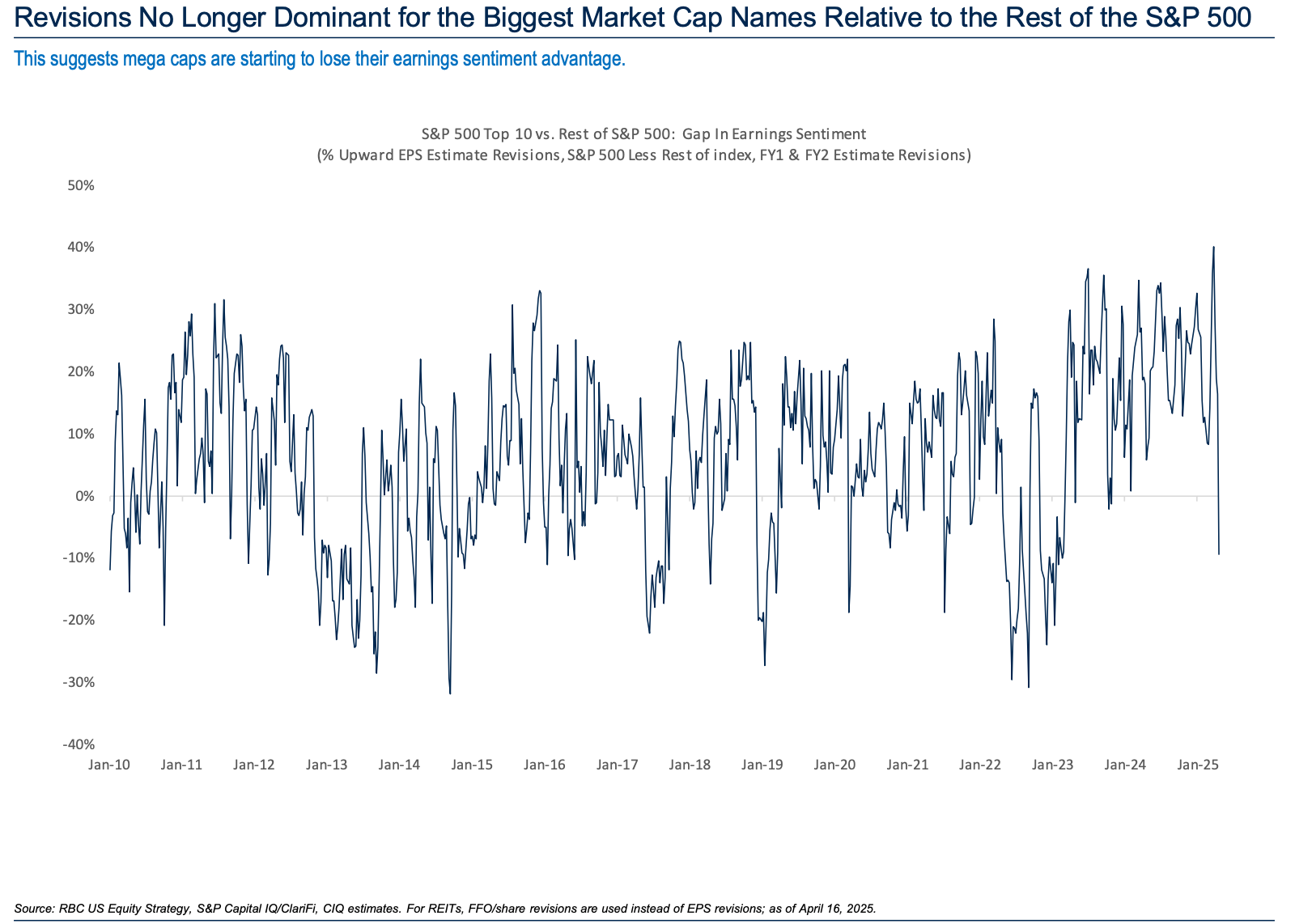
“It’s worth noting that the rate of upward revisions no longer favors the top 10 market cap names relative to the rest of the S&P 500, suggesting that there has been some significant erosion of the earnings case for the mega cap growth names,” she wrote.

She included a chart that tracks how earnings revisions (at least directionally) in the current or next fiscal year for the top 10 components in the S&P 500 are faring relative to the remainder of the members in the benchmark US stock gauge. This metric has made a sharp move lower lately:
RBCCapitalTop10EPSRevisions

Those top 10 companies, as of the date on the above chart, are household names Apple, Microsoft, Nvidia, Alphabet, Amazon, Meta, Berkshire Hathaway, Broadcom, Tesla, and Walmart.


More Markets

See all Markets
markets

Micron announces deal to buy fabrication plant for $1.8 billion as AI demand drives memory chip supply crunch

Micron is preparing to benefit from the supply crunch in memory chips for years to come.

On Saturday, the company announced that it had signed a letter of intent to buy a fabrication plan from Powerchip Semiconductor Manufacturing Corporation in Taiwan for $1.8 billion.

This acquisition “will enable Micron to increase production and better serve our customers in a market where demand continues to outpace supply,” said executive vice president of global operations Manish Bhatia. Management expects this purchase to begin to add to DRAM output in the second half of 2027.

Micron’s spectacular quarterly earnings and guidance released in mid-December catalyzed a fresh wave of buying for memory chip and storage stocks, reinforcing the fact that near-term demand is running far hotter than analysts anticipated. The memory chip specialist and its rivals have been scrambling to boost production as the AI boom leaves supplies short and propels prices higher.

“Without considering conventional DRAM supply-demand, we believe the DRAM industry is in net deficit of 180k wafer starts per month in 2027E to resolve the standalone high-bandwidth memory part of the industry S-D shortage,” write JPMorgan analysts led by Jay Kwon. “MU’s P5 fab (50k wspm or annualized 35k equivalent volume), if 100% is dedicated to HBM, would only resolve 20% of the shortage, by our calculation.”

TOPSHOT-GREENLAND-DENMARK-US-DEMONSTRATION

Stocks slide further as President Trump doubles down on Greenland ambitions despite European pushback

With US exchanges shut yesterday, traders are finally getting the chance to react to the president’s tariff threats and escalation over Greenland. The only winners so far are precious metals like gold and silver.

markets

Stock futures slide on Trump's 25% European tariff threat over Greenland, as gold and silver push higher

With US exchanges closed for MLK Day, European and Asian stock markets have been the main release valve for reaction to President Trump’s fresh tariff threats to Europe, which followed sharp pushback from European allies around America’s ongoing Greenland pursuit.

In a Truth Social post on Saturday, Trump warned that the US would impose tariffs on several European countries — Denmark, Norway, Sweden, France, Germany, the UK, the Netherlands, and Finland — unless a deal is reached for the “Complete and Total purchase of Greenland.” A 10% tariffs on “any and all goods” shipped to the US from the eight countries would take effect February 1, rising to 25% by the start of June if an agreement isn’t reached.

European stock markets opened lower, with the broad STOXX Europe 600 down 1.2%. France's CAC 40 index, Germany's DAX, and the UK's FTSE 100 fell 1.5%, 1.3%, and 0.5%, respectively, as of 5:12 a.m. ET. Asian markets also closed lower on global trade fears, with Tokyo's Nikkei 225 down 0.6%.

Although liquidity is thin, US risk assets weren’t entirely shielded, with S&P 500 Futures (Mar ‘26 E-Mini contract) down a little over 1% as of 5:45 a.m. ET. Bitcoin also dropped sharply, down ~2.5% from its undisturbed price.

Meanwhile, precious metals (again) hit all-time highs, with spot gold up more than 2% to a record $4,690 per ounce and silver hitting a record $94.08 per ounce, extending its rally this year.

TACO vs. TART?

A popular market narrative over the last year has been that President Trump often employs tariffs as threat, using them as a bargaining tool for other goals. But the “Trump Always Chickens Out” argument isn’t really borne out by the data. As Luke Kawa pointed out last year, the reality is that the US has raised its levies rate on both occasions that Trump has been in the White House, suggesting that the more accurate acronym is really: “Trump Always Raises Tariffs.” For now, this latest reactive threat to America’s allies looks more like a bargaining tool than a high-priority bit of trade policy.

markets
Luke Kawa

Nvidia’s H200 suppliers reportedly pause production after China blocks imports

The saga of Nvidia’s H200s has more confounding twists and turns than a house of mirrors.

On Friday evening, the Financial Times reported that suppliers for Nvidia’s H200 chips have halted production amid reports that Beijing has banned these processors from entering the country. Bloomberg had previously reported that China would begin to allow H200 imports for commercial use “as soon as this quarter.”

Nvidia called upon suppliers to boost output of components for these H200 chips after reportedly receiving more than 2 million orders from Chinese customers while only having roughly 700,000 in inventory.

Chinese policymakers have been keen on boosting their domestic semiconductor industry, with Nvidia’s H20 chips (a nerfed version of the H200) not breaking through into the market in a meaningful way even after export restrictions were lifted last year. Even though the H200 is considerably more powerful than the H20, recent reporting by both the FT and The Information suggests that regulators are similarly intent on limiting access.

That’s creating a more robust black market for Nvidia’s flagship Blackwell chips, per the FT:

One Chinese seller of Nvidia AI servers said many local customers had cancelled orders for the H200. Instead, they have switched to the more advanced B200 and B300, which are banned for export into China by Washington, leading to an active black market for the chips.

The Department of Commerce had recently revised its export review policy to lay the foundation for Nvidia to begin to ship these chips to the world’s second-largest economy, while US President Donald Trump imposed a 25% levy on H200 imports into the US that will not be used domestically (that is, will be brought in then re-exported to China). These announcements also cover AMD’s MI325X chips.

Latest Stories

Sherwood Media, LLC produces fresh and unique perspectives on topical financial news and is a fully owned subsidiary of Robinhood Markets, Inc., and any views expressed here do not necessarily reflect the views of any other Robinhood affiliate, including Robinhood Markets, Inc., Robinhood Financial LLC, Robinhood Securities, LLC, Robinhood Crypto, LLC, or Robinhood Money, LLC.