
Markets
Electronic Arts Photo Illustrations
(Jakub Porzycki/Getty Images)
ANOTHER ONE BITES THE DUST

Electronic Arts set to go private in $55 billion deal — the latest in a long line of disappearing stocks

The “Madden” maker is set to join a growing group of listed companies that are deciding to drop out of exchanges.

Claire Yubin Oh

This morning, video game maker Electronic Arts confirmed that it will be taken private by a consortium including Saudi Arabia’s wealth fund, along with private equity firms Silver Lake and Affinity Partners, in a deal that would value the company at some $55 billion, roughly 25% more than what the company was worth before deal rumors started circling last week.

The deal marks the largest take-private transaction in US history, topping the $45 billion buyout of Texas utility group TXU in 2007. That’s quite a record considering the rise of take-private deals more generally — a trend that’s exploded since 2012 in both count and volume. Per data from Bloomberg, last year saw a whopping 173 deals take stocks off the market, transactions worth some ~$289 billion and change.
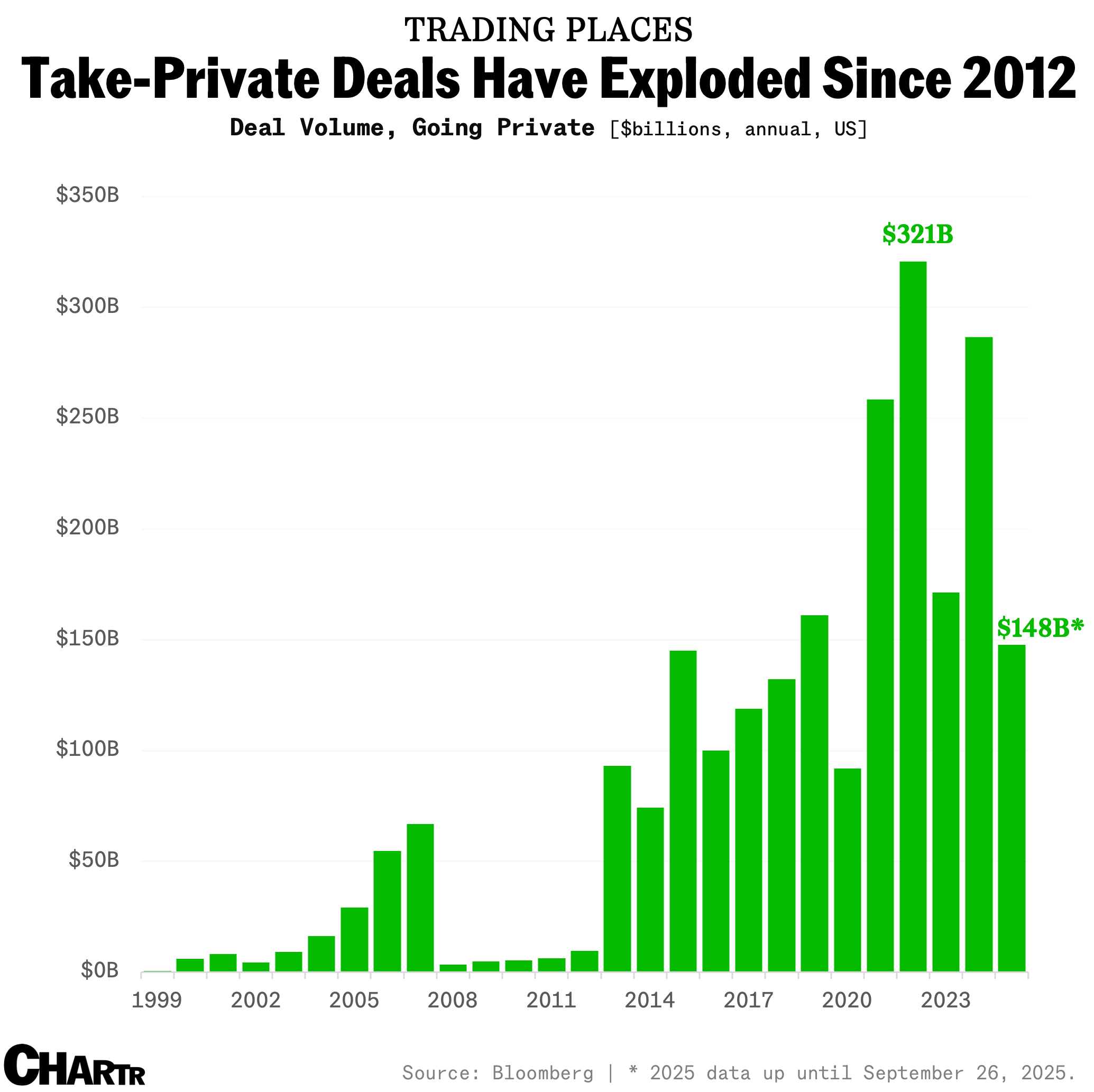
More companies are going private
Sherwood News

Private party

Aided by a private markets capital pool that increasingly rivals its public cousin, the swelling dealmaking market is contributing to a broader trend: the slow decline of public markets.

Indeed, many high-profile startups like SpaceX and OpenAI have completely bypassed the hassle of public markets (like quarterly reporting, *cough*), finding no problem raising tens of billions of dollars for their cash-hungry operations.

The combined effect of fewer IPOs and a rise in take-private deals: there are now only half the number of public companies that were listed in the US in 1996, with just 4,010 public equities as of last year.
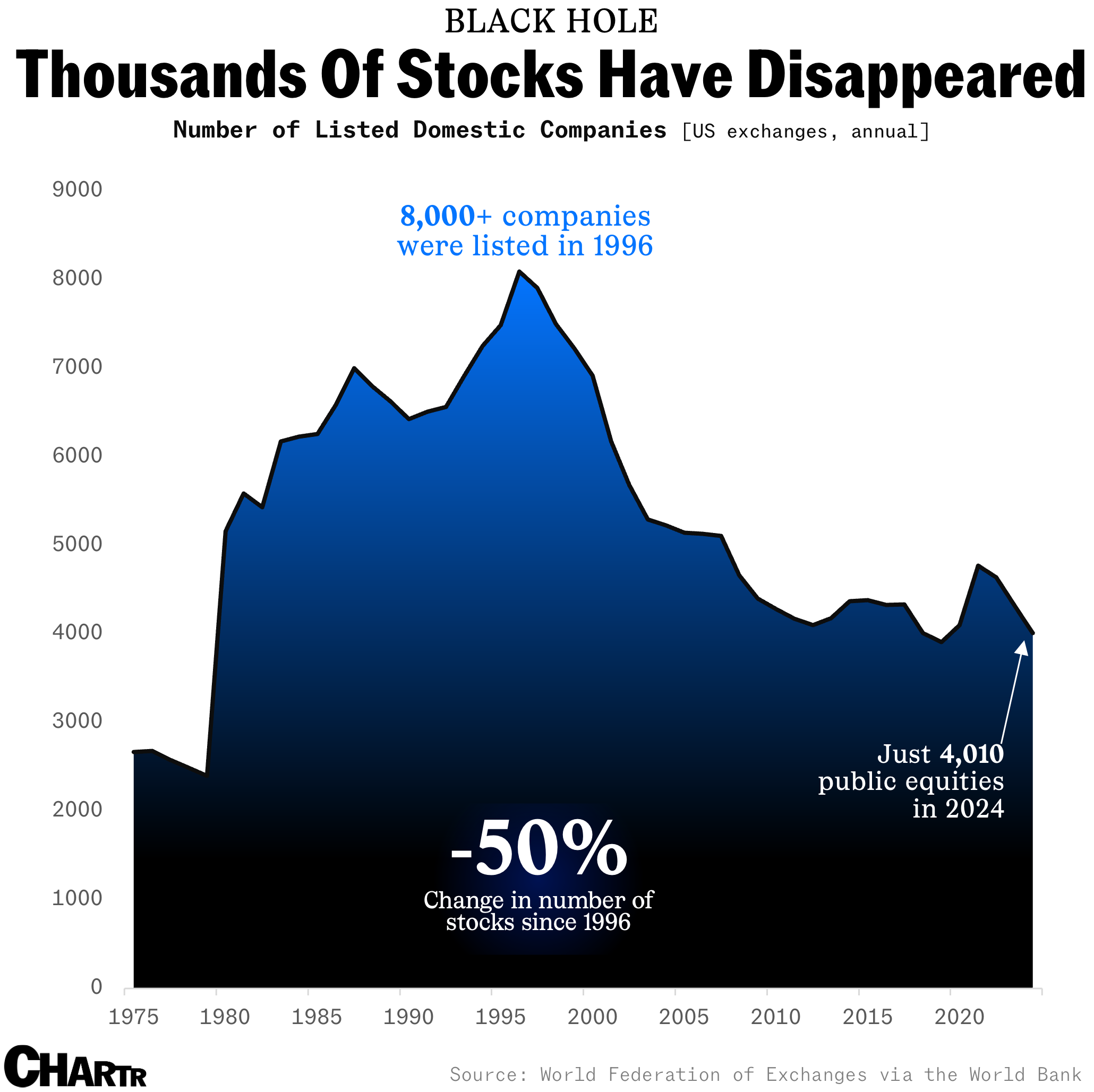
Thousands of stocks have disappeared
Sherwood News

Related reading: Where did all the stocks go?

More Markets

See all Markets
Business And Economy In Washington D.C.

Live Nation beats Q4 revenue estimates

The company reported earnings results on Thursday.

markets

AMD to “effectively guarantee” a loan to AI startup Crusoe that will be used to purchase its chips, The Information reports

Advanced Micro Devices will “effectively guarantee” a $300 million loan to data center company Crusoe from Goldman Sachs, according to The Information.

That is, Crusoe is taking out a loan to purchase AMD’s chips, and the chips that it’s purchasing are being used as collateral for that loan.

You’d be forgiven for thinking that this sounds an awful lot like a very common form of borrowing done by American families: borrowing money to buy a house, and having the home be collateral for the mortgage.

One big difference, of course, is that your home is expected to appreciate in value, while AI chips are expected to depreciate in value as they’re used. (The silver lining, however, is that so far these processors haven’t lost value too quickly.)

Another difference is that AMD, per the report, has agreed to rent these chips from Crusoe if it can’t find customers for this compute, which helped reduced the interest rate Crusoe will pay on this loan.

Similarly, in September, Nvidia agreed to buy any of CoreWeave’s unused cloud computing capacity through April 13, 2032, for $6.3 billion.

Rather than get overly hung up on “circular financing” elements, I’d probably frame the issue here like this: everyone wants AI chips. AMD sells AI chips. And yet, in both this deal and the most high-profile one we know about (AMD’s pact with OpenAI), the chip designer seems to be having to go the extra mile to get companies to use its AI chips. You might recall that as part of the OpenAI agreement, AMD issued warrants that enable the ChatGPT developer to receive 160 million shares, or about 10% of the company, if certain operational and stock price targets are hit over time.

Why is it so tough to get buyers on normal terms? My guess would be that this either says something negative about the financing environment for AI startups or the perception of AMD’s AI chips.

markets

Rental car companies drop amid volatile demand following an “unacceptable” Q4 from Avis

Rental car company Avis shed roughly $1 billion in market cap on Thursday as its stock fell more than 23% following the company’s Q4 results, which CEO Brian Choi called “unacceptable.”

Avis’ adjusted earnings before interest, taxes, depreciation, and amortization came in at $5 million on the quarter, a massive miss compared to the $145.4 million expected by Wall Street analysts polled by FactSet.

Avis said commercial rental days fell 11% in November, as thousands of flights were canceled amid the government shutdown. That led Avis to reduce its fleet size in Q4, “the most difficult period to sell used vehicles.” The company also took a $500 million write-down on its EV fleet at year-end.

“When operational performance speaks for itself, we earn the right to focus on the bigger picture. This quarter, we didn’t earn that right. We fell significantly short of guidance. That’s unacceptable, and I have no excuses to offer,” Choi said on the company’s earnings call.

Avis said it expects lower earnings in the first quarter of 2026, as January was also impacted by weather-related flight cancellations. Rival Hertz was dragged down in the sell-off, dropping more than 14%.

Latest Stories

Sherwood Media, LLC produces fresh and unique perspectives on topical financial news and is a fully owned subsidiary of Robinhood Markets, Inc., and any views expressed here do not necessarily reflect the views of any other Robinhood affiliate, including Robinhood Markets, Inc., Robinhood Financial LLC, Robinhood Securities, LLC, Robinhood Crypto, LLC, or Robinhood Money, LLC.
