
Markets
31st UEC Road Cycling European Championships 2025 - Men's Elite Road Race
The value of these medals has gone up (Jean Catuffe/Getty Images)
My Precious

Gold and silver are the new meme stocks

Momentum. Flows. Options activity. Intense retail enthusiasm. It’s all there.

Luke Kawa

The r/WallStreetBets corner of Reddit is one of the places I go — and one of the sources that the Roundhill Meme Stock ETF draws upon — to get a handle on retail trader sentiment.

And right now, it’s showing quite starkly that gold and silver are the new meme stocks.

Momentum. Flows. Options activity. Intense retail enthusiasm. It’s all there. The new shiny toys for traders are the oldest, shiniest perceived stores of value.

Over the past 12 hours, the SPDR Gold Shares ETF and iShares Silver Trust are the two most mentioned and most positively mentioned tickers on the subreddit, per SwaggyStocks.
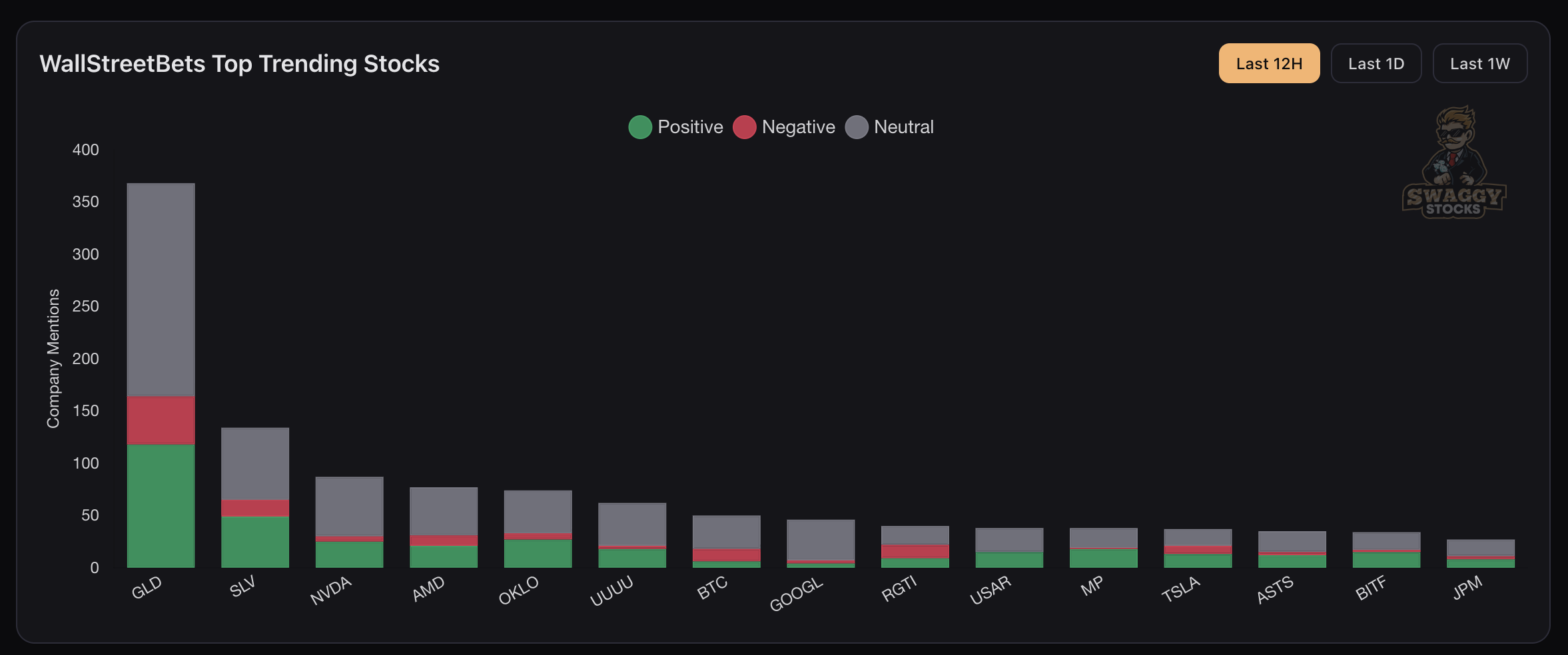
GLD SLV ticker references on r/WSB
Source: SwaggyStocks

JPMorgan strategist Arun Jain, who tracks retail flows, showed that net buying of commodity ETFs from this cohort were $163.1 million as of 4 p.m. ET on Monday, or in the 98th percentile relative to their one-year history. On Friday, those flows were in the 90th percentile, and nearly in the 80th percentile on Thursday.

The five-day average for call volumes in GLD recently hit a record, while those for its silver peer are at their highest since 2021.

The 14-day relative strength index, a technical gauge of the magnitude and persistence of price movements, is at its highest level since 2020 for the silver ETF. The gold ETF, meanwhile, has seen its 14-day RSI close above 70 (which indicates it’s in “overbought” territory) in all but one of the 30 trading days since the end of August. That’s far and away the highest share of time it’s spent in “overbought” territory over any 30-session stretch since this product was introduced in 2004.

The very underfollowed @VKMacro argued on X that the price performance of gold is an example of flows driving very extreme performance:

Precious metals are normally what you turn to when the world is going to hell in a handbasket. And yet we’re seeing it bid up at the same time that the AI trade remains near all-time highs, zero-revenue nuclear energy company Oklo is ramping, and quantum computing stocks are also on fire.

Once again, the nature of the assets that are seemingly going parabolic suggests to me that we’re in an intense bull market in anti-humanity.


More Markets

See all Markets
markets

Trump says he has ordered all federal agencies to cease use of Anthropic’s products

President Trump said he has ordered all federal agencies to IMMEDIATELY CEASE all use of Anthropic’s technologyas the AI startup and the federal government disagree over safety guardrails.

Anthropic has reportedly clashed with the Pentagon after its tools were used to surveil and ultimately detain Venezuelas president, Nicolás Maduro, which the company says is against its policies. The startup had until today to reach a deal with the government, and the presidents statement suggests an accord wasnt reached.

The Leftwing nut jobs at Anthropic have made a DISASTROUS MISTAKE trying to STRONG-ARM the Department of War, and force them to obey their Terms of Service instead of our Constitution, the president wrote in a Truth Social post. Their selfishness is putting AMERICAN LIVES at risk, our Troops in danger, and our National Security in JEOPARDY.

Trump said agencies like the Pentagon will phase out Anthropics products over the next six months.

Anthropic better get their act together, and be helpful during this phase out period, or I will use the Full Power of the Presidency to make them comply, with major civil and criminal consequences to follow, Trump said.

markets

Rocket Lab dives on new delay for Neutron

Shares of retail favorite Rocket Lab plunged Friday after the company pushed back plans for the first launch of its bigger Neutron rocket to the fourth quarter of 2026.

Neutron was originally set launch in late 2025. That plan was scrapped in November, with the new target date set broadly for the middle of 2026.

As CEO Peter Beck laid out for Sherwood News in an interview, Neutron is the cornerstone of the money-losing company’s plans to leap to profitability, as it will enable Rocket Lab to enter the market for larger, and more lucrative, payload launches. That market is currently dominated by Elon Musk’s SpaceX.

In January, one of Neutron’s fuel tanks ruptured during a test, necessitating construction of another, as well as some design changes. During the company’s post-earnings conference call last night, Beck told analysts Neutron’s first launch is now expected during the fourth quarter of 2026.

“Neutron is still scheduled to come to market in an incredibly aggressive time frame,” Beck said.

Judging by the stumble for the shares, which by around 1:30 p.m. ET were on track for their worst drop since last fall, investors are not buoyed by those assurances.

As CEO Peter Beck laid out for Sherwood News in an interview, Neutron is the cornerstone of the money-losing company’s plans to leap to profitability, as it will enable Rocket Lab to enter the market for larger, and more lucrative, payload launches. That market is currently dominated by Elon Musk’s SpaceX.

In January, one of Neutron’s fuel tanks ruptured during a test, necessitating construction of another, as well as some design changes. During the company’s post-earnings conference call last night, Beck told analysts Neutron’s first launch is now expected during the fourth quarter of 2026.

“Neutron is still scheduled to come to market in an incredibly aggressive time frame,” Beck said.

Judging by the stumble for the shares, which by around 1:30 p.m. ET were on track for their worst drop since last fall, investors are not buoyed by those assurances.

markets

Dorsey swings the axe at Block in “extreme step” to “replace human labor with compute power”

The market clearly loves it. Jack Dorsey’s decision to axe some 4,000 workers has kicked off what is on track to be Block’s best day in the stock market in over three years.

The takeaways from analysts who have followed the stock — down about 80% from its August 2021 peak — are a bit more nuanced:

Evercore ISI: “Mgmt is explicitly redesigning Block as an AI-native organization — embedding automation and efficiency tools across product development, underwriting, operations, and customer interfaces. The financial implications are significant: FY26 Adjusted Operating Income guidance of $3.2B (26% margin) sits materially above mgmt’s prior expectations at the Investor Day just a few months ago, signaling confidence that AI-driven efficiencies can expand margins structurally while sustaining or potentially accelerating product velocity.”

Morgan Stanley: “Cutting 40% of employees (to ~6,000 from ~10,000) encapsulates XYZ’s undertaking that it is now prepared to replace human labor with compute power. We certainly view it as an audacious move by the management, but one that is not without preparation... The reduced headcount should now drive a marked improvement in the gross profit/employee metric, which we expect will justify expanded valuation premium.”

Piper Sandler: “Dorsey characterized the move as a proactive step to make way for AI related productivity gains. The cost saves from lower headcount drive a $500M increase in Block’s Adjusted EBIT guidance for 2026 — now $3.2B vs. $2.7B at investor day just 3 months ago. Bottom line, while the right sizing from XYZ is being well received by investors and should boost short-term profitability, it seems like an extreme step, and we remain skeptical of XYZs longer term growth profile.”

Citi: “Several times during the Q&A, the sell side probed management’s comfort with carrying out the major headcount reduction in parallel with more extensive and more effective GenAI use over a roughly two quarter timespan. On the one hand, Block seemed confident in the organization’s ability to adapt and rise to the challenge, but on the other hand, we are aware that a 40% reduction in heads should generate many empty seats. While we believe it more likely for XYZ to succeed here, we think that more reassurance can surface should XYZ continue to do as they plan.”

RBC Capital: “The main question from investors thus far — is this just legacy bloat or real AI enhancements — only time will tell, but it feels like a combination of both... While AI efficiencies no doubt played a key role in a reduction in force of this magnitude, we also believe XYZ was moving in a direction to materially shrink the organization.”

Evercore ISI: “Mgmt is explicitly redesigning Block as an AI-native organization — embedding automation and efficiency tools across product development, underwriting, operations, and customer interfaces. The financial implications are significant: FY26 Adjusted Operating Income guidance of $3.2B (26% margin) sits materially above mgmt’s prior expectations at the Investor Day just a few months ago, signaling confidence that AI-driven efficiencies can expand margins structurally while sustaining or potentially accelerating product velocity.”

Morgan Stanley: “Cutting 40% of employees (to ~6,000 from ~10,000) encapsulates XYZ’s undertaking that it is now prepared to replace human labor with compute power. We certainly view it as an audacious move by the management, but one that is not without preparation... The reduced headcount should now drive a marked improvement in the gross profit/employee metric, which we expect will justify expanded valuation premium.”

Piper Sandler: “Dorsey characterized the move as a proactive step to make way for AI related productivity gains. The cost saves from lower headcount drive a $500M increase in Block’s Adjusted EBIT guidance for 2026 — now $3.2B vs. $2.7B at investor day just 3 months ago. Bottom line, while the right sizing from XYZ is being well received by investors and should boost short-term profitability, it seems like an extreme step, and we remain skeptical of XYZs longer term growth profile.”

Citi: “Several times during the Q&A, the sell side probed management’s comfort with carrying out the major headcount reduction in parallel with more extensive and more effective GenAI use over a roughly two quarter timespan. On the one hand, Block seemed confident in the organization’s ability to adapt and rise to the challenge, but on the other hand, we are aware that a 40% reduction in heads should generate many empty seats. While we believe it more likely for XYZ to succeed here, we think that more reassurance can surface should XYZ continue to do as they plan.”

RBC Capital: “The main question from investors thus far — is this just legacy bloat or real AI enhancements — only time will tell, but it feels like a combination of both... While AI efficiencies no doubt played a key role in a reduction in force of this magnitude, we also believe XYZ was moving in a direction to materially shrink the organization.”

markets

The return of AI credit risk is crushing data center stocks, tipping over other speculative trades in the process

The upstarts participating in the disruptive industry of today as well as the speculative trades that mark the industries of the future are getting crushed on Friday.

It’s a sign of the creeping investor revolt against the capex binge.

The poster child for the move is CoreWeave, which is sinking after reporting Q4 capex figures that were larger than expected along with a 2026 investment budget that also surprised to the upside.

Neoclouds and data center companies like Nebius, IREN, Applied Digital, and Cipher Mining are also getting whacked. So too are the quantum computing companies: IonQ, D-Wave Quantum, Rigetti Computing, and Infleqtion.

What’s the common link between these two things?

Well, as we’ve discussed, speculative stocks tend to have common owners and trade in a relatively correlated fashion. And once again, this simultaneous swoon is coinciding with a perceived escalation in AI credit risk.

These smaller AI companies that have effectively bet their existence on this boom and the willingness of capital markets to fund their expansion plans would have the most to lose if either demand or access to credit shrinks. And, of course, the latter would impact other companies in nascent industries that need capital to grow.

The private credit industry, which has been broadly overweight software companies in their lending activities, is coming under severe pressure as those firms face competition from AI tools.

Block’s job cuts, regardless of any previous mismanagement CEO Jack Dorsey is willing to cop to, will do little to allay fears that software executives may take dramatic actions to grapple with the impacts of this emergent technology.

Meanwhile, the source of that disruption — AI — is also continuing to suck in a lot of capital without much in the way of returns. It feels like the credit market simultaneously doesn’t want to fund software because of the AI disruption threat and doesn’t want to fund upstart AI firms because of the lack of visibility into free cash flow generation. Not great, Bob!

Oracle, the large-cap stock most used as a barometer for AI credit risk, enjoyed a sharp improvement in its perceived creditworthiness after management said on February 1 that about half their funding needs this year would come from equity, rather than fully from debt. Now, its five-year credit default swap spreads are poised to close at their widest level since 2009.

Latest Stories

Sherwood Media, LLC produces fresh and unique perspectives on topical financial news and is a fully owned subsidiary of Robinhood Markets, Inc., and any views expressed here do not necessarily reflect the views of any other Robinhood affiliate, including Robinhood Markets, Inc., Robinhood Financial LLC, Robinhood Securities, LLC, Robinhood Crypto, LLC, or Robinhood Money, LLC.