
Markets
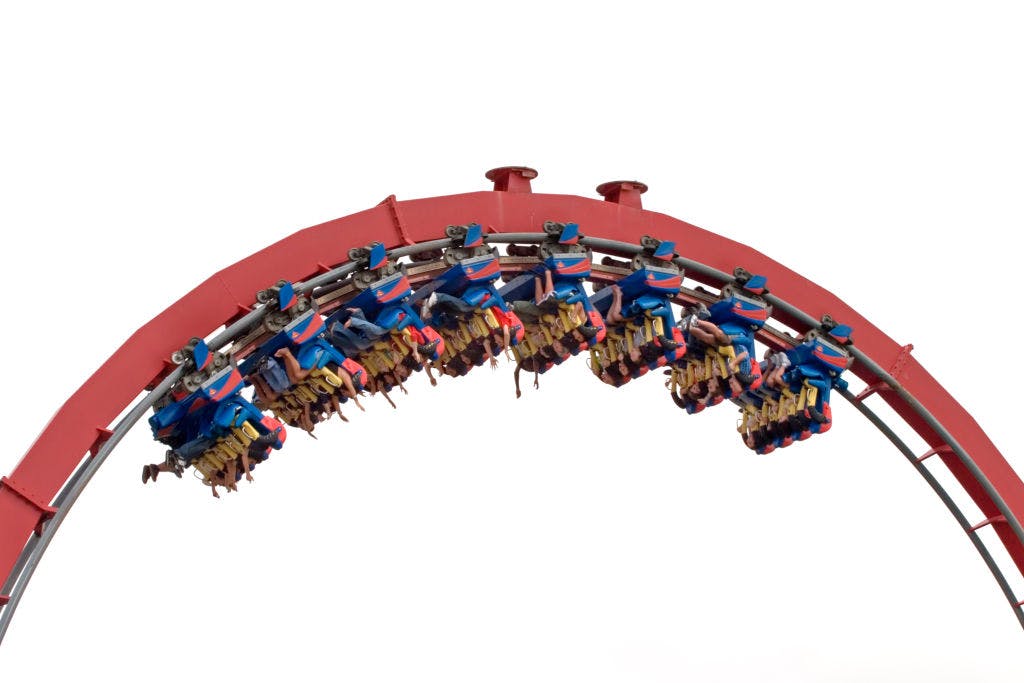
Roller coaster steel car full of riders
Roller coaster with a car full of screaming people (MyLoupe/Getty Images)

How bitcoin’s moves show that the stock market is actually fueled by vibes

Bitcoin has been strongly correlated with the S&P 500; the low-volatility stocks within the S&P 500 have not.

Luke Kawa

Bitcoin is behaving more like the S&P 500 than the boring, safer stocks within the S&P 500 are.

The 21-session correlation between the daily change in the iShares Bitcoin Trust and the SPDR S&P 500 ETF recently got above 0.75, a level not seen since early April, when both were cratering on the announcement of reciprocal tariffs. Meanwhile, the 21-session correlation between SPY and the Invesco S&P 500 Low Volatility ETF, which holds the stocks that tend not to move as much, has collapsed. It’s gone negative, but could reasonably just be described as simply uncorrelated.

These correlations hint at what’s been a key driver for the benchmark US index: the ebbs and flows of speculative appetite. (I’m operating under the assumption that changes in sentiment, willingness to take risk, and ride momentum are the proximate causes of why bitcoin goes up and down.)

I have received more than a bit of pushback across social media recently for suggesting that bitcoin is behaving like a leveraged, low-fundamentals tech stock. I’m happy to correct the record — but only to change the chain of causality here.

That is, stocks are behaving like a de-levered version of bitcoin.

It seems fairly clear at this juncture that rollovers in bitcoin and other speculative pockets of the market in October were the bleeding edge of the retreat from risk that’s gone on to infect even the AI megacap leaders as of late.


More Markets

See all Markets
markets

Lucid reports Q4 earnings miss, revenue beat

Luxury EV maker Lucid reported its fourth-quarter earnings after the bell Tuesday. Shares fell more than 6% in after-hours trading.

The company posted an adjusted loss of $3.08 per share, wider than the $2.63 loss expected by analysts polled by FactSet. Lucid booked $522.7 million in revenue, beating the consensus estimate of $459.5 million.

Lucid issued a full-year 2026 production outlook of between 25,000 to 27,000 vehicles, up from the 18,378 vehicles it produced in 2025 and higher than the 22,750 Wall Street was expecting. The company maintained the timeline of its unnamed midsize SUV due to begin production later this year. That schedule puts it close to rival Rivian’s planned second-quarter release of its R2 SUV.

Lucid did not issue an update to its ongoing CEO search. The company has been led by interim CEO Marc Winterhoff for the past year, after it abruptly announced in its fourth-quarter 2024 report that then CEO Peter Rawlinson would step aside.

The stock has fallen to all-time lows this month and is down 98% from its high in 2021. Last week, the company announced it would lay off 12% of its US workforce in an effort to improve profitability.

markets

Tempus AI slides after missing Q4 EBITDA target

Cancer diagnostics company and sometimes retail shareholder favorite Tempus AI reported soft Q4 adjusted EBITDA numbers late Tuesday, sending shares lower in the after-hours session. 

It reported: 

  • Q4 revenue of $367.2 million vs. FactSet’s expectation of $362.8 million.

  • An adjusted loss per share of $0.04 vs. the $0.04 loss estimated.

  • Adjusted EBITDA of $12.9 million vs. expectations for $22 million, per FactSet.

Since going public in June 2024, Tempus has been a volatile stock that has both doubled — and cratered — on multiple occasions. That spectacle has at times captured the attention of retail traders who’ve tried to ride the waves.

Of late, the wave has been breaking bad, with shares down more than 30% since the stock hit a record high on October 8, 2025

Still, the company is now adjusted EBITDA positive. That, CEO Eric Lefkofsky told us last year, is the first milestone on Tempus journey to profitability, a mark that analysts think will take until at least next year for the company to hit.

markets

Sandisk sinks more as product release underwhelms market

Sandisk’s online event marking its one-year anniversary since being spun off from Western Digital seems to be something of a damp squib.

The shares, already down a fair bit following the Citron Research short announcement, fell further after the company announced an upgrade to its consumer solid state memory drives alongside a YouTube-based presentation aimed at highlighting all the things one might do with, well, access to additional digital storage.

The stock — which is still up more than 150% in 2026 — was down more than 7% shortly after the company’s post at 2 p.m. ET. That was in stark contrast to the bump software stocks were riding following Anthropic’s product announcement earlier on Tuesday.

Latest Stories

Sherwood Media, LLC produces fresh and unique perspectives on topical financial news and is a fully owned subsidiary of Robinhood Markets, Inc., and any views expressed here do not necessarily reflect the views of any other Robinhood affiliate, including Robinhood Markets, Inc., Robinhood Financial LLC, Robinhood Securities, LLC, Robinhood Crypto, LLC, or Robinhood Money, LLC.