


If you can gamble on your phone — do you need to go to Las Vegas?
“Sin City” is having one of its worst summers in years — but America hasn’t lost its lust for gambling. Quite the opposite, in fact, as sports betting, event contracts, and high-risk trading explode.
The click-clacking of the roulette tables, the dings, chimes, beeps, and whistles of the slot machines, and the general hum of America’s gambling capital should be reaching fever pitch about now.
But this year, Sin City is a little quieter than usual.
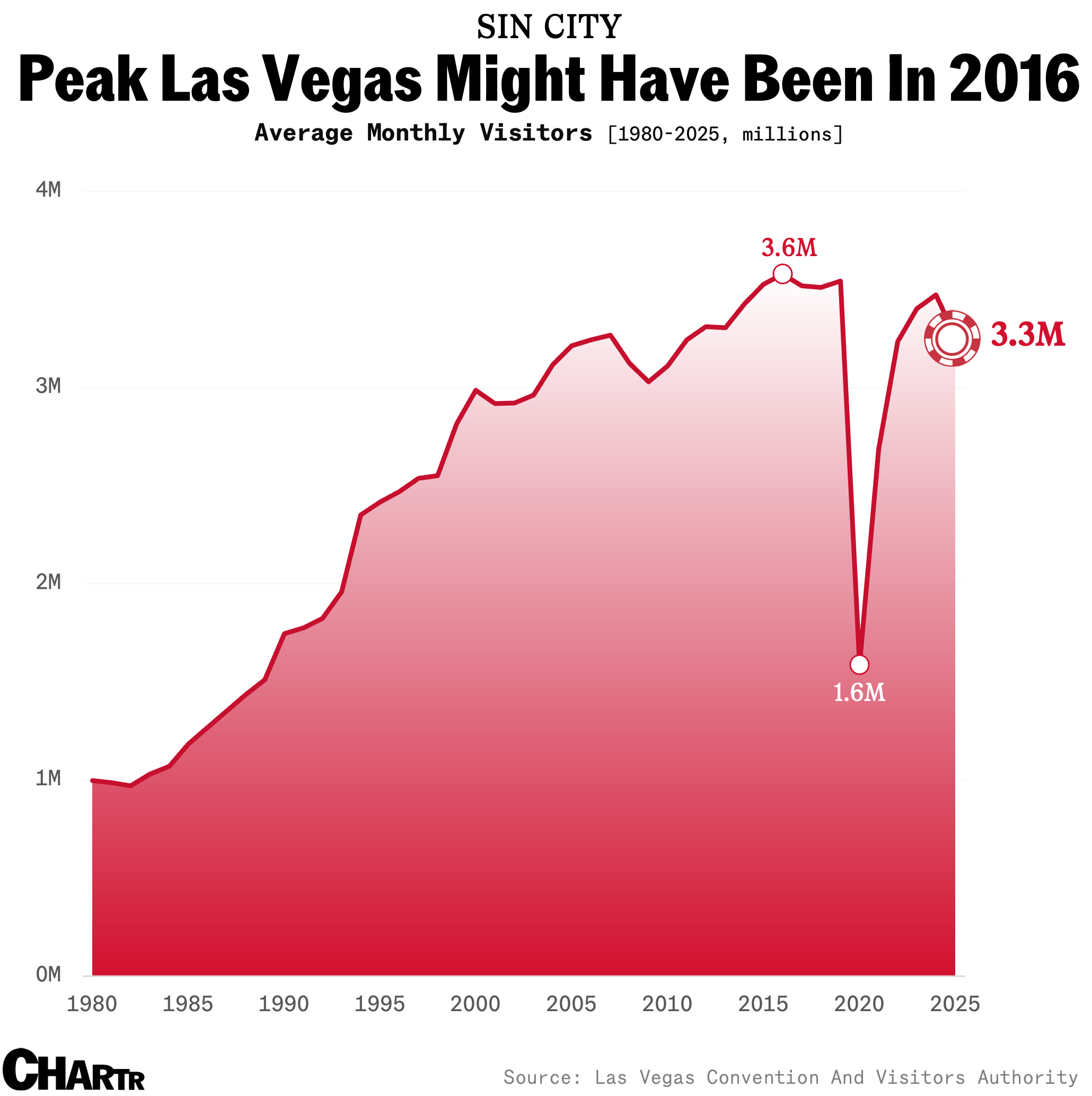
According to data from the Las Vegas Convention and Visitors Authority, the number of visitors to the City of Lights has dropped every single month in 2025, relative to 2024, with June seeing 11% fewer tourists compared to the same time a year before. Hotel occupancy rates are down, and passenger numbers through the city’s Harry Reid International Airport have also fallen 4% so far this year.
Deserted
Historically a barometer worth watching to get a sense of how frivolous Middle America is feeling, Las Vegas’ woes are out of step with many of the other signals from the economy. Tariff-induced recession fears have abated, and though the city’s scorching heat is intimidating, it’s always like this in Nevada in summer.
Even during some of the worst financial conditions, like the global financial crisis, the yearly drop in visitors was not as affected as this year (down 6%). Put simply: in modern times, Vegas has never seen this level of slowdown with the exception of the pandemic.
So, what explains Sin City’s slowdown?
Some people think it’s simply become too expensive, with exorbitant fees for everything from parking to food. Just yesterday, Time magazine wrote about Las Vegas’ slump, saying:
“Some blame rising prices, others have attributed Vegas’s fall to the rise of other vacation destinations like Nashville, while the Las Vegas Convention Center Authority attributed the downturn to ‘economic uncertainty and weaker consumer confidence.’”
Those, maybe, are all relevant to varying degrees, but there’s one major factor not mentioned: Americans’ growing ability to take wild bets while sitting on their couch.
It’s in the game
Vegas’ slowdown comes as an online sports betting craze sweeps over the nation. Since the Supreme Court overturned a federal law banning sports betting in 2018, the market has now grown to 38 states, with the vast majority of them also permitting mobile and online gambling. Last year, Legal Sports Report estimated that Americans wagered some $150 billion on sports, 24% more than the year before — thanks to the mobile-friendly betting experience that allows millions of users to take a punt anytime, anywhere.
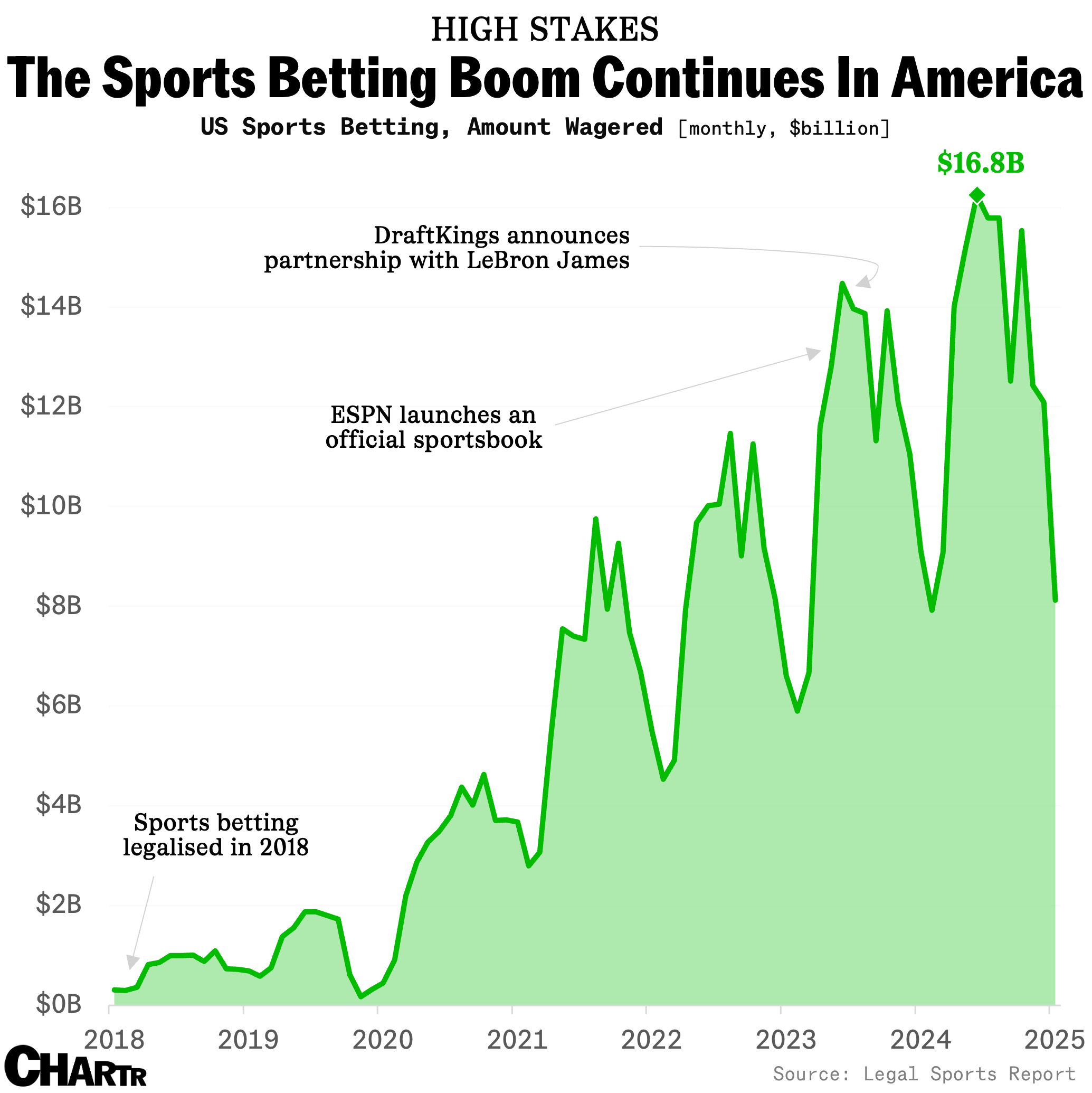
That doesn’t look like a nation that’s done gambling.
The sports betting boom is especially pronounced among younger men, with 48% of American men under 50 having an account on a digital sportsbook, per the Siena Research Institute. Nor are they disproportionally played by poorer folks like traditional state lotteries — a decent chunk of sports gamblers are well-off, with 44% of them reportedly earning more than $100,000 a year. That’s a Las Vegas crowd.
And from prime-time Super Bowl commercials to big celebrity endorsements, online sportsbooks like FanDuel owner Flutter Entertainment have been playing their cards right to tailor to that audience, spending billions on sales and marketing last year.
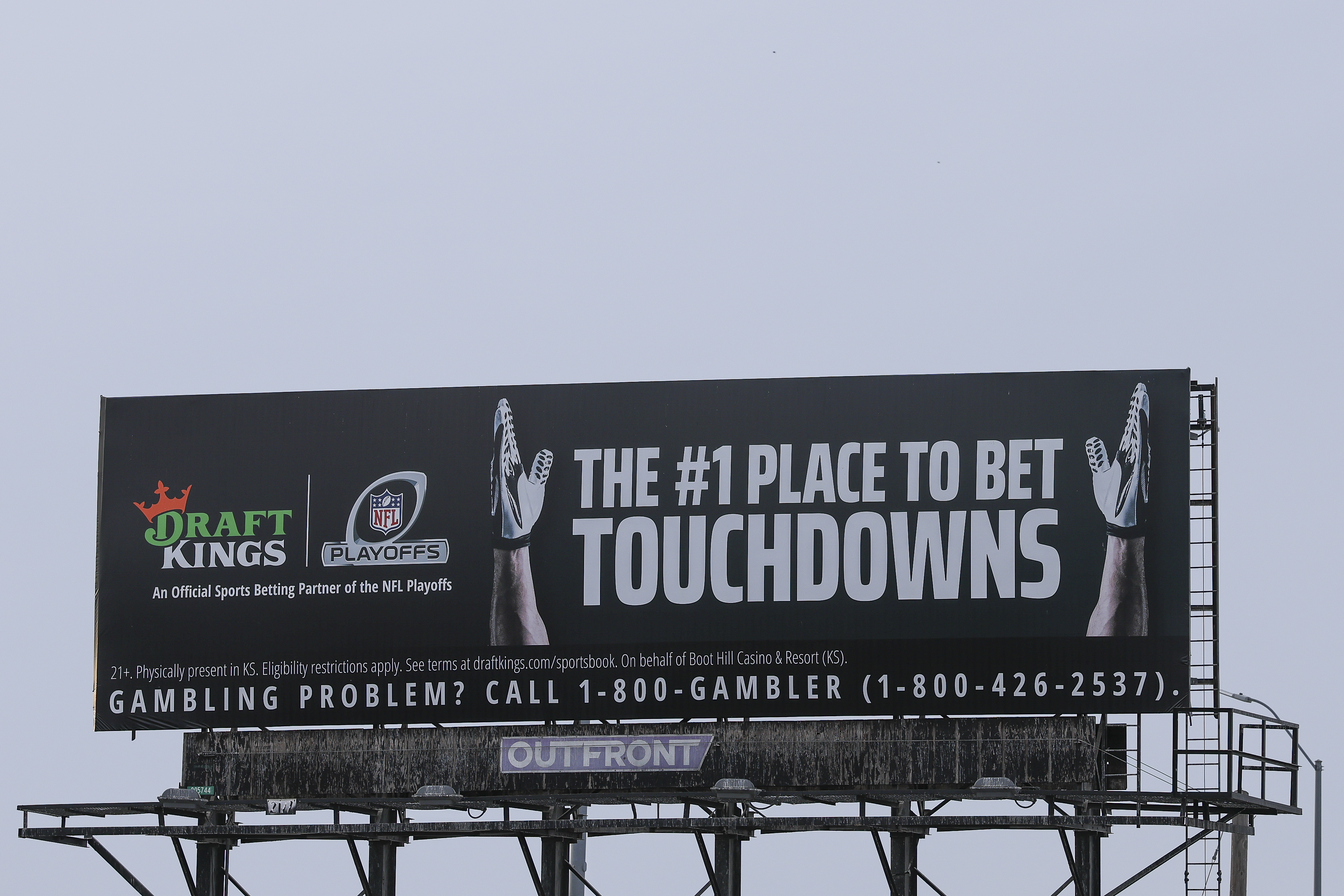
Those ad dollars are paying off, with FanDuel and rival DraftKings currently commanding a whopping 67% of the American online sports betting scene combined, with the FanDuel owner now boasting a market cap of $52 billion — way ahead of the $37 billion market value of the iconic physical resort and casino giant Las Vegas Sands.
Modern-day prophets
Just as the sports betting wave rolls across the country, another way to express a view, take a punt, and add risk to a gambler’s portfolio has also taken flight: prediction markets.
Breaking into the mainstream in the run-up to last year’s presidential elections, prediction sites like Kalshi and Polymarket allow people to stake money on the results of real-world events — the odds of a recession, who is going to win Nathan’s Hot Dog Eating Contest, or even the chances of a potential Swift-Kelce engagement. Kalshi and Polymarket were recently valued at $2 billion and over $1 billion, respectively.
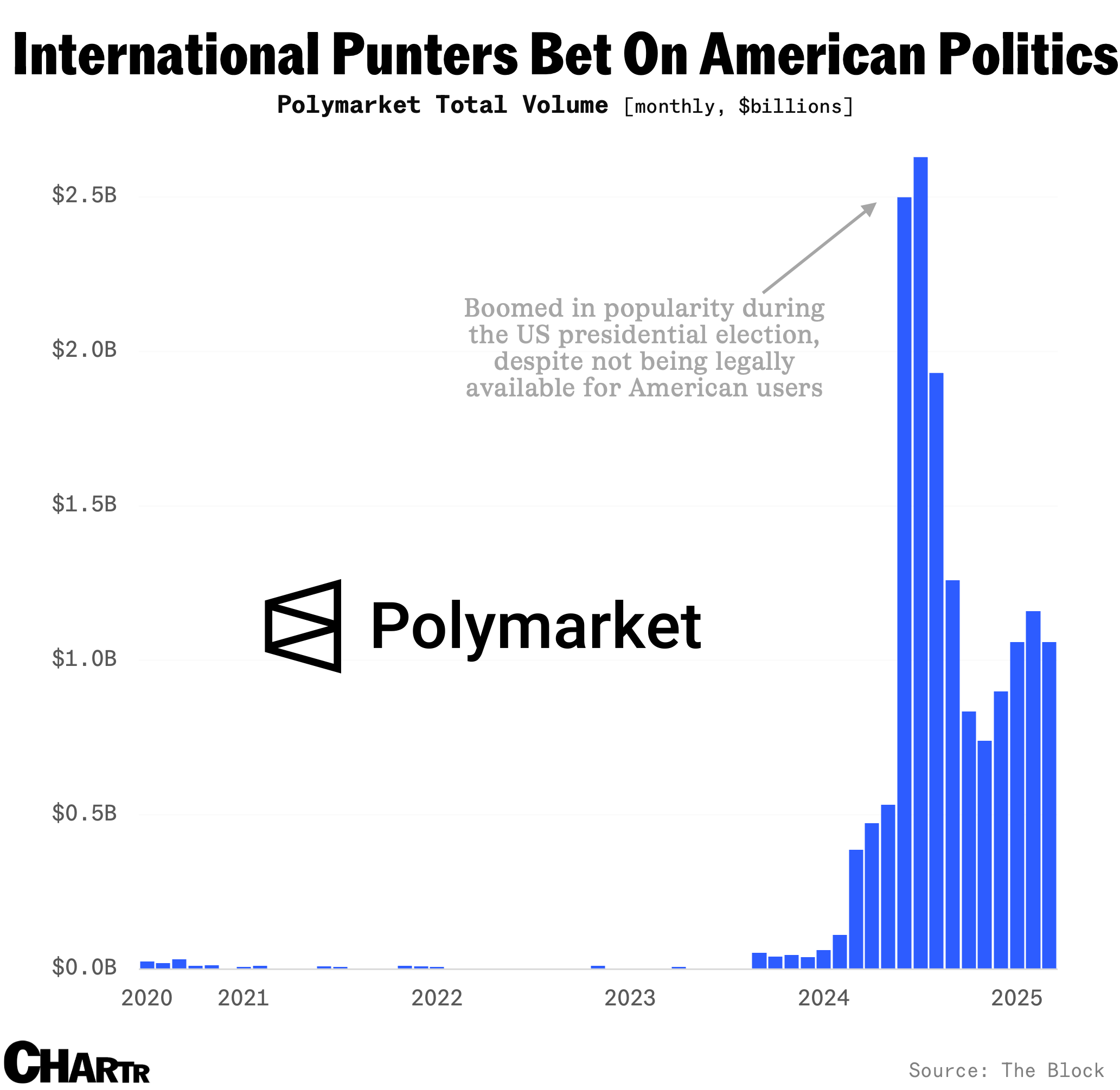
Bets on prediction platforms are structured as short-term derivatives contracts on a yes-or-no outcome, in which prices for opposing sides add up to $1 at the time of betting and then pay out the full dollar (minus fees) if the choice turns out to be correct. In the US, this unique process means prediction market providers are regulated as derivatives platforms, allowing these newcomers to bypass sports gambling bans in certain states.
That’s how you get a market hooked on who is going to be the next pope, what inflation will be, or who President Trump might tap to run the Fed. But that’s not the only derivatives market that’s booming.
I need this by EOD
While sports betting has been taking off, another retail revolution has been in the making in the world of investing, as platforms like Robinhood Markets have given armies of retail traders the tools to trade financial derivatives.
(Robinhood Markets Inc. is the parent company of Sherwood Media, an independently operated media company subject to certain legal and regulatory restrictions. Authors of this article own Robinhood stock as part of their compensation.)
Indeed, the number of retail investors trading derivatives has exploded in the last decade — with some estimates suggesting that retail traders were behind nearly one in two options trades in the US in mid-2023.
One type of contract in particular has soared in volumes: zero day to expiry options (0DTE). In the span of five years up to Q1 2025, 0DTE options, which investors use to make same-day bets on market movements, have grown nearly fivefold for the S&P 500.
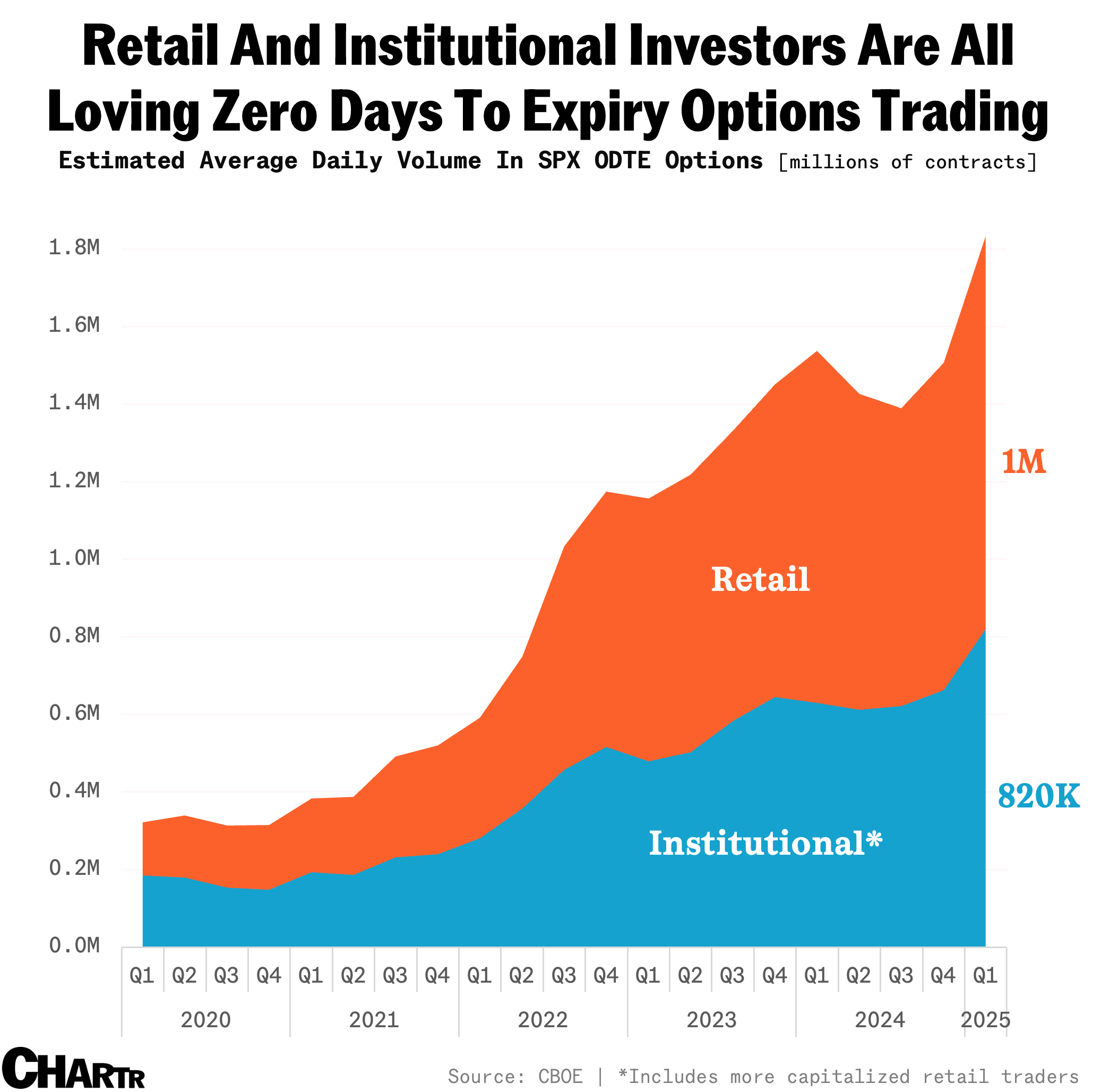
Though historically used by institutional investors to hedge against large price changes, 0DTE options are now drawing retail speculators, lured in by the chance to make large gains if prices swing wildly in their favor in a short amount of time — a behavior that’s been compared to gambling by many.
House money
Of course, whether it’s a bet on your phone or a crisp stack of chips pushed across the felt of a table under the clockless, windowless walls of a Las Vegas casino floor, the old adage remains for players: in the long run, the house always wins.
However, another adage also applies to the struggling giants of the Las Vegas Strip — if you can’t beat ’em, join ’em. And that’s exactly what the Sin City casinos are trying to do, in an attempt to become omnichannel players. Wynn Las Vegas, the biggest casino on the Strip, ventured into the online world with “WynnBET,” while the world-famous MGM brand has its own sportsbook for mobile and retail sports betting called “BetMGM.”
But real-world expertise doesn’t guarantee success. In August 2023, Wynn shuttered its efforts in eight states, with its CFO saying, “In light of the continued requirement for outsized marketing spend through user acquisition and promotions in online sports betting, we believe there are higher and better uses of capital deployment for Wynn Resorts shareholders.”




