
Markets
Great expectations
(Getty Images)

Investors are paying record prices for every dollar of future S&P 500 revenue

The current market is a Rorschach test; do you see a golden age of corporate profitability ushered in by AI, or irrational exuberance gone mad?

US stocks may be breaking new ground, but with every fresh high, the chorus of people asking “are stocks overvalued?” gets a little bit louder.

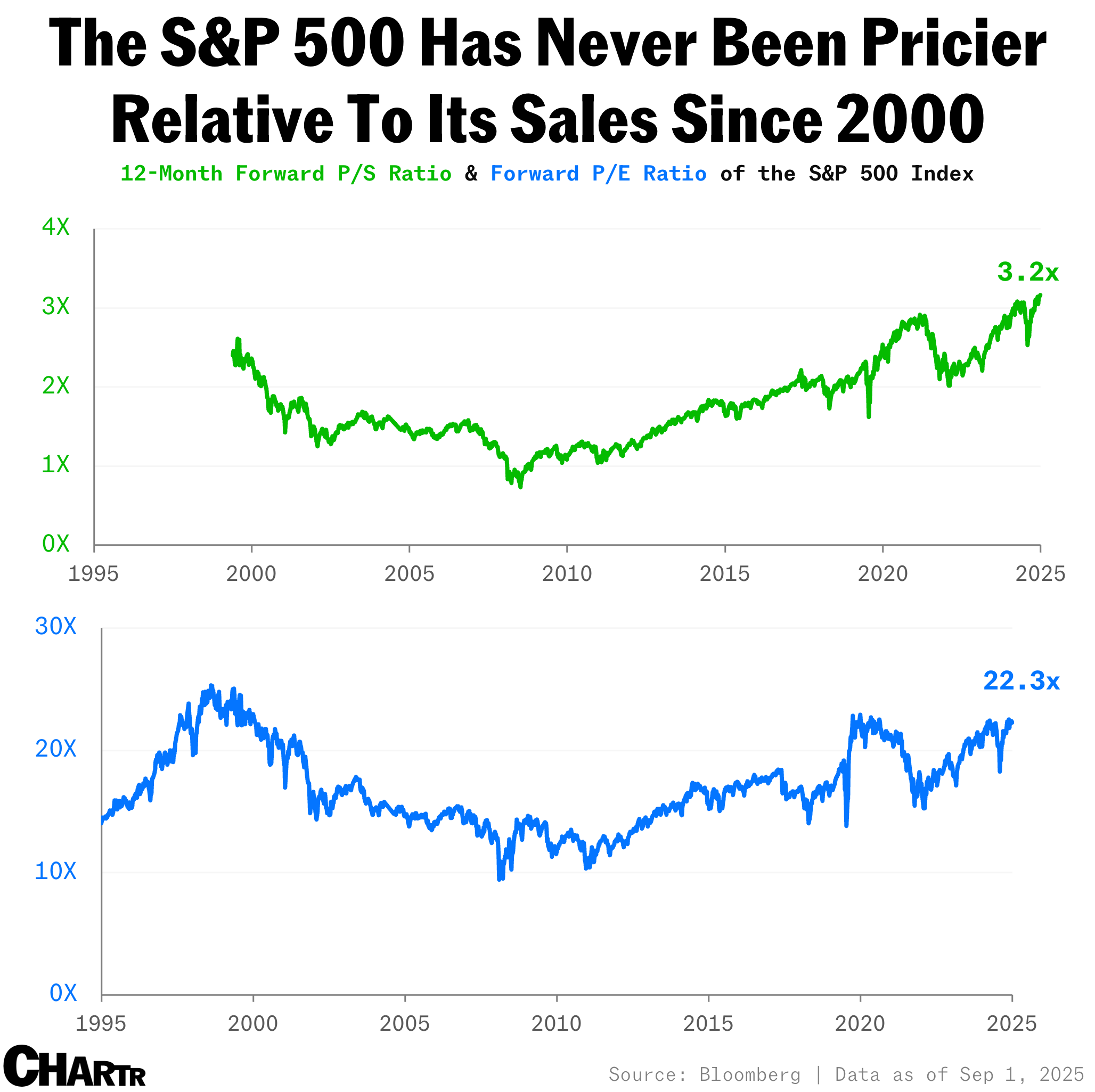
According to The Wall Street Journal, the S&P 500 now trades at about 22.5x projected earnings for the next year, well above the three-decade average of 17.1x and inching closer to the dot-com peak of over 25x in 1999.
SP500 valuations
Sherwood News

Things look even more stretched on a price-to-sales basis: the index is now at a record 3.2x forward revenue — meaning investors are paying more than ever for every dollar of sales the S&P 500 companies are expected to generate over the coming 12 months.

All eggs in tech

In fact, the split between the two ratios shows a deeper issue in today’s market: its reliance on Big Tech. The 10 largest companies of the S&P 500 now make up nearly 40% of the index’s total value, and most of them are uber profitable megacap tech stocks, their tasty margins keeping a lid on the P/E ratio.

Nvidia, for example, has an operating profit margin near 60%, and it alone represents more than 7% of the index, dominating the S&P 500 more than any company has for 44 years. Back in 1990, by contrast, the top 10 companies were less dominant and came from a more varied mix of sectors, including names like Exxon, IBM, Walmart, and Coca-Cola.

Put simply: stocks are undeniably expensive, whether measured on profits or sales. Whether you think that’s a problem depends a lot on whether you think the BATMMAAN stocks are about to collectively stumble.


More Markets

See all Markets
markets

American Eagle posts stronger-than-expected Q4 earnings and revenue

If American Eagle has seen farther, it is by standing on the shoulders of Sydney Sweeney.

The jeans seller posted adjusted earnings of $0.84 per share, ahead of the $0.71 expected by analysts polled by FactSet. It booked $1.76 billion in fourth-quarter revenue, versus the $1.74 billion consensus.

Shares initially climbed more than 5% after-hours before paring gains to about 2%.

“Compelling new product collections, supported by fresh marketing campaigns, led to higher demand trends in the quarter,” said CEO Jay Schottenstein.

American Eagle said it’s expecting same-store sales to grow by high single digits in the first quarter.

Marketing controversy has proved to be a powerful mover of denim for AE. In its third-quarter earnings call in December, AE said its partnership with Sydney Sweeney — together with a Travis Kelce partnership — had garnered more than 44 billion impressions. The retailer hit meme stock status last July when it initially launched its “Sydney Sweeney has great jeans” campaign.

As of Wednesday’s close, American Eagle shares had climbed 120% since the Sweeney ad first landed.

markets

Investors are itching to buy the dip in memory stocks

The intense drubbing in South Korean stocks, with the benchmark Korean index (KOSPI) falling nearly 20% in its first two trading days of the week following a Monday holiday, represented a serious threat to the hottest AI trade: memory stocks.

South Korea’s market is dominated by two high-bandwidth memory giants: SK Hynix and Samsung.

After Tuesday’s tumble, US investors seemingly said enough is enough: it’s a buy-the-dip opportunity.

US memory stocks like Micron, Sandisk, Western Digital, and Seagate Technology Holdings are posting massive gains on the day. The advance comes amid positive commentary at a Morgan Stanley conference on demand for memory chips.

Even more interestingly, the iShares MSCI South Korea ETF is up big today despite the KOSPI falling 12% overnight, its largest drop on record. The ETF’s outperformance of the South Korean equity gauge is the largest since 2008, as the global financial crisis raged.

The daily performance of these two can differ materially since they trade at different times and don’t track precisely the same things. US investors are making the bet that a potential break in this momentum trade and the potential for an unwind of retail leverage in South Korean markets be damned, big drops in memory stocks are meant to be bought.

Latest Stories

Sherwood Media, LLC produces fresh and unique perspectives on topical financial news and is a fully owned subsidiary of Robinhood Markets, Inc., and any views expressed here do not necessarily reflect the views of any other Robinhood affiliate, including Robinhood Markets, Inc., Robinhood Financial LLC, Robinhood Securities, LLC, Robinhood Crypto, LLC, or Robinhood Money, LLC.