Markets
markets

IREN tumbles after unveiling plan to sell as much as $6 billion in stock

Bitcoin miner turned data center play IREN is down early after announcing an amended share sale agreement that would allow it to sell as much as $6 billion worth of ordinary shares.

(Such share sales can generate a negative market reaction because, if consummated, they dilute existing shareholders.)

The company said in its statement that it had already sold some $1 billion in ordinary shares under a previous share sale agreement from August.

IREN said it would use the cash from the potential sale of new shares “to contribute to funding our growth initiatives (including, but not limited to, hardware purchases and acquisition and development of data center sites and facilities), and for working capital and general corporate purposes.”

The company said in its statement that it had already sold some $1 billion in ordinary shares under a previous share sale agreement from August.

IREN said it would use the cash from the potential sale of new shares “to contribute to funding our growth initiatives (including, but not limited to, hardware purchases and acquisition and development of data center sites and facilities), and for working capital and general corporate purposes.”

More Markets

See all Markets
markets

The war is a mega rotation trade

Coming into this week, there had been some very well-defined and well-subscribed trades:

  • Memory stocks > everything, especially software

  • Rest of the world stocks > US stocks

  • Within the US market, the many > the few (as in, S&P 500 equal weight over S&P 500)

War is far from kind. In fact, for markets, it is seemingly a catalyst for mean reversion: all of these aforementioned trades are reversing this week.

There’s some fundamental backing, or at least an excuse, behind all of these unwinding:

  • Europe, for instance, is much more adversely impacted by oil price shocks than the US;

  • That’s also true for South Korea (whose market is dominated by a pair of memory chip stocks);

  • Oil price spikes are generally negative for economic activity; tech companies (particularly the heavyweights) have tended to enjoy acyclical growth.

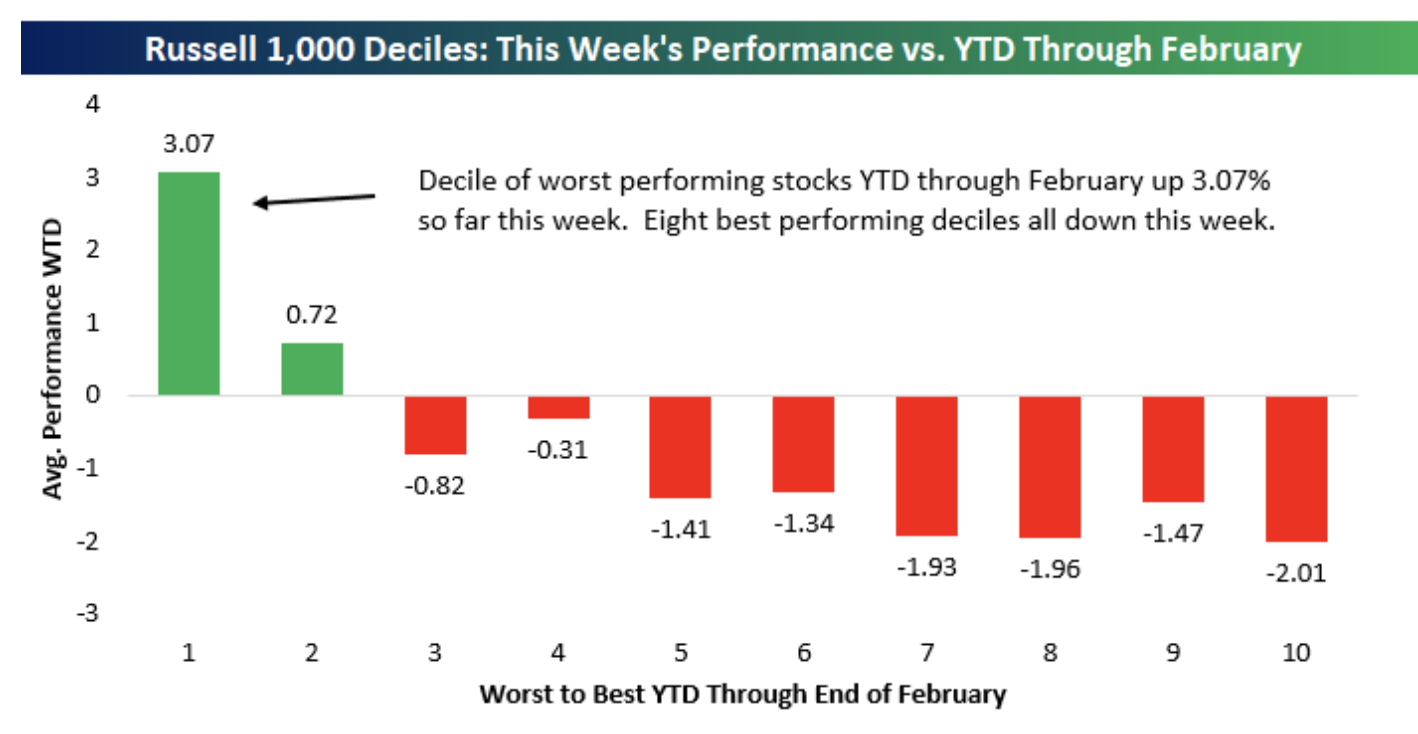
“Who knew that a war against Iran would cause a mean reversion trade here in the US?” wrote analysts at Bespoke Investment Group on Wednesday. “So far this week, the best-performing stocks have been ones hit hardest this year through February, and vice versa.”

War as mean reversion
Source: Bespoke Investment Group

For markets, the risk was that war would drive a pickup in correlations within US stocks and between different asset classes. On Tuesday, the price action was validating and accentuating these concerns. Since then, broadly speaking, it hasn’t.

markets

As oil spikes, energy stocks again lead US markets

The S&P 500’s energy stocks (Energy Select Sector SPDR Fund) are some of the few bright spots in the blue-chip index Thursday, after continued US and Israeli bombing, and renewed Iranian attacks on energy infrastructure throughout the Middle East diminished hopes that the Islamic Republic’s military action to disrupt the flow of oil and gas out of the Gulf would quickly peter out.

“There are no signs that either the US and Israeli attacks or the Iranian retaliatory missile and drone strikes are slowing down,” Arne Lohmann Rasmussen, chief analyst at Global Risk Management, told reporters for Platt’s Commodity News early Thursday.

US gas drillers such as APA Corporation, Devon Energy, and Coterra Energy are seeing sizable gains as Qatar Energy’s ongoing shutdown of liquefied natural gas production has sent global gas prices soaring. Qatar Energy fully shut down gas liquefaction on Wednesday. It is unclear when it will resume liquefaction, but once it does, it will take a month for Qatar’s LNG production to hit peak capacity again.

US crude oil prices are also on the rise, with NYMEX continuous futures on West Texas Intermediate — the US oil benchmark — up to over $78 shortly after 10 a.m. ET. That’s the highest since the start of the war and the highest price for US crude since early 2025.

Indeed, oil market participants are currently putting almost as big a premium for a barrel of Brent crude delivered as soon as possible relative to future delivery as they did during the energy shock that followed Russia’s 2022 invasion of Ukraine.

The surge in energy prices in recent months — amid US interventions first in Venezuela and now Iran — has turned energy stocks into the biggest winner of the year among the S&P 500’s 11 so-called industry “sectors.”

The rise in crude bodes poorly for US gasoline prices, but it’s a boon to US refiners and marketers: Valero and Phillips 66 are posting solid gains on the day.

Airlines, sensitive to short-term swings in fuel prices, also fell. Budget airlines including Allegiant and Frontier were down more than 6%. Delta Air Lines, United Airlines, and American Airlines were all down more than 5%.

And since gasoline prices will mechanically work as a tax on consumption, it’s unsurprising to see that Thursday’s biggest losers early were consumer staples stocks, with that sector (Consumer Staples Select Sector SPDR Fund) down more than 2%.

Walmart and Dollar General — whose less affluent customers can be especially sensitive to higher gasoline prices — was leading the charge lower there.

markets

StubHub plunges on big earnings miss in a Taylor Swift-less Q4

Shares of ticket marketplace StubHub are down 16% in premarket trading following weaker-than-expected earnings results.

StubHub posted a loss of $1.56 per share, significantly worse than the $0.01 loss per share analysts polled by FactSet had expected. It booked $449.2 million in revenue, below the $485 million consensus and down about 16% from a year earlier.

Gross merch sales reached $2.3 billion in Q4, which StubHub pointed out would represent 6% year-over-year growth excluding the impact of Taylor Swift’s Eras Tour. The figure was also below expectations.

Looking ahead, StubHub expects full-year earnings before interest, taxes, depreciation, and amortization of between $400 million and $420 million. Analysts had expected $704.4 million.

Legal changes also threaten to squeeze StubHub in the year ahead. Earlier this month, lawmakers in both New York and California — two of the world’s largest live music markets — introduced legislation that would cap concert ticket resale prices to the ticket’s original face value.

JPMorgan analyst Doug Anmuth downgraded StubHub to “neutral” from “overweight” in the wake of these results, while slashing his price target to $10 from $22.

The company “needs to work through its lock-up expiration beginning this Monday, March 9, overcome ongoing regulatory concerns, and gain credibility with the Street,” he wrote.

markets

Credo surges, Lumentum and Coherent slump after Broadcom says major customers are sticking with copper cables in chip racks through 2028

The future of connectivity is not now, and that’s great news for Credo Technology Group.

During Broadcom’s Q1 earnings call, CEO Hock Tan said that its custom chip clients would be staying with direct attach copper cables to connect components inside racks through 2028 rather than utilizing optical solutions.

Having many major chip buyers stay copper-centric is a positive for Credo, whose active electrical cables increase the transmission capabilities of these copper cables. Tan’s remarks are seemingly pushing back the timetable for when more cutting-edge technologies (that include lasers!) will be in ascendance. Shares of Credo are up nearly 10% as of 8:05 am ET.

This comes just days after Nvidia invested $2 billion each in a pair of advanced optics companies, Lumentum and Coherent. Both of those stocks, which had surged on the vote of confidence from the world’s largest publicly traded company, are 4% and 5% lower, respectively, in premarket trading on Thursday.

markets

Nvidia reportedly halts production of H200 chips for sale to China in favor of Vera Rubin ramp

Selling H200s to China is proving more difficult than Nvidia had anticipated.

The Financial Times reports that the chip designer has asked TSMC to stop output of the H200 processors and instead produce Vera Rubin offerings, its upcoming flagship edition, citing two people familiar with the matter.

There’s likely a lot more conviction that megacap tech companies outside of China will appreciate any supply boost for these next-generation processors than the US-China trade and regulatory morass that’s complicated H200 sales will suddenly be swept away.

Nvidia had H200s in inventory and, per the FT, also already produced 250,000 of these chips — so the sales opportunity is still there, but just diminished for now.

The loose sequencing on how we got here, based on myriad reports on the topic:

  • Nvidia has wanted to sell AI chips to China;

  • Back in December, US President Donald Trump said this would be allowed for the H200, a generation that was much more powerful than China produced domestically, but not cutting-edge tech (as well as chips with similar specs from other producers);

  • Leading Chinese tech companies wanted to buy a lot of these chips;

  • Nvidia called on TSMC to increase production of these chips in expectation of realizing a sales opportunity as high as $54 billion for 2026;

  • China would prefer its companies to purchase from domestic producers to reduce their dependence on US technology;

  • The US wants to limit the total number of these newly permitted AI chips that can get into China as well as how many each buyer can purchase;

  • Nvidia, which had planned to have its first shipments of H200s there by the Lunar New Year, still hasn’t sold any of these chips to China.

The twists and turns here, and conflicting media coverage, has been maddening to try and keep track of. I cannot imagine the level of frustration for an executive attempting to navigate their operations through this haze.

Maybe the real H200 sales were the friends we never made along the way.

Latest Stories

Sherwood Media, LLC produces fresh and unique perspectives on topical financial news and is a fully owned subsidiary of Robinhood Markets, Inc., and any views expressed here do not necessarily reflect the views of any other Robinhood affiliate, including Robinhood Markets, Inc., Robinhood Financial LLC, Robinhood Securities, LLC, Robinhood Crypto, LLC, or Robinhood Money, LLC.