Markets
markets
Luke Kawa

Morgan Stanley counts Amazon’s data center square footage to explain why its cloud business will boom

The second-quarter reporting period showed that competitors have been making up ground on Amazon in a key AI battleground among tech giants: their cloud businesses.

Amazon Web Services’ revenues rose 17.5% year on year in Q2, trailing growth of 31% for Alphabet’s Google Cloud and 39% from Microsoft’s Azure. Granted, AWS is still the leader in the cloud, but its slow growth versus rivals was a sore spot for investors after earnings — especially after CEO Andy Jassy fumbled his way through an answer on the subject.

Amazon Web Services had a $195 billion backlog as of June 30, and turning those would-be orders into actual cash requires time and/or increased capacity. Morgan Stanley analysts led by Brian Nowak have a framework for assessing how Amazon aims to maintain its dominant footprint in the cloud business: by literally counting up expected data center square footage.

“Our analysis of AWS expected forward square footage (analyzing S&P 451 Research DataCenter KnowledgeBase and company filings) speaks to how AWS potentially has ~8.5 million/~10 million of data center square feet coming online in ’25/’26. This would be similar to annual square footage added in ’24 and ahead (in some cases significantly ahead) of prior periods,” they wrote. “This expected square footage growth combined with AWS’s ~$3.5 billion historical median incremental revenue per prior year incremental square foot leads to our sensitivity below showing how upcoming data center capacity growth could translate into 20%+ AWS revenue growth in ’26.”
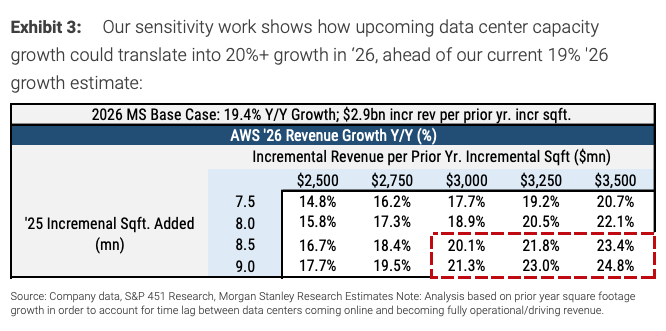
Morgan Stanley AWS revenue growth estimates

However, this analysis also comes with a large caveat attached:

“We acknowledge there are sources of volatility and (ongoing) constraints around incremental revenue per incremental square feet analyses — component supply constraints like chips, racks, cables, boards, power, and demand differences like client readiness and products to drive adoption, product pricing, and yield per foot, etc. — but we think this framework is helpful in showcasing how AWS is investing to match demand and drive accelerating growth in the early innings of the GenAI era.”

Nowak has an “overweight” rating and $300 price target on Amazon.

More Markets

See all Markets
markets

Intel jumps to new 52-week high on upgrade

Intel jumped early Tuesday, hitting a 52-week high soon after the open, as Keybanc analysts upgraded the stock to “overweight” and put an above-consensus $60 price target on the shares, suggesting an upside of 25%.

They also upgraded Advanced Micro Devices to “overweight” and put a $270 target on the shares, a ~23% premium from where they’re trading.

markets

Companies are still facing ransom demands from Oracle’s business software data breach, the WSJ reports

A hack that stole sensitive data in Oracle’s business software — which may have started as early as last July, but wasn’t disclosed by the company until October — is still generating ransom demands, per reporting by The Wall Street Journal.

The number of affected organizations seems to be rising, with executives at Harvard University, Canon USA, Mazda, American Airlines unit Envoy Air, and Logitech all receiving emails demanding millions in exchange for the release of data in recent months.

An online extortion group known as Cl0p had been identified as the source of the breach on Oracle’s E-Business Suite, with the hackers reportedly leveraging a security flaw that did not need any fake or stolen sign-in credentials, and leaving responsible teams “zero-days” to fix the vulnerability. By the time Oracle issued software patches in October to prevent further attacks, more than 100 companies were estimated to be affected by the data breach, per the WSJ.

The number of affected organizations seems to be rising, with executives at Harvard University, Canon USA, Mazda, American Airlines unit Envoy Air, and Logitech all receiving emails demanding millions in exchange for the release of data in recent months.

An online extortion group known as Cl0p had been identified as the source of the breach on Oracle’s E-Business Suite, with the hackers reportedly leveraging a security flaw that did not need any fake or stolen sign-in credentials, and leaving responsible teams “zero-days” to fix the vulnerability. By the time Oracle issued software patches in October to prevent further attacks, more than 100 companies were estimated to be affected by the data breach, per the WSJ.

markets

Report: Micron thinks memory chip shortage could last until ’28

Taiwanese tech site DigiTimes reports that Micron is warning customers that the supply shortage for memory chips could last until 2028, as its Boise, Idaho, fabrication facility slowly comes online.

In addition to Micron, this is a big deal for memory and storage stocks like Sandisk, Seagate Technology Holdings, and Western Digital, which soared last year after a price spike for DRAM and NAND — types of memory chips — pushed their profit margins sharply higher.

With demand from AI data centers seemingly insatiable, the key question for investors is how long the supply crunch — and for the chipmakers, the profit-palooza — will last.

With demand from AI data centers seemingly insatiable, the key question for investors is how long the supply crunch — and for the chipmakers, the profit-palooza — will last.

markets

Microsoft unveils “community-first AI infrastructure plan” after Trump calls out data centers for high electricity bills

Microsoft is committing to paying up for its data center electricity needs so American households won’t have to face higher costs.

This announcement comes after President Donald Trump posted on Monday evening that his administration was working with leading tech companies to ensure that US households don’t “pick up the tab” for their data center-driven energy demands, which have helped propel electricity bills higher.

Microsoft, he said, would be the first to unveil steps in this direction.

Here’s its plan, from a post attributed to Microsoft Vice Chair and President Brad Smith:

Microsoft community first AI infrastructure plan
Source: Microsoft

From a markets and economics standpoint, the first part is the most interesting. Smith said that Microsoft will ask utilities and public commissions to charge Microsoft enough to cover both data center installation and usage, as well as support two-tier pricing systems (like what’s being proposed in Wisconsin) that will see “Very Large Customers” like data centers face higher costs.

The hyperscalers are walking a fine line of trying to aggressively pursue a build-out of a technology that they believe will be transformative and offer profits for years to come while avoiding public and political backlash due to how resource-intensive these capital outlays and operations are.

“Especially when tech companies are so profitable, we believe that it’s both unfair and politically unrealistic for our industry to ask the public to shoulder added electricity costs for AI,” Smith said. “Instead, we believe the long-term success of AI infrastructure requires that tech companies pay their own way for the electricity costs they create.”

Microsoft’s 12-month forward expected profit margin is above 38%, per analysts polled by Bloomberg, its highest projection on record.

Microsoft, he said, would be the first to unveil steps in this direction.

Here’s its plan, from a post attributed to Microsoft Vice Chair and President Brad Smith:

Microsoft community first AI infrastructure plan
Source: Microsoft

From a markets and economics standpoint, the first part is the most interesting. Smith said that Microsoft will ask utilities and public commissions to charge Microsoft enough to cover both data center installation and usage, as well as support two-tier pricing systems (like what’s being proposed in Wisconsin) that will see “Very Large Customers” like data centers face higher costs.

The hyperscalers are walking a fine line of trying to aggressively pursue a build-out of a technology that they believe will be transformative and offer profits for years to come while avoiding public and political backlash due to how resource-intensive these capital outlays and operations are.

“Especially when tech companies are so profitable, we believe that it’s both unfair and politically unrealistic for our industry to ask the public to shoulder added electricity costs for AI,” Smith said. “Instead, we believe the long-term success of AI infrastructure requires that tech companies pay their own way for the electricity costs they create.”

Microsoft’s 12-month forward expected profit margin is above 38%, per analysts polled by Bloomberg, its highest projection on record.

markets

Stocks rise after core inflation rises by less than feared in December

SPDR S&P 500 ETF erased premarket losses to jump higher after core CPI inflation rose 0.2% month on month in December, slightly less than analysts had forecast.

Economists anticipated that headline and core CPI inflation (the latter of which strips out food and energy prices) would be up 0.3% month on month. Headline CPI did indeed rise 0.3% for the month.

The pricing of event contracts for December CPI implied that traders expected headline inflation to be up 0.3% month on month, with higher odds of a reading coming in above than below.

(Event contracts are offered through Robinhood Derivatives, LLC — probabilities referenced or sourced from KalshiEx LLC or ForecastEx LLC.)

The November CPI report showed that core inflation had cooled by much more than expected, with the annual rate decelerating to a 4.5-year low. However, that reading was flattered by the Bureau of Labor Statistics’ decision to assume housing-centric components were flat in October.

Annual core CPI inflation held steady at 2.6% in December, having been projected to tick up to 2.7%.

Latest Stories

Sherwood Media, LLC produces fresh and unique perspectives on topical financial news and is a fully owned subsidiary of Robinhood Markets, Inc., and any views expressed here do not necessarily reflect the views of any other Robinhood affiliate, including Robinhood Markets, Inc., Robinhood Financial LLC, Robinhood Securities, LLC, Robinhood Crypto, LLC, or Robinhood Money, LLC.