
Markets
WNBA: JUN 23 Indiana Fever at Chicago Sky
(Melissa Tamez/Getty Images)
AIudiophile

Morgan Stanley: Most Gen Zers and millennials in the US listen to about three hours of AI music a week

That’s enough AI music to last the run time of “Avatar.”

Luke Kawa

Video may have killed the radio star, but AI is starting to dance on its grave.

Morgan Stanley’s annual survey of audio habits revealed that younger Americans are listening to an amount of AI-generated music each week that’s roughly on par with the run time of “Avatar.”

“This is the first year we included any AI music questions in our survey,” wrote a team led by analyst Benjamin Swinburne. “What we found surprised us, with 50-60% of listeners 18- 44 reporting 2.5-3 hours per week of AI music listening.”
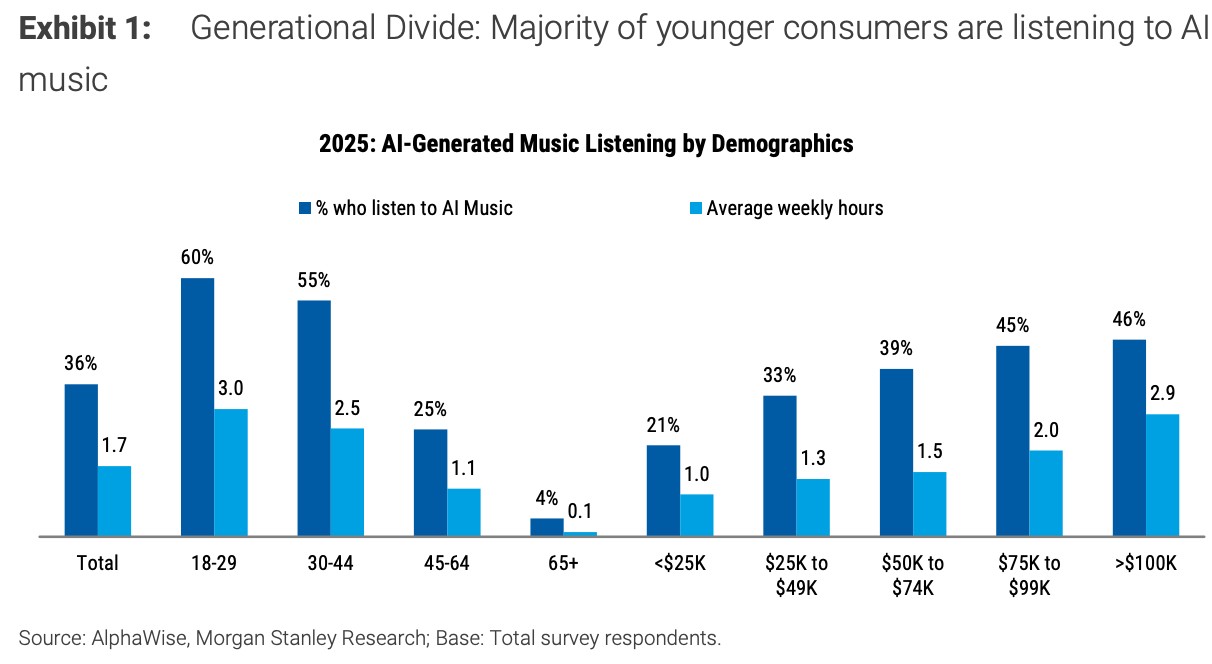
Morgan Stanley AI listening

The most common sources from which AI music is being ingested are YouTube and TikTok, per Morgan Stanley’s survey. Even so, their analysts remain bullish on Spotify and Warner Music Group, writing:

“As a distribution platform with leading global scale, a history of product innovation, and leveraging machine learning, we see AI as a tailwind to Spotify in 2026 and beyond. Specifically, we expect AI to prove foundational to Spotifys personalization 2.0 efforts. For OW WMG, we expect the rise of AI music to increase the value of scarce catalog assets while potentially creating new competition for front line content. However, we see WMGs recently announced Suno partnership as an important step toward AI music monetization. We believe the multiple compression absorbed by WMG shares in 2025 suggests a lot of AI risk is already priced in.”

More Markets

See all Markets
markets

US job growth crushes estimates in March, with the unemployment rate unexpectedly dipping to 4.3%

US hiring surged in March, with job growth of 178,000 well ahead of estimates while the unemployment rate unexpectedly edged down to 4.3%.

Economists had anticipated non-farm payrolls growth of 65,000 for the month with the unemployment rate holding steady at 4.4%

Event contracts had presumed that job growth would come in between 70,000 and 80,000, a sunnier view than Wall Street.

Prediction markets had anticipated roughly 70% odds that the unemployment rate would hold steady at 4.4%, with a much higher implied likelihood of an increase versus a decrease.

(Event contracts are offered through Robinhood Derivatives, LLC — probabilities referenced or sourced from KalshiEx LLC or ForecastEx LLC.)

S&P 500 equity futures, which were modestly negative ahead of the report in thin holiday trading, were little changed in the immediate aftermath of this release. Treasury yields jumped, with the 10-year yield rising to 4.35% from 4.31%.

The inflationary impact of the higher crude prices in the wake of US-Israeli attacks on Iran and the subsequent challenges shipping oil through the Strait of Hormuz has been the dominant macroeconomic development of the past month, rather than US labor market data.

Before the conflict began, roughly 60 basis points of easing by the Federal Reserve was priced in for 2026. Heading into this release, that’s slimmed to just 5 basis points as US gas prices jumped above $4 per gallon.

The Federal Reserve’s “dot plot” from the March meeting still suggests that officials think it will be appropriate to lower the policy rate this year if the economy unfolds in line with their expectations.

The February jobs report had been a big disappointment, with jobs unexpectedly contracting and the unemployment rate edging higher. With this release, the February figures were revised to show an even larger decline of 133,000.

Strikes which had weighed on employment in health care during February, a critical source of US employment growth in recent years, seemingly reversed. The industry accounted for more than half of net job growth for March.

markets

AI server cluster maker Penguin Solutions takes flight

Small-cap AI server cluster maker Penguin Solutions surged Thursday after posting better-than-expected Q2 revenue and profit numbers Wednesday after the close, along with an increase in full-year sales and profit guidance.

The company, which was known as Smart Global Holdings until July 2024, has positioned itself as a provider of “end-to-end AI infrastructure solutions.”

Its Advanced Computing division designs and sells computers, cabling, and cooling systems, the server racks and clusters of racks AI data centers need. Its other main division sells flash and DRAM memory products.

It’s a pretty small company, with a fully diluted market cap of just over $1 billion and roughly 2,900 employees, according to FactSet.

The stock is volatile. Penguin dove during last year’s tariff tantrum that followed “Liberation Day” in April. Then it turned tail and doubled through early October amid a surge of call options activity, which tends to reflect retail interest. From the October peak, it then plunged by about 50%, before Thursday’s renaissance.

For what it’s worth, call options activity in Penguin is pretty busy today, too — relatively speaking — with roughly 2,625 traded as of 1:15 p.m. ET. That’s the most since early January, when the company last reported quarterly numbers. The average volume over the previous 25 trading sessions is about 325 calls a day, FactSet data shows.

The company, which was known as Smart Global Holdings until July 2024, has positioned itself as a provider of “end-to-end AI infrastructure solutions.”

Its Advanced Computing division designs and sells computers, cabling, and cooling systems, the server racks and clusters of racks AI data centers need. Its other main division sells flash and DRAM memory products.

It’s a pretty small company, with a fully diluted market cap of just over $1 billion and roughly 2,900 employees, according to FactSet.

The stock is volatile. Penguin dove during last year’s tariff tantrum that followed “Liberation Day” in April. Then it turned tail and doubled through early October amid a surge of call options activity, which tends to reflect retail interest. From the October peak, it then plunged by about 50%, before Thursday’s renaissance.

For what it’s worth, call options activity in Penguin is pretty busy today, too — relatively speaking — with roughly 2,625 traded as of 1:15 p.m. ET. That’s the most since early January, when the company last reported quarterly numbers. The average volume over the previous 25 trading sessions is about 325 calls a day, FactSet data shows.

markets
Luke Kawa

Momentum returns to optics stocks as the release valve for AI optimism

Potentially imminent end to the war? Buy optics stocks.

Maybe not? Buy optics stocks anyway.

Effectively all the juice left in the AI trade is coming from optics (and memory) stocks. And the latter group is taking a bit of a breather today while the former continues to surge.

Shares of Ciena Corp., Lumentum, and Coherent are building on recent big gains and among the biggest gainers in the S&P 500 near midday, while Applied Optoelectronics is also surging on Thursday.

These companies all provide solutions that help information move around in data centers, and thus are key beneficiaries of the aggressive capex plans of hyperscalers. Nvidia has invested $2 billion apiece in Coherent and Lumentum in deals that also include purchase commitments.

markets

Space stocks rip during a topsy-turvy day for the equity market

Satellite-services-from-space stocks surged Thursday after reports that Amazon is in talks to buy Globalstar, which provides voice and connectivity services from its satellite network. It also can’t hurt that the general mood around space is ebullient, following the successful launch of Artemis II on Thursday.

Planet Labs and ViaSat also soared on the news.

The gains for EchoStar — seen as a backdoor play at pre-IPO SpaceX exposure — and Rocket Lab were more muted, perhaps because a deep-pocketed competitor like Jeff Bezos getting serious about space services could complicate the plans of the two largest commercial space launch companies.

Rocket Lab and SpaceX see launch services as key to their aspirations of being major providers of voice and data services from low-Earth orbit satellites.

Tesla CEO Elon Musk’s SpaceX is the dominant provider of such services, and the early rumors on the company’s planned IPO — expected to be the largest ever — suggest the market is very excited about the prospects for the industry.

Elsewhere in the space stock world, Intuitive Machines — a maker of space infrastructure that provides services to NASA for lunar missions — also rose.

The gains for EchoStar — seen as a backdoor play at pre-IPO SpaceX exposure — and Rocket Lab were more muted, perhaps because a deep-pocketed competitor like Jeff Bezos getting serious about space services could complicate the plans of the two largest commercial space launch companies.

Rocket Lab and SpaceX see launch services as key to their aspirations of being major providers of voice and data services from low-Earth orbit satellites.

Tesla CEO Elon Musk’s SpaceX is the dominant provider of such services, and the early rumors on the company’s planned IPO — expected to be the largest ever — suggest the market is very excited about the prospects for the industry.

Elsewhere in the space stock world, Intuitive Machines — a maker of space infrastructure that provides services to NASA for lunar missions — also rose.

Latest Stories

Sherwood Media, LLC produces fresh and unique perspectives on topical financial news and is a fully owned subsidiary of Robinhood Markets, Inc., and any views expressed here do not necessarily reflect the views of any other Robinhood affiliate, including Robinhood Markets, Inc., Robinhood Financial LLC, Robinhood Securities, LLC, Robinhood Crypto, LLC, Robinhood Derivatives, LLC, or Robinhood Money, LLC. Futures and event contracts are offered through Robinhood Derivatives, LLC.