
Markets
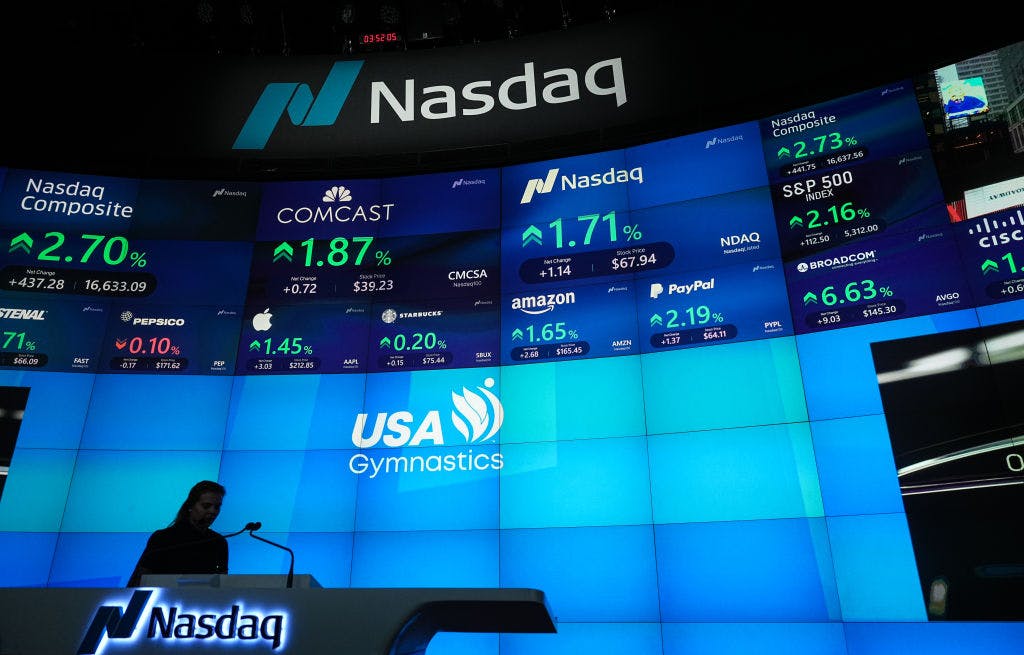
USA Gymnastics Rings Nasdaq Closing Bell
USA Gymnastics rings the Nasdaq closing bell (John Nacion/Getty Images)
Weird Money

Nasdaq is (finally) cracking down on reverse stock splits

Penny stocks' favorite feat of financial engineering is about to get a little bit harder.

Jack Raines

Over the last couple of years, you may have seen a stock chart that looks something like this, where the current price is down 90% or more from a peak of more than $1,000 per share.

But this chart is deceiving: Nikola Motors was never worth $1,977 per share. In an effort to stay listed on the Nasdaq, Nikola issued a 1-30 reverse stock split after its stock price collapsed below $1, a practice that has become increasingly popular over the last few years.

For context, stock exchanges like the Nasdaq and the New York Stock Exchange (NYSE) have continued listing standards for companies whose shares trade on their exchanges, and of the main requirements is a share price above $1. When a company’s share price closes below $1 for 30 consecutive trading days, the Nasdaq issues the company a noncompliance warning and gives it 180 days to remedy the situation. However, a delinquent company can request another 180 day grace period when the first period ends, effectively giving it a year to increase its share price. Given that companies can stay listed below $1 for a while, many have, and as of last Thursday, there were 509 stocks listed on US exchanges trading below $1 per share, with 421 of those listed on the Nasdaq. For reference, there were fewer than 12 sub-$1 stocks in the US in early 2021.

Unsurprisingly, companies whose share prices have declined below $1 tend to continue declining, so, to maintain their listings, they have turned to one of the more interesting feats of financial engineering: reverse splits.

Normal stock splits are typically viewed as a positive sign. Companies that have witnessed their share prices climb to the hundreds (or thousands) of dollars often announce stock splits (see Nvidia in 2021 and again in 2024) to maintain a more accessible price.

Reverse splits, however, tend to signal a struggling stock. While General Electric’s stock has done well since its 2021 1-for-8 reverse split, it wasn’t facing delisting warnings, and this move may have been a precursor to the conglomerate’s decision to later split into three separate companies.

A reverse split to avoid delisting usually means the company couldn’t do anything else to keep its stock price above $1. Reverse split volume has continued to increase as more companies’ stock prices slid below $1, with companies carrying out 495 reverse splits in 2023, compared to 102 in 2021.

Last month, electronic trading firm Virtu Financial filed a petition with the SEC asking the Nasdaq to adopt stricter listing requirements:

The bottom line is that current SEC rules that allow high-risk penny stocks to be listed on major stock exchanges present serious investor protection concerns. We believe that it is long past due for the Commission to take a fresh look at its rules around the listing of such securities and ensure that investors are armed with the information they need to assess the investment risks. 

One of Virtu’s primary concerns is that the proliferation of reverse splits threatens to confuse retail investors, with the price increases disguising investment risks. It looks like Nasdaq took notice, and last week, The Wall Street Journal reported that Nasdaq had submitted rule changes to accelerate delistings:

Under one of the proposed changes, companies that reach the end of their second 180-day grace period wouldn’t be able to postpone delisting by seeking an appeal. Instead, their shares would move to the over-the-counter market—a sort of purgatory where companies land after being delisted—while they await the appeal. Effectively, the rule change caps the amount of time that sub-$1 stocks can be listed on Nasdaq to roughly a year.

The second proposed rule change would speed up the delisting process for companies that recently did a reverse stock split. Under the change, if a company carried out a reverse split to prop up its share price, but then its stock fell below $1 within a year, Nasdaq would immediately send the company a delisting notice.

This is, to me, a long-overdue change. The idea that a company facing delisting could simply change its stock price without an improvement in the underlying business felt a bit… scummy. 

More Markets

See all Markets
markets
Saleah Blancaflor

US gas prices rise again, sitting at their highest levels in four years ahead of Memorial Day weekend

Just days away from Memorial Day weekend, the national average of US gas prices rose from a week earlier and sat at the highest they've been in four years.

The price is currently $4.56 a gallon, up 3 cents over last week, and $1.38 higher than this time last year, according to AAA. Today's prices are right around what customers were paying four years ago, when the price on Memorial Day was $4.61. Gas prices experienced a short-lived dip earlier this month before rising again.

Gasoline is in high demand ahead of Memorial Day weekend and the Strait of Hormuz remains closed because of the war in Iran, leaving prices elevated as more drivers hit the road. GasBuddy's Patrick De Haan predicts that gas prices could soon hit $4.80 a galloon soon amid the Strait closure.

Oil prices ticked up slightly on Thursday, with WTI sitting around $100 a barrel, after plunging on Wednesday.

Loading...
 

(Event contracts are offered through Robinhood Derivatives, LLC — probabilities referenced or sourced from KalshiEx LLC or ForecastEx LLC.)

Gasoline is in high demand ahead of Memorial Day weekend and the Strait of Hormuz remains closed because of the war in Iran, leaving prices elevated as more drivers hit the road. GasBuddy's Patrick De Haan predicts that gas prices could soon hit $4.80 a galloon soon amid the Strait closure.

Oil prices ticked up slightly on Thursday, with WTI sitting around $100 a barrel, after plunging on Wednesday.

Loading...
 

(Event contracts are offered through Robinhood Derivatives, LLC — probabilities referenced or sourced from KalshiEx LLC or ForecastEx LLC.)

markets

SoftBank rallies on OpenAI and SB Energy IPO plans; its Japanese-traded stock notches best day since 2000

SoftBank shares skyrocketed in Tokyo trading, notching their biggest daily gain since 2000, boosted by news about planned IPOs at OpenAI, in which SoftBank has a sizable stake, and SoftBank’s own SB Energy unit. ADRs of SoftBank traded in the US rallied, too.

OpenAI is accelerating the timeline to its public debut, preparing to confidentially file its IPO prospectus with regulators as early as Friday, according to The Wall Street Journal. That could set the stage for a highly anticipated public listing as early as September.

SoftBank has systematically expanded its financial exposure to OpenAI, securing a highly valuable stake in the company. As of the fiscal year-end, SoftBank’s cumulative investment in OpenAI totaled $34.6 billion, with a fair value of $79.6 billion, and cumulative investment gains totaled $45 billion, according to a SoftBank filing.

For SoftBank, a successful public debut is critical to demonstrating that OpenAI can protect its market position amid intense industry pressure. Investors have grown increasingly anxious that OpenAI is losing ground to competitors like Anthropic, which is currently in talks for a funding round that could push its own valuation past that of OpenAI.

Adding to the upward momentum, SB Energy, the digital infrastructure and clean energy development firm co-owned by SoftBank and Ares Management, confirmed its own confidential draft registration filing for a major US public listing.

This multipronged IPO pipeline has boosted investors’ confidence in billionaire founder Masayoshi Son’s high-conviction AI thesis, showcasing a road map for SoftBank to transition its paper gains into potential liquidity. SoftBank’s stock is up 37% so far this year.

markets

Nio posts better-than-expected first-quarter earnings and forecasts strong Q2 sales

Chinese EV maker Nio posted Q1 results before markets opened on Thursday, reporting earnings that beat expectations and strong sales guidance for the second quarter. Shares of the company climbed more than 4% in premarket trading.

For the first quarter, Nio reported:

  • Adjusted earnings of $0.00 per share, compared to the $0.05 loss per share that Wall Street analysts polled by FactSet had expected.

  • $3.7 billion in revenue, compared to the $3.74 billion consensus estimate.

  • 83,465 vehicle deliveries, slightly exceeding its own forecast of between 80,000 and 83,000.

For Q2, Nio guided for deliveries of between 110,000 and 115,000, compared to estimates of 113,807. The company expects second-quarter revenues to come in between $4.75 billion and $4.99 billion, while analysts are forecasting $4.6 billion.

The Chinese auto industry has seen a surge in exports so far this year, as companies make efforts to combat declining domestic sales. Nio, which is still relatively new to overseas operations, has plans to ship “several thousand” EVs overseas this year.

Latest Stories

Sherwood Media, LLC and Chartr Limited produce fresh and unique perspectives on topical financial news and are fully owned subsidiaries of Robinhood Markets, Inc., and any views expressed here do not necessarily reflect the views of any other Robinhood affiliate, including Robinhood Markets, Inc., Robinhood Financial LLC, Robinhood Securities, LLC, Robinhood Crypto, LLC, Robinhood Money, LLC, Robinhood U.K. Ltd, Robinhood Derivatives, LLC, Robinhood Gold, LLC, Robinhood Asset Management, LLC, Robinhood Credit, Inc., Robinhood Ventures DE, LLC and, where applicable, its managed investment vehicles.

